Thank you for visiting SNEWPapers!
Sign up free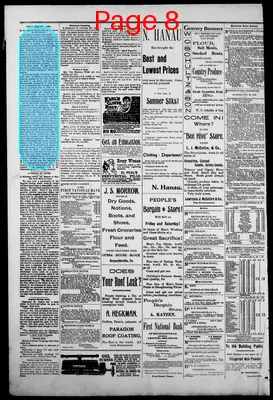
Story
May 15, 1895
The Star
Reynoldsville, Jefferson County, Pennsylvania
What is this article about?
Rev. C. H. Parkhurst's essay posits the family as the core unit of society and church, essential for social and religious wholesomeness, illustrated by church architecture preserving family identity.
Clipping
OCR Quality
98%
Excellent
Full Text
THE POWER OF HOME
Its Relation to Society and Its Influence In the Church.
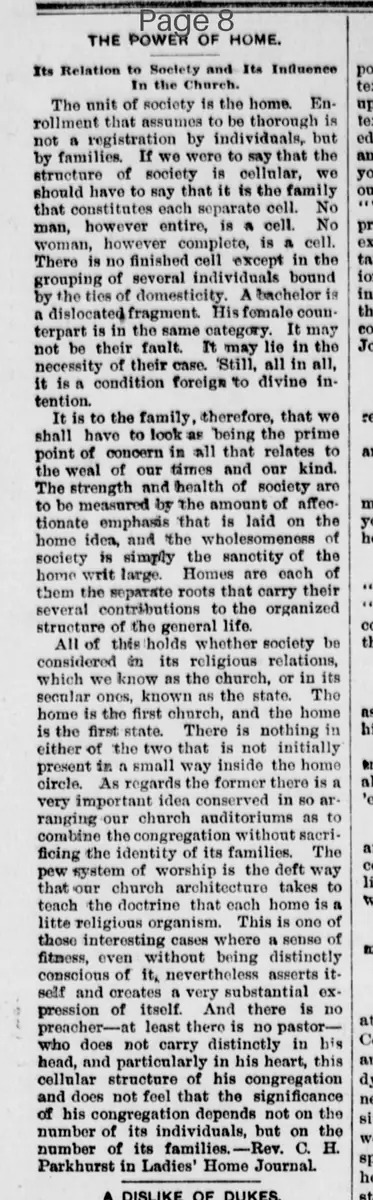
The unit of society is the home. Enrollment that assumes to be thorough is not a registration by individuals, but by families. If we were to say that the structure of society is cellular, we should have to say that it is the family that constitutes each separate cell. No man, however entire, is a cell. No woman, however complete, is a cell. There is no finished cell except in the grouping of several individuals bound by the ties of domesticity. A bachelor is a dislocated fragment. His female counterpart is in the same category. It may not be their fault. It may lie in the necessity of their case. Still, all in all, it is a condition foreign to divine intention.
It is to the family, therefore, that we shall have to look as being the prime point of concern in all that relates to the weal of our times and our kind. The strength and health of society are to be measured by the amount of affectionate emphasis that is laid on the home idea, and the wholesomeness of society is simply the sanctity of the home writ large. Homes are each of them the separate roots that carry their several contributions to the organized structure of the general life.
All of this holds whether society be considered in its religious relations, which we know as the church, or in its secular ones, known as the state. The home is the first church, and the home is the first state. There is nothing in either of the two that is not initially present in a small way inside the home circle. As regards the former there is a very important idea conserved in so arranging our church auditoriums as to combine the congregation without sacrificing the identity of its families. The pew system of worship is the deft way that our church architecture takes to teach the doctrine that each home is a little religious organism. This is one of those interesting cases where a sense of fitness, even without being distinctly conscious of it, nevertheless asserts itself and creates a very substantial expression of itself. And there is no preacher—at least there is no pastor—who does not carry distinctly in his head, and particularly in his heart, this cellular structure of his congregation and does not feel that the significance of his congregation depends not on the number of its individuals, but on the number of its families.—Rev. C. H. Parkhurst in Ladies' Home Journal
Its Relation to Society and Its Influence In the Church.
The unit of society is the home. Enrollment that assumes to be thorough is not a registration by individuals, but by families. If we were to say that the structure of society is cellular, we should have to say that it is the family that constitutes each separate cell. No man, however entire, is a cell. No woman, however complete, is a cell. There is no finished cell except in the grouping of several individuals bound by the ties of domesticity. A bachelor is a dislocated fragment. His female counterpart is in the same category. It may not be their fault. It may lie in the necessity of their case. Still, all in all, it is a condition foreign to divine intention.
It is to the family, therefore, that we shall have to look as being the prime point of concern in all that relates to the weal of our times and our kind. The strength and health of society are to be measured by the amount of affectionate emphasis that is laid on the home idea, and the wholesomeness of society is simply the sanctity of the home writ large. Homes are each of them the separate roots that carry their several contributions to the organized structure of the general life.
All of this holds whether society be considered in its religious relations, which we know as the church, or in its secular ones, known as the state. The home is the first church, and the home is the first state. There is nothing in either of the two that is not initially present in a small way inside the home circle. As regards the former there is a very important idea conserved in so arranging our church auditoriums as to combine the congregation without sacrificing the identity of its families. The pew system of worship is the deft way that our church architecture takes to teach the doctrine that each home is a little religious organism. This is one of those interesting cases where a sense of fitness, even without being distinctly conscious of it, nevertheless asserts itself and creates a very substantial expression of itself. And there is no preacher—at least there is no pastor—who does not carry distinctly in his head, and particularly in his heart, this cellular structure of his congregation and does not feel that the significance of his congregation depends not on the number of its individuals, but on the number of its families.—Rev. C. H. Parkhurst in Ladies' Home Journal
What sub-type of article is it?
Essay
Sermon
What themes does it cover?
Family
Moral Virtue
Social Manners
What keywords are associated?
Family Unit
Home Importance
Society Structure
Church Organization
Domestic Ties
What entities or persons were involved?
Rev. C. H. Parkhurst
Story Details
Key Persons
Rev. C. H. Parkhurst
Story Details
The essay argues that the family is the fundamental unit of society and the church, emphasizing the home's role in social health and religious organization, with the pew system in churches reflecting family identity.