Thank you for visiting SNEWPapers!
Sign up free
Story
July 10, 1887
The Cheyenne Daily Leader
Cheyenne, Laramie County, Wyoming
What is this article about?
Detailed explanation of traditional olive oil production: olives ground into paste with mill stones, pressed in jute bags to yield multiple grades of oil, with lower grades used for soap and residue treated for lubricant.
Clipping
OCR Quality
98%
Excellent
Full Text
Preparing Olive Oil
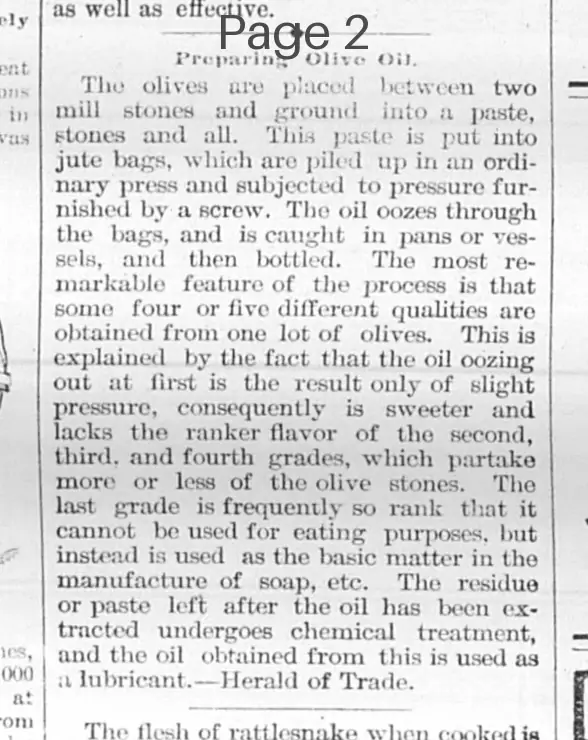
The olives are placed between two mill stones and ground into a paste, stones and all. This paste is put into jute bags, which are piled up in an ordinary press and subjected to pressure furnished by a screw. The oil oozes through the bags, and is caught in pans or vessels, and then bottled. The most remarkable feature of the process is that some four or five different qualities are obtained from one lot of olives. This is explained by the fact that the oil oozing out at first is the result only of slight pressure, consequently is sweeter and lacks the ranker flavor of the second, third, and fourth grades, which partake more or less of the olive stones. The last grade is frequently so rank that it cannot be used for eating purposes, but instead is used as the basic matter in the manufacture of soap, etc. The residue or paste left after the oil has been extracted undergoes chemical treatment, and the oil obtained from this is used as a lubricant.—Herald of Trade.
The olives are placed between two mill stones and ground into a paste, stones and all. This paste is put into jute bags, which are piled up in an ordinary press and subjected to pressure furnished by a screw. The oil oozes through the bags, and is caught in pans or vessels, and then bottled. The most remarkable feature of the process is that some four or five different qualities are obtained from one lot of olives. This is explained by the fact that the oil oozing out at first is the result only of slight pressure, consequently is sweeter and lacks the ranker flavor of the second, third, and fourth grades, which partake more or less of the olive stones. The last grade is frequently so rank that it cannot be used for eating purposes, but instead is used as the basic matter in the manufacture of soap, etc. The residue or paste left after the oil has been extracted undergoes chemical treatment, and the oil obtained from this is used as a lubricant.—Herald of Trade.
What sub-type of article is it?
Curiosity
What keywords are associated?
Olive Oil
Production Process
Mill Stones
Pressing
Oil Grades
Soap Manufacture
Story Details
Story Details
Olives are ground into paste with mill stones, placed in jute bags, and pressed to extract oil in multiple grades based on pressure; first grade sweetest, later grades ranker for soap; residue chemically treated for lubricant.