Thank you for visiting SNEWPapers!
Sign up free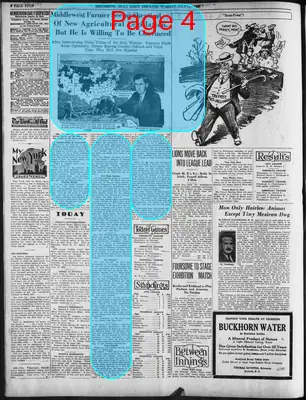
Henderson Daily Dispatch
Henderson, Vance County, North Carolina
What is this article about?
In 1933, reporter Charlotte Prescott interviews three Midwestern farmers on Roosevelt's new Farm Relief Act: lawyer-turned-farmer John Martin is optimistic about production cuts boosting prices; intelligent Mrs. Roy Brown is skeptical, seeing it as unworkable; Holiday association's Tom Wells is cautiously hopeful amid rising prices and drought.
Clipping
OCR Quality
Full Text
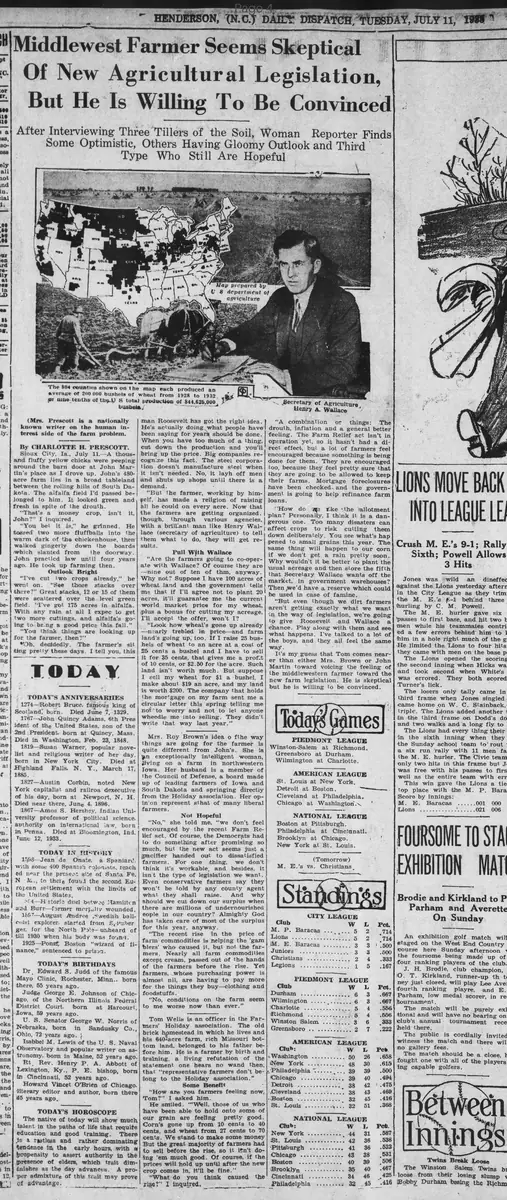
Middlewest Farmer Seems Skeptical Of New Agricultural Legislation, But He Is Willing To Be Convinced
After Interviewing Three Tillers of the Soil, Woman Reporter Finds Some Optimistic, Others Having Gloomy Outlook and Third Type Who Still Are Hopeful
or Nine-tenths of the U. S. total production of 844,625,000 bushels.
Secretary of Agriculture Henry A. Wallace
(Mrs. Prescott is a nationally known writer on the human interest side of the farm problem.)
By CHARLOTTE H. PRESCOTT.
Sioux City, Ia., July 11. A thousand fluffy yellow chicks were peeping around the barn door at John Martin's place as I drove up. John's 480-acre farm lies in a broad tableland between the rolling hills of South Dakota. The alfalfa field I'd passed belonged to him. It looked green and fresh in spite of the drouth.
"That's a money crop, isn't it, John?" I inquired.
"You bet it is," he grinned. He tossed two more fluffballs into the warm dark of the chickenhouse, then walked gingerly down the boards which slanted from the doorway.
John practiced law until four years ago. He took up farming then.
Outlook Bright
"I've cut two crops already," he went on. "See those stacks over there?" Great stacks, 12 or 15 of them were scattered over the level green field. "I've got 175 acres in alfalfa. With any rain at all I expect to get two more cuttings, and alfalfa is going to bring a good price this fall."
"You think things are looking up for the farmer, then?"
"Oh, decidedly. The farmer's sitting pretty these days. I tell you, this man Roosevelt has got the right idea.
He's actually doing what people have been saying for years should be done. When you have too much of a thing cut down the production and you'll bring up the price. Big companies recognize this fact. The steel corporation doesn't manufacture steel when it isn't needed. No, it lays off men and shuts up shops until there is a demand.
"But the farmer, working by himself, has made a religion of raising all he could on every acre. Now that the farmers are getting organized, though, through various agencies, with a brilliant man like Henry Wallace (secretary of agriculture) to tell them what to do, they will get results."
Pull With Wallace
"Are the farmers going to co-operate with Wallace? Of course they are—nine out of ten of them, anyway. Why not? Suppose I have 100 acres of wheat land and the government tells me that if I'll agree not to plant 20 acres, it'll guarantee me the current world market price for my wheat plus a bonus for cutting my acreage, I'll accept the offer, won't I?
"Look how wheat's gone up already—nearly trebled in price—and farm land's going up, too. If I raise 25 bushels of wheat to an acre at a cost of 25 cents a bushel and I have to sell it for 35 cents, that gives me a profit of 10 cents, or $2.50 for the acre. Such land isn't worth much. But suppose I sell my wheat for $1 a bushel, I make about $19 an acre, and my land is worth $200. The company that holds the mortgage on my farm sent me a circular letter this spring telling me not to worry and not to let anyone wheedle me into selling. They didn't write that way last year."
Mrs. Roy Brown's idea of the way things are going for the farmer is quite different from John's. She is an exceptionally intelligent woman, living on a farm in northwestern Iowa. Her husband is a member of the Council of Defense, a board made up of leading farmers of Iowa and South Dakota and springing directly from the Holiday association. Her opinion represents that of many liberal farmers.
Not Hopeful
"No," she told me, "we don't feel encouraged by the recent Farm Relief act. Of course, the Democrats had to do something after promising so much, but the new act seems just a pacifier handed out to dissatisfied farmers. For one thing, we don't think it's workable, and besides, it isn't the type of legislation we want. Even conservative farmers say they won't be told by any county agent what they shall raise. And why should we cut down our surplus when there are millions of undernourished people in our country? Almighty God has taken care of most of the surplus for this year, anyway.
"The recent rise in the price of farm commodities is helping the 'gamblers' who caused it, but not the farmers. Nearly all farm commodities except cream, passed out of the hands of the farmers before the rise. Yet farmers, whose purchasing power is almost nil, are having to pay more for the things they buy—clothing and foodstuffs.
"No, conditions on the farm seem to me worse now than ever."
Tom Wells is an officer in the Farmers' Holiday association. The old brick homestead in which he lives and his 640-acre farm, rich Missouri bottom land, belonged to his father before him. He is a farmer by birth and training, a living refutation of the statement one hears now and then, that "representative farmers don't belong to the Holiday association."
Some Benefit
"How are you farmers feeling now, Tom?" I asked him.
He smiled. "Well, those of us who have been able to hold onto some of our grain are feeling pretty good. Corn's gone up from 10 cents to 40 cents, and wheat from 27 cents to 70 cents. We stand to make some money. But the great majority of farmers had to sell before the rise, so it isn't doing 'em much good. Of course, if the prices will hold up until after the new crop comes in, it'll be fine."
"What do you think caused the rise?" I inquired.
"A combination of things: The drouth, inflation and a general better feeling. The Farm Relief act isn't in operation yet, so it hasn't had a direct effect, but a lot of farmers feel encouraged because something is being done for them. They are encouraged too, because they feel pretty sure that they are going to be allowed to keep their farms. Mortgage foreclosures have been checked and the government is going to help refinance farm loans.
"How do you like the 'allotment plan? Personally, I think it is a dangerous one. Too many disasters can affect crops to risk cutting them down deliberately. You see what's happened to small grains this year. The same thing will happen to our corn if we don't get a rain pretty soon. Why wouldn't it be better to plant the usual acreage and then store the fifth that Secretary Wallace wants off the market, in government warehouses? Then we'd have a reserve which could be used in case of famine.
"But even though we dirt farmers aren't getting exactly what we want in the way of legislation, we're going to give Roosevelt and Wallace a chance. Play along with them and see what happens. I've talked to a lot of the boys, and they all feel the same way."
It's my guess that Tom comes nearer than either Mrs. Brown or John Martin toward voicing the feeling of the middlewestern farmer toward the new farm legislation. He is skeptical but he is willing to be convinced.
What sub-type of article is it?
What themes does it cover?
What keywords are associated?
What entities or persons were involved?
Where did it happen?
Story Details
Key Persons
Location
Middlewest, Sioux City Ia., South Dakota, Northwestern Iowa, Missouri Bottom Land
Event Date
July 11, 1933
Story Details
Reporter Charlotte H. Prescott interviews three Midwestern farmers on the new Farm Relief Act: optimistic John Martin praises Roosevelt and Wallace's production control; skeptical Mrs. Roy Brown calls it unworkable and unfair; Holiday association officer Tom Wells is hopeful but cautious, willing to cooperate.