Thank you for visiting SNEWPapers!
Sign up free
Editorial
March 10, 1827
New Hampshire Statesman And Concord Register
Concord, Merrimack County, New Hampshire
What is this article about?
This editorial critiques the New-Hampshire Patriot's advocacy for short congressional terms to rotate officeholders, arguing it hinders Northern influence in national councils compared to the South. It calls for longer terms unless representatives err, referencing candidates like Cartland, Whipple, Eastman, and Harvey.
Clipping
OCR Quality
98%
Excellent
Full Text
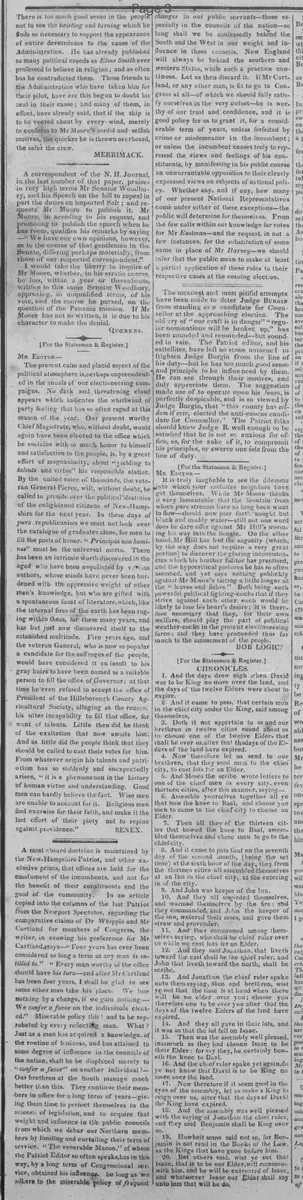
A most absurd doctrine is maintained by the New-Hampshire Patriot, and other exclusive prints, that offices are held for the emolument of the incumbents, and not for the benefit of their constituents and the good of the community. In an article copied into the columns of the last Patriot from the Newport Spectator, regarding the comparative claims of Dr. Whipple and Mr. Cartland for members of Congress, the writer, in avowing his preference for Mr. Cartland, says—
"Four years has ever been considered as long a term as any man is entitled to."
"Every man worthy of the office should have his turn—and after Mr. Cartland has been four years, I shall be glad to see some other man take his place. We lose nothing by a change, if we gain nothing.— We confer a favor on the individuals elected."
Miserable policy this! and to be reprobated by every reflecting man. What? Just as a man has acquired a knowledge of the routine of business, and has attained to some degree of influence in the councils of the nation, shall he be displaced merely to "confer a favor" on another individual?— Our brethren at the South manage much better than this. They continue their members in office for a long term of years—giving them time to perfect themselves in the science of legislation, and to acquire that weight and influence in the public councils from which we debar our Northern members by limiting and curtailing their term of service. "The venerable Macon," of whom the Patriot Editor so often speaks, has in this way, by a long term of Congressional service, obtained his influence. So long as we adhere to the miserable policy of frequent changes in our public servants—those especially in the councils of the nation—so long shall we be confessedly behind the South and the West in our weight and influence in those councils. New England will always be behind the southern and western States, while such a practice continues. Let us then discard it. If Mr. Cartland, or any other man, is fit to go to Congress at all—of which we should fully satisfy ourselves in the very outset—he is worthy of our trust and confidence, and it is good policy for us to grant it, for a considerable term of years, unless forfeited by crime or misdemeanor in the incumbent; or unless the incumbent ceases truly to represent the views and feelings of his constituents, by manifesting in his public course an unwarrantable opposition to their clearly expressed views on subjects of national policy. Whether any, and if any, how many of our present National Representatives come under either of these exceptions—the public will determine for themselves. From the few calls within our knowledge for votes for Mr. Eastman—and the request, in not a few instances, for the substitution of some name in place of Mr. Harvey—we should infer that the public mean to make at least a partial application of these rules to their respective cases at the ensuing election.
"Four years has ever been considered as long a term as any man is entitled to."
"Every man worthy of the office should have his turn—and after Mr. Cartland has been four years, I shall be glad to see some other man take his place. We lose nothing by a change, if we gain nothing.— We confer a favor on the individuals elected."
Miserable policy this! and to be reprobated by every reflecting man. What? Just as a man has acquired a knowledge of the routine of business, and has attained to some degree of influence in the councils of the nation, shall he be displaced merely to "confer a favor" on another individual?— Our brethren at the South manage much better than this. They continue their members in office for a long term of years—giving them time to perfect themselves in the science of legislation, and to acquire that weight and influence in the public councils from which we debar our Northern members by limiting and curtailing their term of service. "The venerable Macon," of whom the Patriot Editor so often speaks, has in this way, by a long term of Congressional service, obtained his influence. So long as we adhere to the miserable policy of frequent changes in our public servants—those especially in the councils of the nation—so long shall we be confessedly behind the South and the West in our weight and influence in those councils. New England will always be behind the southern and western States, while such a practice continues. Let us then discard it. If Mr. Cartland, or any other man, is fit to go to Congress at all—of which we should fully satisfy ourselves in the very outset—he is worthy of our trust and confidence, and it is good policy for us to grant it, for a considerable term of years, unless forfeited by crime or misdemeanor in the incumbent; or unless the incumbent ceases truly to represent the views and feelings of his constituents, by manifesting in his public course an unwarrantable opposition to their clearly expressed views on subjects of national policy. Whether any, and if any, how many of our present National Representatives come under either of these exceptions—the public will determine for themselves. From the few calls within our knowledge for votes for Mr. Eastman—and the request, in not a few instances, for the substitution of some name in place of Mr. Harvey—we should infer that the public mean to make at least a partial application of these rules to their respective cases at the ensuing election.
What sub-type of article is it?
Partisan Politics
What keywords are associated?
Congressional Terms
Office Rotation
Northern Influence
Southern Advantage
Political Service
Elections
New England Politics
What entities or persons were involved?
New Hampshire Patriot
Dr. Whipple
Mr. Cartland
Mr. Eastman
Mr. Harvey
Macon
Southern States
Western States
New England
Editorial Details
Primary Topic
Advocacy For Longer Congressional Terms
Stance / Tone
Critical Of Short Term Rotation, Supportive Of Extended Service
Key Figures
New Hampshire Patriot
Dr. Whipple
Mr. Cartland
Mr. Eastman
Mr. Harvey
Macon
Southern States
Western States
New England
Key Arguments
Short Terms Prevent Acquisition Of Legislative Expertise And Influence
Southern Representatives Gain Advantage Through Long Service
Rotation Policy Benefits Individuals Over Community
Retain Fit Representatives For Years Unless They Err Or Oppose Constituents
Frequent Changes Keep North Behind South And West In National Councils