Thank you for visiting SNEWPapers!
Sign up free
Story
September 5, 1919
Dresden Enterprise And Sharon Tribune
Dresden, Weakley County, Tennessee
What is this article about?
Historical record from 1416 chronicles describes a rare pair of white storks nesting on Edinburgh's St. Giles church in Scotland, the only known instance, as noted in Scotichronicon by Walter Bower. The church was newly built then.
Clipping
OCR Quality
98%
Excellent
Full Text
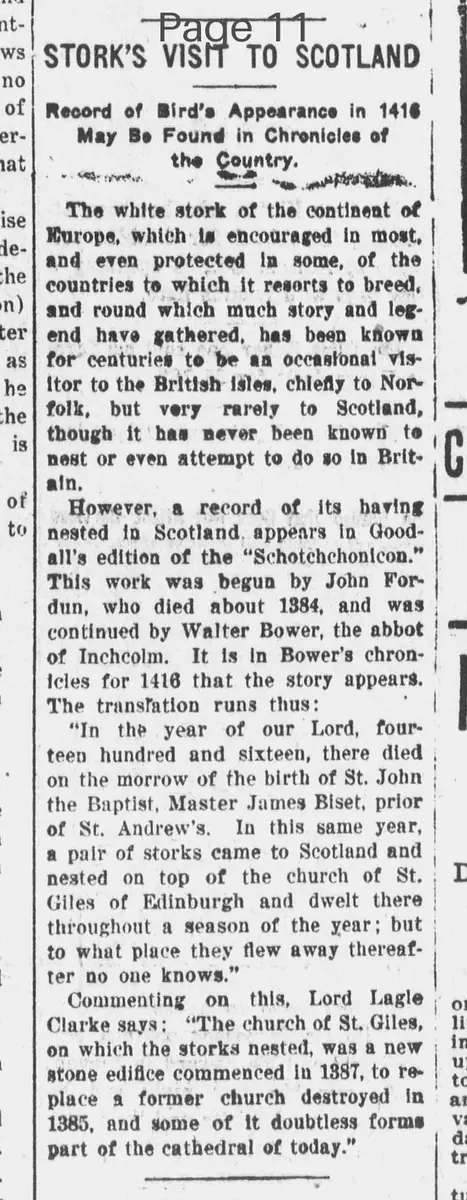
STORK'S VISIT TO SCOTLAND
Record of Bird's Appearance in 1416 May Be Found in Chronicles of the Country.
The white stork of the continent of Europe, which is encouraged in most, and even protected in some, of the countries to which it resorts to breed, and round which much story and legend have gathered, has been known for centuries to be an occasional visitor to the British isles, chiefly to Norfolk, but very rarely to Scotland, though it has never been known to nest or even attempt to do so in Britain.
However, a record of its having nested in Scotland, appears in Goodall's edition of the "Scotichronicon."
This work was begun by John Fordun, who died about 1384, and was continued by Walter Bower, the abbot of Inchcolm. It is in Bower's chronicles for 1416 that the story appears.
The translation runs thus:
"In the year of our Lord, fourteen hundred and sixteen, there died on the morrow of the birth of St. John the Baptist, Master James Biset, prior of St. Andrew's. In this same year, a pair of storks came to Scotland and nested on top of the church of St. Giles of Edinburgh and dwelt there throughout a season of the year; but to what place they flew away thereafter no one knows."
Commenting on this, Lord Lilford Clarke says: "The church of St. Giles, on which the storks nested, was a new stone edifice commenced in 1387, to replace a former church destroyed in 1385, and some of it doubtless forms part of the cathedral of today."
Record of Bird's Appearance in 1416 May Be Found in Chronicles of the Country.
The white stork of the continent of Europe, which is encouraged in most, and even protected in some, of the countries to which it resorts to breed, and round which much story and legend have gathered, has been known for centuries to be an occasional visitor to the British isles, chiefly to Norfolk, but very rarely to Scotland, though it has never been known to nest or even attempt to do so in Britain.
However, a record of its having nested in Scotland, appears in Goodall's edition of the "Scotichronicon."
This work was begun by John Fordun, who died about 1384, and was continued by Walter Bower, the abbot of Inchcolm. It is in Bower's chronicles for 1416 that the story appears.
The translation runs thus:
"In the year of our Lord, fourteen hundred and sixteen, there died on the morrow of the birth of St. John the Baptist, Master James Biset, prior of St. Andrew's. In this same year, a pair of storks came to Scotland and nested on top of the church of St. Giles of Edinburgh and dwelt there throughout a season of the year; but to what place they flew away thereafter no one knows."
Commenting on this, Lord Lilford Clarke says: "The church of St. Giles, on which the storks nested, was a new stone edifice commenced in 1387, to replace a former church destroyed in 1385, and some of it doubtless forms part of the cathedral of today."
What sub-type of article is it?
Curiosity
Historical Event
Animal Story
What themes does it cover?
Nature
What keywords are associated?
White Stork
Scotland Nesting
1416
Edinburgh
St. Giles Church
Scotichronicon
What entities or persons were involved?
Walter Bower
John Fordun
Master James Biset
Lord Lilford Clarke
Where did it happen?
Edinburgh, Scotland, Church Of St. Giles
Story Details
Key Persons
Walter Bower
John Fordun
Master James Biset
Lord Lilford Clarke
Location
Edinburgh, Scotland, Church Of St. Giles
Event Date
1416
Story Details
In 1416, a pair of storks came to Scotland and nested on top of the church of St. Giles in Edinburgh, dwelling there for a season before flying away to an unknown place.