Thank you for visiting SNEWPapers!
Sign up free
The Ladies' Garland
Harpers Ferry, Jefferson County, West Virginia
What is this article about?
Poetic narrative of Hagar's exile from Abraham's tent with her son Ishmael into the wilderness, depicting her anguish, the child's thirst and near-death, and divine provision of water at a well, drawing from the biblical story in Genesis.
Merged-components note: Relabeled from 'literary' to 'poem' as this is a poetic work 'Hagar in the Wilderness'. The image overlaps spatially with the text, indicating it belongs to the same component.
Clipping
OCR Quality
Full Text
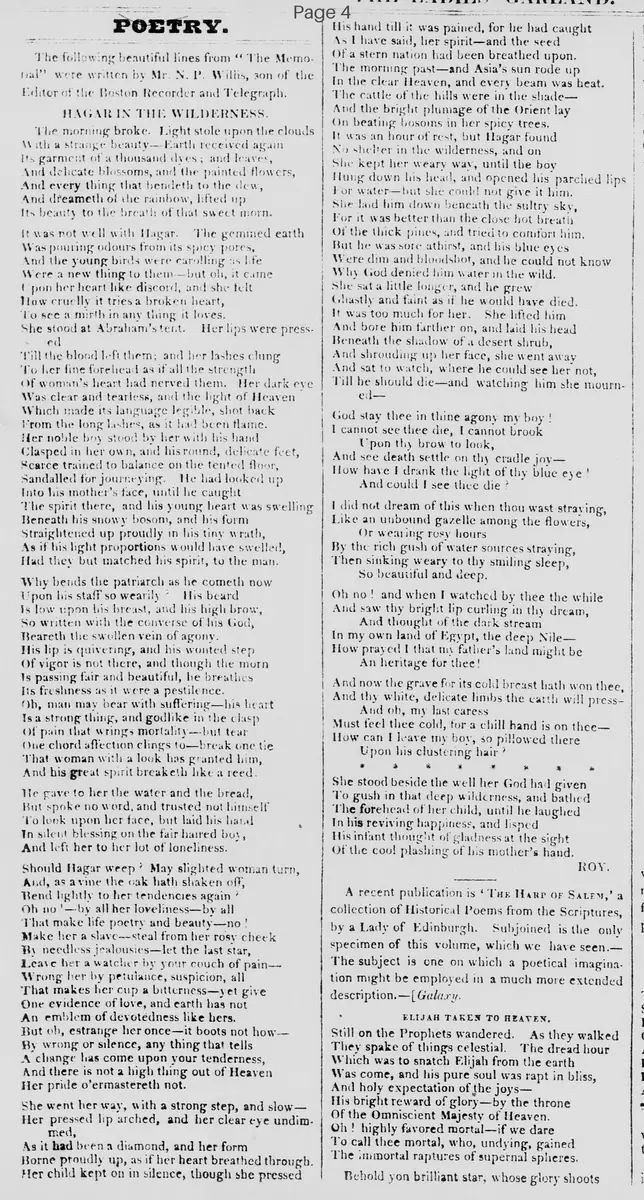
were written by Mr. N. P. Willis, son of the
Editor of the Boston Recorder and Telegraph.
HAGAR IN THE WILDERNESS.
The morning broke. Light stole upon the clouds
With a strange beauty—Earth received again
Its garment of a thousand dyes; and leaves,
And delicate blossoms, and the painted flowers,
And every thing that bendeth to the dew,
And dreameth of the rainbow, lifted up
Its beauty to the breath of that sweet morn.
It was not well with Hagar. The gemmed earth
Was pouring odours from its spicy pores,
And the young birds were carolling as life
Were a new thing to them—but oh, it came
Upon her heart like discord, and she felt
How cruelly it tries a broken heart,
To see a mirth in any thing it loves.
She stood at Abraham's tent. Her lips were pressed
Till the blood left them; and her lashes clung
To her fine forehead as if all the strength
Of woman's heart had nerved them. Her dark eye
Was clear and tearless, and the light of Heaven
Which made its language legible, shot back
From the long lashes, as it had been flame.
Her noble boy stood by her with his hand
Clasped in her own, and his round, delicate feet,
Scarce trained to balance on the tented floor,
Sandalled for journeying. He had looked up
Into his mother's face, until he caught
The spirit there, and his young heart was swelling
Beneath his snowy bosom, and his form
Straightened up proudly in his tiny wrath,
As if his light proportions would have swelled,
Had they but matched his spirit, to the man.
Why bends the patriarch as he cometh now
Upon his staff so wearily? His beard
Is low upon his breast, and his high brow,
So written with the converse of his God,
Beareth the swollen vein of agony.
His lip is quivering, and his wonted step
Of vigor is not there, and though the morn
Is passing fair and beautiful, he breathes
Its freshness as it were a pestilence.
Oh, man may bear with suffering—his heart
Is a strong thing, and godlike in the clasp
Of pain that wrings mortality—but tear
One chord affection clings to—break one tie
That woman with a look has granted him,
And his great spirit breaketh like a reed.
He gave to her the water and the bread,
But spoke no word, and trusted not himself
To look upon her face, but laid his hand
In silent blessing on the fair-haired boy,
And left her to her lot of loneliness.
Should Hagar weep? May slighted woman turn,
And, as a vine the oak hath shaken off,
Bend lightly to her tendencies again?
Oh no!—by all her loveliness—by all
That make life poetry and beauty—no!
Make her a slave—steal from her rosy cheek
By needless jealousies—let the last star,
Leave her a watcher by your couch of pain—
Wrong her by petulance, suspicion, all
That makes her cup a bitterness—yet give
One evidence of love, and earth has not
An emblem of devotedness like hers.
But oh, estrange her once—it boots not how
By wrong or silence, any thing that tells
A change has come upon your tenderness,
And there is not a high thing out of Heaven
Her pride o'ermastereth not.
She went her way, with a strong step, and slow—
Her pressed lip arched, and her clear eye undimmed,
As it had been a diamond, and her form
Borne proudly up, as if her heart breathed through.
Her child kept on in silence, though she pressed
His hand till it was pained, for he had caught
As I have said, her spirit—and the seed
Of a stern nation had been breathed upon.
The morning passed—and Asia's sun rode up
In the clear Heaven, and every beam was heat.
The cattle of the hills were in the shade—
And the bright plumage of the Orient lay
On beating bosoms in her spicy trees.
It was an hour of rest, but Hagar found
No shelter in the wilderness, and on
She kept her weary way, until the boy
Hung down his head, and opened his parched lips
For water—but she could not give it him.
She laid him down beneath the sultry sky,
For it was better than the close hot breath
Of the thick pines, and tried to comfort him.
But he was sore athirst, and his blue eyes
Were dim and bloodshot, and he could not know
Why God denied him water in the wild.
She sat a little longer, and he grew
Ghastly and faint as if he would have died.
It was too much for her. She lifted him
And bore him farther on, and laid his head
Beneath the shadow of a desert shrub,
And shrouding up her face, she went away
And sat to watch, where he could see her not,
Till he should die—and watching him she mourned—
God stay thee in thine agony my boy!
I cannot see thee die, I cannot brook
Upon thy brow to look,
And see death settle on thy cradle joy—
How have I drank the light of thy blue eye!
And could I see thee die?
I did not dream of this when thou wast straying,
Like an unbound gazelle among the flowers,
Or wearing rosy hours
By the rich gush of water sources straying,
Then sinking weary to thy smiling sleep,
So beautiful and deep.
Oh no! and when I watched by thee the while
And saw thy bright lip curling in thy dream,
And thought of the dark stream
In my own land of Egypt, the deep Nile—
How prayed I that my father's land might be
An heritage for thee!
And now the grave for its cold breast hath won thee,
And thy white, delicate limbs the earth will press—
And oh, my last caress
Must feel thee cold, for a chill hand is on thee—
How can I leave my boy, so pillowed there
Upon his clustering hair.
She stood beside the well her God had given
To gush in that deep wilderness, and bathed
The forehead of her child, until he laughed
In his reviving happiness, and lisped
His infant thought of gladness at the sight
Of the cool plashing of his mother's hand. ROY.
What sub-type of article is it?
What themes does it cover?
What keywords are associated?
What entities or persons were involved?
Poem Details
Title
Hagar In The Wilderness.
Author
Mr. N. P. Willis, Son Of The Editor Of The Boston Recorder And Telegraph.
Subject
Biblical Story Of Hagar And Ishmael In The Wilderness
Form / Style
Narrative Verse With Iambic Pentameter And Rhymed Stanzas
Key Lines