Thank you for visiting SNEWPapers!
Sign up free
Editorial
November 19, 1896
Union County Courier
Elk Point, Union County, South Dakota
What is this article about?
A pro-prohibition analysis of the recent state vote repealing the constitutional prohibitory clause, noting decreased support from 1889 levels, attributing it to liquor industry organization, misleading campaigns by brewing companies like Pabst, ballot confusion, and illegal votes, arguing the result misrepresents public will.
Clipping
OCR Quality
95%
Excellent
Full Text
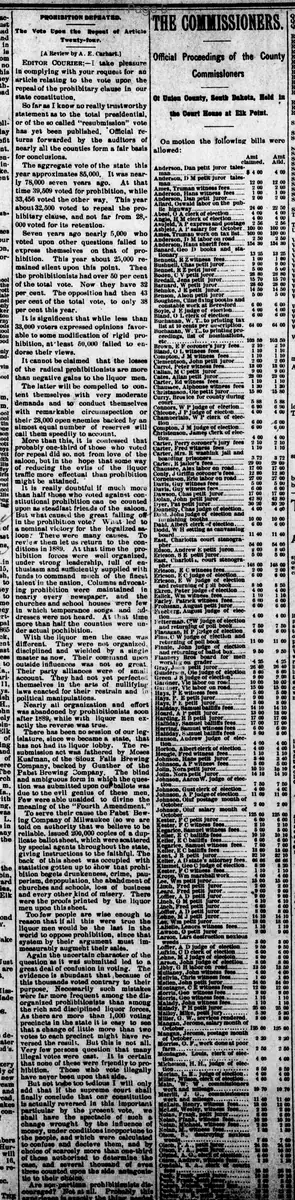
EDITOR COURIER:—I take pleasure in complying with your request for an article relating to the vote upon the repeal of the prohibitory clause in our state constitution.
So far as I know no really trustworthy statement as to the total presidential, or of the so called "resubmission" vote has yet been published. Official returns forwarded by the auditors of nearly all the counties form a fair basis for conclusions.
The aggregate vote of the state this year approximates 85,000. It was nearly 78,000 seven years ago. At that time 39,509 voted for prohibition, while 33,456 voted the other way. This year about 32,500 voted to repeal the prohibitory clause, and not far from 28,000 voted for its retention.
Seven years ago nearly 5,000 who voted upon other questions failed to express themselves on that of prohibition. This year about 25,000 remained silent upon this point. Then the prohibitionists had over 50 per cent of the total vote. Now they have 32 per cent. The opposition had then 43 per cent of the total vote, to only 38 per cent this year.
It is significant that while less than 33,000 voters expressed opinions favorable to some modification of rigid prohibition, at least 50,000 failed to endorse their views.
It cannot be claimed that the losses of the radical prohibitionists are more than negative gains to the liquor men. The latter will be compelled to content themselves with very moderate demands and to conduct themselves with remarkable circumspection or their 28,000 open enemies backed by an almost equal number of reserves will call them speedily to account.
More than this, it is confessed that probably one-third of those who voted for repeal did so, not from love of the saloon, but in the hope that some way of reducing the evils of the liquor traffic more effectual than prohibition might be attained.
It is really doubtful if much more than half those who voted against constitutional prohibition can be counted upon as steadfast friends of the saloon.
But what caused the great falling off in the prohibition vote? What led to a nominal victory for the legalized saloon? There were many causes. To review them let us return to the conditions in 1889. At that time the prohibition forces were well organized, under strong leadership, full of enthusiasm and sufficiently supplied with funds to command much of the finest talent in the nation. Columns advocating prohibition were maintained in nearly every newspaper, and the churches and school houses were few in which temperance songs and addresses were not heard. At that time more than half the counties were under actual prohibition.
With the liquor men the case was different. They were not organized, disciplined and wielded by a single master as now. Their command upon outside influences was not so great. Their party alliances were of small account. They had not yet perfected themselves in the arts of nullifying laws enacted for their restraint and in political manipulations.
Nearly all organization and effort was abandoned by prohibitionists soon after 1889, while with liquor men exactly the reverse was true.
There has been no session of our legislature, since we became a state, that has not had its liquor lobby. The resubmission act was fathered by Moses Kauffman, of the Sioux Falls Brewing Company, backed by Gunther of the Pabst Brewing Company. The blind and ambiguous form in which the question was submitted upon our ballots was due to the evil genius of these men. Few were able unaided to divine the meaning of the "Fourth Amendment."
To serve their cause the Pabst Brewing Company of Milwaukee (so we are told on authority that we believe to be reliable) issued 200,000 copies of a duplicate ballot-sheet, which were scattered by special agents throughout the state, giving instructions to the faithful. The back of this sheet was occupied with statistics gotten up to show that prohibition begets drunkenness, crime, pauperism, depopulation, the abandonment of churches and schools, loss of business and every other kind of misery. There were the proofs printed by the liquor men upon this sheet.
Too few people are wise enough to reason that if all this were true the liquor men would be the last in the world to oppose prohibition, since that system by their argument must immeasurably augment their sales.
Again the uncertain character of the question as it was submitted led to a great deal of confusion in voting. The evidence is abundant that, because of this thousands voted contrary to their purpose. Necessarily such mistakes were far more frequent among the disorganized prohibitionists than among the rich and disciplined liquor forces.
As there are more than 1,000 voting precincts in the state it is easy to see that a change of little more than two votes to each precinct might have reversed the result.
But this is not all. Very few persons question that many illegal votes were cast. It is certain that none of these were friendly to prohibition, have never been upon that side. Those who vote illegally...
But not to be too tedious I will only add that if the supreme Court shall finally conclude that our constitution is actually reversed in this important particular by the present vote, we shall have the spectacle of such change wrought by the influence of money under conditions inopportune to the people, and which were calculated to confuse and deceive them, and choice of scarcely more than one-third of those authorized to determine the case, and several thousand of even then counted upon the aid dishonest to their anti-prohibitionists.
So far as I know no really trustworthy statement as to the total presidential, or of the so called "resubmission" vote has yet been published. Official returns forwarded by the auditors of nearly all the counties form a fair basis for conclusions.
The aggregate vote of the state this year approximates 85,000. It was nearly 78,000 seven years ago. At that time 39,509 voted for prohibition, while 33,456 voted the other way. This year about 32,500 voted to repeal the prohibitory clause, and not far from 28,000 voted for its retention.
Seven years ago nearly 5,000 who voted upon other questions failed to express themselves on that of prohibition. This year about 25,000 remained silent upon this point. Then the prohibitionists had over 50 per cent of the total vote. Now they have 32 per cent. The opposition had then 43 per cent of the total vote, to only 38 per cent this year.
It is significant that while less than 33,000 voters expressed opinions favorable to some modification of rigid prohibition, at least 50,000 failed to endorse their views.
It cannot be claimed that the losses of the radical prohibitionists are more than negative gains to the liquor men. The latter will be compelled to content themselves with very moderate demands and to conduct themselves with remarkable circumspection or their 28,000 open enemies backed by an almost equal number of reserves will call them speedily to account.
More than this, it is confessed that probably one-third of those who voted for repeal did so, not from love of the saloon, but in the hope that some way of reducing the evils of the liquor traffic more effectual than prohibition might be attained.
It is really doubtful if much more than half those who voted against constitutional prohibition can be counted upon as steadfast friends of the saloon.
But what caused the great falling off in the prohibition vote? What led to a nominal victory for the legalized saloon? There were many causes. To review them let us return to the conditions in 1889. At that time the prohibition forces were well organized, under strong leadership, full of enthusiasm and sufficiently supplied with funds to command much of the finest talent in the nation. Columns advocating prohibition were maintained in nearly every newspaper, and the churches and school houses were few in which temperance songs and addresses were not heard. At that time more than half the counties were under actual prohibition.
With the liquor men the case was different. They were not organized, disciplined and wielded by a single master as now. Their command upon outside influences was not so great. Their party alliances were of small account. They had not yet perfected themselves in the arts of nullifying laws enacted for their restraint and in political manipulations.
Nearly all organization and effort was abandoned by prohibitionists soon after 1889, while with liquor men exactly the reverse was true.
There has been no session of our legislature, since we became a state, that has not had its liquor lobby. The resubmission act was fathered by Moses Kauffman, of the Sioux Falls Brewing Company, backed by Gunther of the Pabst Brewing Company. The blind and ambiguous form in which the question was submitted upon our ballots was due to the evil genius of these men. Few were able unaided to divine the meaning of the "Fourth Amendment."
To serve their cause the Pabst Brewing Company of Milwaukee (so we are told on authority that we believe to be reliable) issued 200,000 copies of a duplicate ballot-sheet, which were scattered by special agents throughout the state, giving instructions to the faithful. The back of this sheet was occupied with statistics gotten up to show that prohibition begets drunkenness, crime, pauperism, depopulation, the abandonment of churches and schools, loss of business and every other kind of misery. There were the proofs printed by the liquor men upon this sheet.
Too few people are wise enough to reason that if all this were true the liquor men would be the last in the world to oppose prohibition, since that system by their argument must immeasurably augment their sales.
Again the uncertain character of the question as it was submitted led to a great deal of confusion in voting. The evidence is abundant that, because of this thousands voted contrary to their purpose. Necessarily such mistakes were far more frequent among the disorganized prohibitionists than among the rich and disciplined liquor forces.
As there are more than 1,000 voting precincts in the state it is easy to see that a change of little more than two votes to each precinct might have reversed the result.
But this is not all. Very few persons question that many illegal votes were cast. It is certain that none of these were friendly to prohibition, have never been upon that side. Those who vote illegally...
But not to be too tedious I will only add that if the supreme Court shall finally conclude that our constitution is actually reversed in this important particular by the present vote, we shall have the spectacle of such change wrought by the influence of money under conditions inopportune to the people, and which were calculated to confuse and deceive them, and choice of scarcely more than one-third of those authorized to determine the case, and several thousand of even then counted upon the aid dishonest to their anti-prohibitionists.
What sub-type of article is it?
Temperance
Legal Reform
Partisan Politics
What keywords are associated?
Prohibition Repeal
Temperance Vote
Liquor Lobby
State Constitution
Ballot Confusion
Brewing Companies
Illegal Votes
What entities or persons were involved?
Moses Kauffman
Sioux Falls Brewing Company
Gunther
Pabst Brewing Company
Editorial Details
Primary Topic
Analysis Of Vote Repealing Prohibitory Clause In State Constitution
Stance / Tone
Pro Prohibition Critique Of Repeal Vote As Flawed And Influenced By Liquor Interests
Key Figures
Moses Kauffman
Sioux Falls Brewing Company
Gunther
Pabst Brewing Company
Key Arguments
Prohibition Vote Dropped From 50% In 1889 To 32% This Year Due To Disorganization
Liquor Interests Became Better Organized And Funded Post 1889
Resubmission Act Backed By Brewing Companies Led To Confusing Ballot
Pabst Distributed Misleading Ballot Sheets And Statistics
Thousands Voted Against Intent Due To Ballot Confusion
Illegal Votes Favored Anti Prohibition
Repeal Supported By Only About One Third Of Voters, Many Not Saloon Supporters