Thank you for visiting SNEWPapers!
Sign up free
Editorial
December 12, 1833
Richmond Enquirer
Richmond, Richmond County, Virginia
What is this article about?
An editorial by a Bank of Virginia director defends the bank's agreement with the U.S. Treasury Secretary to receive public deposits, refuting Governor's criticisms on its impact on state interests, bank security, exchanges, and political control. It argues the arrangement benefits the bank and commerce without harming others.
Clipping
OCR Quality
98%
Excellent
Full Text
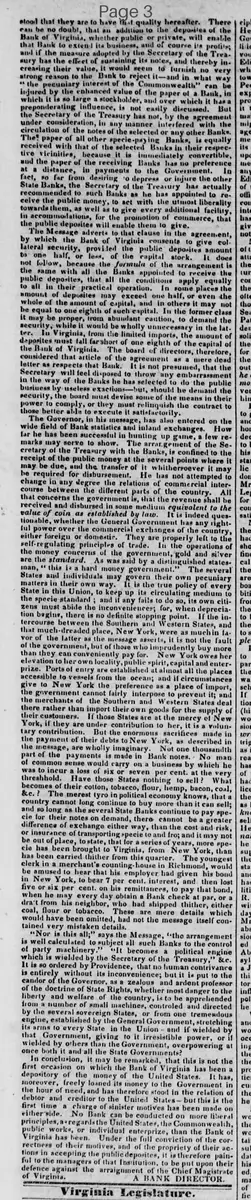
It is understood that they are to have that quality hereafter. There can be no doubt, that an addition to the deposits of the Bank of Virginia, whether public or private, will enable that Bank to extend its business, and of course its profits; and if the measure adopted by the Secretary of the Treasury has the effect of sustaining its notes, and thereby increasing their value, it would seem to furnish no very strong reason to the Bank to reject it—and in what way "the pecuniary interest of the Commonwealth" can be injured by the enhanced value of the paper of the Bank in which it is so large a stockholder, and over which it has a preponderating influence, is not easily seen. The Secretary of the Treasury has not, by the agreement under consideration, in any manner interfered with the circulation of the notes of the selected or any other Banks. The paper of all other specie-paying Banks, is equally received with that of the selected Banks in their respective vicinities, because it is immediately convertible, and the paper of the receiving Banks has no preference at a distance, in payments to the Government. In fact, so far from desiring to depress or injure the other State Banks, the Secretary of the Treasury has actually recommended to such Banks as he has appointed to receive the public money, to act with the utmost liberality towards them, as well as to give every additional facility in accommodations, for the promotion of commerce, that the public deposits will enable them to give. The Message adverts to that clause in the agreement, by which the Bank of Virginia consents to give collateral security, provided the public deposits amount to one half, or less, of the capital stock. It does not follow, because the formula of the arrangement is the same with all the Banks appointed to receive the public deposits, that all the conditions apply equally to all in their practical operation. In some places the amount of deposits may exceed one half, or even the whole of the amount of capital, and in others it may not be equal to one eighth of such capital. In the former class it may be proper, from abundant caution, to demand the security, while it would be wholly unnecessary in the latter. In Virginia, from the limited imports, the amount of deposits must fall far short of one eighth of the capital of the Bank of Virginia. The board of directors, therefore, considered that article of the agreement as a mere dead letter as respects that Bank. It is not presumed, that the Secretary will feel disposed to throw any embarrassment in the way of the Banks he has selected to do the public business by useless exactions—but, should he demand the security, the board must devise some of the means in their power to comply, or they must relinquish the contract to those better able to execute it satisfactorily. The Governor, in his message, has also entered on the wide field of Bank statistics and inland exchanges. How far he has been successful in hunting up game, a few remarks may serve to show. The arrangement of the Secretary of the Treasury with the Banks, is confined to the receipt of the public money at the several points where it may be due, and the transfer of it whithersoever it may be required for disbursement. He has not attempted to change in any degree the relations of commercial intercourse between the different parts of the country. All that concerns the government is, that the revenue shall be received and disbursed in some medium equivalent to the value of coin as established by law. It is indeed questionable, whether the General Government has any rightful power over the commercial exchanges of the country, either foreign or domestic. They are properly left to the self-regulating principles of trade. In the operations of the money concerns of the government, gold and silver are the standard. As was said by a distinguished statesman, "this is a hard money government." The several States and individuals may govern their own pecuniary matters in their own way. It is the true policy of every State in this Union, to keep up its circulating medium to the specie standard; and if any fails to do so, its own citizens must abide the inconveniences; for, when depreciation begins, there is no definite stopping point. If the intercourse between the Southern and Western States, and that much-dreaded place, New York, were as much in favor of the latter as the message asserts, it is not the fault of the government, but of those who imprudently buy more than they can conveniently pay for. New York owes her elevation to her own locality, public spirit, capital and enterprise. Ports of entry are established at almost all the places accessible to vessels from the ocean; and if circumstances give to New York the preference as a place of import, the government cannot fairly interpose to prevent it; and the merchants of the Southern and Western States deal there rather than import their own goods for the supply of their customers. If those States are at the mercy of New York, if they are under contribution to her, it is a voluntary contribution. But the enormous sacrifices made in the payment of their debts to New York, as described in the message, are wholly imaginary. Not one thousandth part of the payments is made in Bank notes. No man of common sense would carry on a business by which he was to incur a loss of six or seven per cent. at the very threshold. Have those States nothing to sell? What becomes of their cotton, tobacco, flour, hemp, bacon, coal, &c.? The merest tyro in political economy knows, that a country cannot long continue to buy more than it can sell; and so long as the several State Banks continue to pay specie for their notes on demand, there cannot be a greater difference of exchange either way, than the cost and risk, or insurance of transporting specie to and fro; and it may not be out of place, to state, that for a series of years, more specie has been brought to Virginia, from New York, than has been carried thither from this quarter. The youngest clerk in a merchant's counting-house in Richmond, would be amused to hear that his employer had given his bond in New York, to bear 7 per cent. interest, and then lost five or six per cent. on his remittances, to pay that bond, when he may every day obtain a Bank check at par, or a draft from his neighbor, who had shipped thither, either coal, flour or tobacco. These are mere details which would have been omitted, had not the message itself contained very mistaken details. "Nor is this all;" says the Message, "the arrangement is well calculated to subject all such Banks to the control of party machinery." "It becomes a political engine which is wielded by the Secretary of the Treasury." &c. It is so ordered by Providence, that no human contrivance is entirely without its inconvenience; but it is put to the candor of the Governor, as a zealous and ardent professor of the doctrine of State Rights, whether most danger to the liberty and welfare of the country, is to be apprehended from a number of small machines, controlled and directed by the several sovereign States, or from one tremendous engine, established by the General Government, stretching its arms to every State in the Union - and if wielded by that Government, giving to it irresistible power, or if wielded by others than the Government, overpowering at once both it and all the State Governments? In conclusion, it may be remarked, that this is not the first occasion on which the Bank of Virginia has been a depository of the money of the United States. It has moreover, freely loaned its money to the Government in the hour of need, and has therefore stood in the relation of debtor and creditor to the United States—but this is the first time a charge of sinister motives has been made on either side. No Bank can be conducted on more liberal principles, as regards the United States, the Commonwealth, public works, or individual enterprise, than the Bank of Virginia has been. Under the full conviction of the correctness of their motives, and of the propriety of their actions in accepting the public deposits, it is therefore painful to the managers of that Institution, to be put upon their defence against the arraignment of the Chief Magistrate of Virginia.
A BANK DIRECTOR.
A BANK DIRECTOR.
What sub-type of article is it?
Economic Policy
Partisan Politics
Trade Or Commerce
What keywords are associated?
Bank Deposits
Treasury Agreement
State Banks
Inland Exchanges
New York Trade
Political Control
Specie Standard
What entities or persons were involved?
Bank Of Virginia
Secretary Of The Treasury
Governor Of Virginia
Commonwealth Of Virginia
New York
Editorial Details
Primary Topic
Defense Of Bank Of Virginia's Public Deposit Agreement With U.S. Treasury
Stance / Tone
Supportive Of Federal Banking Arrangement, Critical Of State Governor's Objections
Key Figures
Bank Of Virginia
Secretary Of The Treasury
Governor Of Virginia
Commonwealth Of Virginia
New York
Key Arguments
Public Deposits Benefit Bank Of Virginia's Business And Note Value Without Harming State Interests.
Agreement Does Not Interfere With Other Banks' Circulation Or Prefer Selected Banks.
Collateral Security Clause Is Unnecessary For Bank Of Virginia Due To Low Deposit Levels.
Governor's Concerns On Inland Exchanges And New York Dominance Are Exaggerated And Not Government's Fault.
Federal Arrangement Avoids Political Control Risks Compared To State Banks.
Bank Of Virginia Has Historically Supported U.S. Government Without Prior Accusations.