Thank you for visiting SNEWPapers!
Sign up free
Richmond Enquirer
Richmond, Richmond County, Virginia
What is this article about?
Letter to the Richmond Enquirer editor from 'Wilberforce' opposing slavery restriction in Missouri during 1820 debate, arguing it violates Louisiana Purchase treaty guaranteeing full citizen rights, including self-government and potential for slavery; warns of disunion, civil war, and hypocrisy in 'philanthropy' that harms slaves.
Clipping
OCR Quality
Full Text
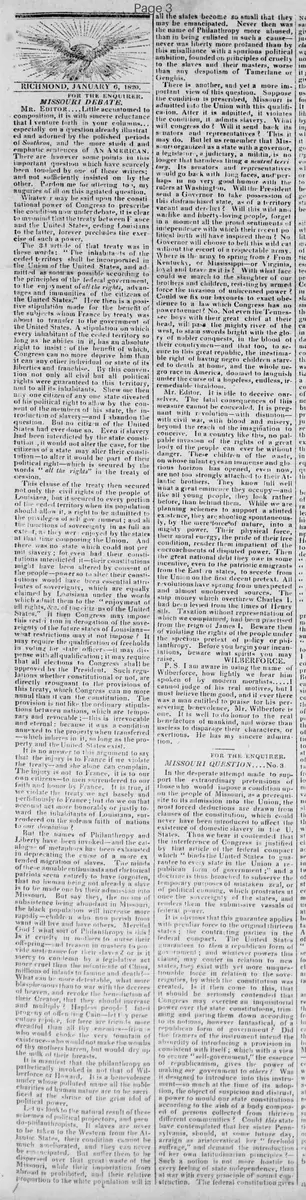
FOR THE ENQUIRER,
MISSOURI DEBATE.
MR. EDITOR—Little accustomed to composition, it is with sincere reluctance that I venture forth in your columns, especially on a question already illustrated and adorned by the polished periods of Southron, and the more studied and emphatic sentences of An AMERICAN.
There are however some points in this important question which have scarcely been touched by one of these writers; and not sufficiently insisted on by the other. Pardon me for uttering to you, my auguries of ill on this agitated question.
Whatever may be said upon the constitutional power of Congress to prescribe the condition now under debate, it is clear to my mind that the treaty between France and the United States, ceding Louisiana to the latter, forever precludes the exercise of such a power.
The 3d article of that treaty was in these words: "The inhabitants of the ceded territory shall be incorporated in the Union of the United States, and admitted as soon as possible according to the principles of the federal government, to the enjoyment of all the rights, advantages and immunities of the citizens of the United States." Here then is a positive stipulation made for the benefit of the subjects whom France by treaty was about to transfer to the government of the United States. A stipulation on which every inhabitant of the ceded territory so long as he abides in it, has an absolute right to insist: of the benefit of which, Congress can no more deprive him than it can any other individual or state of its liberties and franchise. By this convention not only all civil but all political rights were guaranteed to this territory, and to all its inhabitants. Shew me then any one citizen of any one state divested of his political right to allow by the consent of the members of his state, the introduction of slavery—and I abandon the question. But no citizen of the United States has ever done so. Even if slavery had been interdicted by the state constitution, it would not alter the case. for the citizens of a state may alter their constitution—to alter it would be part of their political right—which is secured by the words "all the rights" in the treaty of cession.
This clause of the treaty then secured not only the civil rights of the people of Louisiana, but it secured to every portion of the ceded territory when its population should allow it, a right to be admitted to the privileges of self-government; and all the functions of sovereignty in as full an extent, as they were enjoyed by the states at that time composing the Union. And there was no state which could not permit slavery; for even had their constitutions interdicted it—their constitutions might have been altered by consent of the people—power so to alter their constitutions would have been essential attributes of sovereignty, which are equally claimed by Louisiana under the words which admit them to the "enjoyment of all rights, &c. of the citizens of the United States." If then Congress may impose this restriction in derogation of the sovereignty of the future states of Louisiana—what restrictions may it not impose? It may require the qualification of freeholds in voting for state officer—it may dispense with all qualification; it may require that all elections to Congress shall be approved by the President. Such regulations whether constitutional or not, are directly repugnant to the provisions of this treaty, which Congress can no more annul than it can the Constitution. The provision is not like the ordinary stipulations between nations, which are temporary and revocable;—this is irrevocable and eternal: because it was a condition annexed to the property when transferred—which inheres in it, so long as the property and the United States exist.
It is no answer to this argument to say that the injury is to France if we violate the treaty—and she alone can complain. The injury is not to France, it is to our own citizens—to men surrendered to our faith and honor by France. It is true, if we violate the treaty we act basely and perfidiously to France: but do we on that account act more honorably or justly toward the inhabitants of Louisiana, surrendered on the solemn faith of nations to our dominion?
But the names of Philanthropy and Liberty have been invoked—and the catalogue of metaphors has been exhausted in deprecating the curse of a more extended migration of slaves. The minds of these amiable enthusiasts and rhetorical patriots seem entirely to have forgotten, that no human being not already a slave is to be made one by their admission into Missouri. But say they, the means of subsistence being abundant in Missouri, the black population will increase more rapidly—children who now perish from want will live and have others. Merciful God! what sort of Philanthropy is this! Is it cruelty in mothers to nurse their offspring—and treason in masters to provide sustenance for their slaves? or is it mercy to condemn by a legislative act more cruel than the infanticide of China, millions of infants to famine and death?—What can be more detestable, what more blasphemous than to war with the decrees of heaven, and revoke the benediction of their Creator, that they should increase and multiply? Hapless people! fated progeny of offending Cain—let thy persecutors rejoice, for here are friends more dreadful than all thy enemies—friends who would choke the very fountain of existence—who would not make the wombs of thy mothers barren, but would dry up the milk of their breasts.
It is manifest that the philanthropy so pathetically invoked is not that of Wilberforce or Howard. It is a benevolence under whose polluted name all the noble charities of human nature are to be sacrificed at the shrine of the grim idol of political power.
Let us look to the natural result of these schemes of political projectors, and pseudo-philanthropists. If slaves are never to be taken to the Western from the Atlantic States, their condition cannot be much ameliorated, and they can never be emancipated. But suffer them to be dispersed over that great waste of the Missouri, while their importation from abroad is prohibited, and their relative proportion to the white population will in all the states become so small that they may be emancipated. Never then was the name of Philanthropy more abused, than in being enlisted in such a cause—never was liberty more profaned than by this misalliance with a spurious political ambition, founded on principles of cruelty to the slaves and their masters, worse than any despotism of Tamerlane or Genghis.
There is another, and yet a more important view of this question. Suppose the condition is prescribed, Missouri is admitted into the Union with this qualification. After it is admitted, it violates the condition, It admits slavery. What will congress do? Will it send back its senators and representatives? This it may do. But let us remember that Missouri organized as a state with a governor, a legislature, a judiciary, a militia, is no longer that harmless thing a neutral territory. Its senators and representatives would go back with long faces, and perhaps in no very good humor with the rulers at Washington. Will the President send a Governor to take possession of this disfranchised state, as of a territory vacant and derelict? Will this wild and warlike and liberty-loving people, forget in a moment all the proud sentiments of independence with which their recent political birth will have inspired them? No Governor will choose to bell this wild cat without the escort of a respectable army. Where is the army to spring from? From Kentucky, or Mississippi—or Virginia, loved and brave as it is? "With what face could we march to the slaughter of our brothers and children, resisting by armed force the invasion of unlicensed power? Could we fix our bayonets to exact obedience to a law which Congress has no power to enact? No. Not even the Tennessee boys with their great chief at their head, will pass the mighty river of the west, to stain swords bright with the glory of nobler conquests, in the blood of their countrymen—and that too, to secure to this great republic, the inestimable right of having negro children starved to death at home, and the whole negro race in America, doomed to languish under the curse of a hopeless, endless, irremediable thraldom.
Mr. Editor. It is idle to deceive ourselves. The fatal consequences of this measure cannot be concealed. It is pregnant with revolution—with disunion—with civil war, with blood and misery, beyond the reach of the imagination to conceive. In a country like this, no palpable invasion of the rights of a great body of the people can ever be without danger. These children of the waste, on whose infant eyes an immense and glorious horizon has opened, even now, are not too strongly attached to their Atlantic brothers. "They know full well what a great eminence they occupy—and like all young people, they look rather before, than behind them. While we are planning schemes to support a stinted existence, they are shooting spontaneously, by the mere force of nature, into a mighty power. Their physical force, their moral energy, the pride of their free condition, render them impatient of the encroachments of disputed power. Then the great national debt they owe is some incentive, even to the patriotic emigrants from the Eastern states, to secede from the Union on the first decent pretext. All revolutions have sprung from unexpected and almost unobserved sources. The ship money which overthrew Charles I., had been levied from the times of Henry VIII. Taxation without representation of which we complained, had been practised from the reign of James I. Beware then of violating the rights of the people under the specious pretext of policy or philanthropy. Before you begin your incantations, beware what spirits you may raise.
WILBERFORCE.
P. S. I am aware in using the name of Wilberforce, how lightly we hear him spoken of by modern moralists.....I cannot judge of his real motives. but I must believe them good, and if ever there was a man entitled to praise for his persevering benevolence, Mr. Wilberforce is one. It is well to do honor to the real benefactors of mankind, and worse than useless to disparage their characters. or exertions. He has my sincere admiration.
What sub-type of article is it?
What themes does it cover?
What keywords are associated?
What entities or persons were involved?
Where did it happen?
Story Details
Key Persons
Location
Richmond, Missouri, Louisiana
Event Date
1820 01 06
Story Details
Pseudonymous letter argues that the Louisiana Purchase treaty guarantees Missouri full state rights including permission of slavery, criticizes anti-slavery restriction as violating treaty and harming slaves by preventing population dispersal and emancipation; warns of potential civil war and disunion if enforced.