Thank you for visiting SNEWPapers!
Sign up free
Editorial
August 29, 1953
The Tribune
Roanoke, Virginia
What is this article about?
Walter Chamblin's editorial discusses the Eisenhower administration's initiatives to reduce federal bureaucracy through the new Hoover Commission and a Commission on Intergovernmental Relations, aiming to enhance efficiency, cut expenditures, and return functions to states and local governments.
Merged-components note: Multiple parts of the same 'NO COMMENT' editorial column by Walter Chamblin.
Clipping
OCR Quality
88%
Good
Full Text
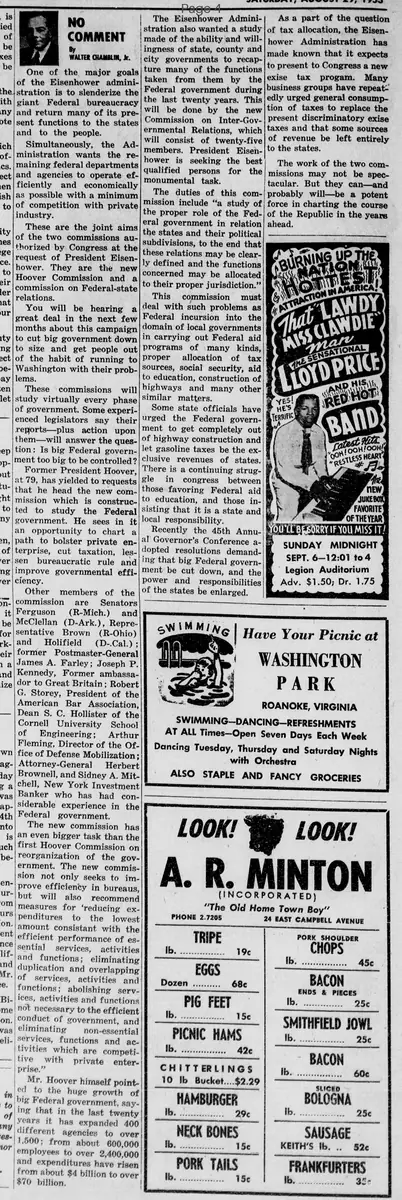
NO
COMMENT
By
WALTER CHAMBLIN, .
One of the major goals
of the Eisenhower administration is to slenderize the
giant Federal bureaucracy
and return many of its present functions to the states
and to the people.
Simultaneously, the Administration wants the remaining federal departments
and agencies to operate efficiently and economically
as possible with a minimum
of competition with private
industry.
These are the joint aims
of the two commissions authorized by Congress at the
request of President Eisenhower. They are the new
Hoover Commission and a
commission on Federal-state
relations.
You will be hearing a
great deal in the next few
months about this campaign
to cut big government down
to size and get people out
of the habit of running to
Washington with their problems.
These commissions will
study virtually every phase
of government. Some experienced legislators say their
reports--plus action upon
them--will answer the question: Is big Federal government too big to be controlled?
Former President Hoover,
at 79, has yielded to requests
that he head the new commission which is constructed to study the Federal
government. He sees in it
an opportunity to chart a
path to bolster private enterprise, cut taxation, lessen bureaucratic rule and
improve governmental efficiency.
Other members of the
commission are Senators
Ferguson (R-Mich.) and
McClellan (D-Ark.), Representative Brown (R-Ohio) and
Holifield (D-Cal.); former Postmaster-General
James A. Farley; Joseph P.
Kennedy, former ambassador
to Great Britain; Robert
G. Storey, President of the
American Bar Association,
Dean S. C. Hollister of the
Cornell University School
of Engineering; Arthur
Fleming, Director of the Office of Defense Mobilization;
Attorney-General Herbert
Brownell, and Sidney A. Mitchell, New York Investment
Banker who has had considerable experience in the
Federal government.
The new commission has
an even bigger task than the
first Hoover Commission on
reorganization of the government. The new commission not only seeks to improve efficiency in bureaus,
but will also recommend
measures for 'reducing expenditures to the lowest
amount consistent with the
efficient performance of essential services, activities
and functions; eliminating
duplication and overlapping
of services, activities and
functions; abolishing services, activities and functions
not necessary to the efficient
conduct of government, and
eliminating non-essential
services, functions and activities which are competitive with private enterprise."
Mr. Hoover himself pointed to the huge growth of
big Federal government, saying that in the last twenty
years it has expanded from 400 different agencies to over
1,500; from about 600,000
employees to over 2,400,000 and expenditures have risen
from about $4 billion to over
$70 billion.
The Eisenhower Administration also wanted a study
made of the ability and willingness of state, county and
city governments to recapture many of the functions
taken from them by the
Federal government during
the last twenty years. This
will be done by the new
Commission on Inter-Governmental Relations, which
will consist of twenty-five
members. President Eisenhower is seeking the best
qualified persons for the
monumental task.
The duties of this commission include "a study of
the proper role of the Federal government in relation
to the states and their political
subdivisions, to the end that
these relations may be clearly defined and the functions
concerned may be allocated
to their proper jurisdiction."
This commission must
deal with such problems as
Federal incursion into the
domain of local governments
in carrying out Federal aid
programs of many kinds, proper allocation of tax
sources, social security, aid
to education, construction of
highways and many other
similar matters.
Some state officials have
urged the Federal government to get completely out
of highway construction and
let gasoline taxes be the exclusive revenues of states.
There is a continuing struggle in congress between
those favoring Federal aid
to education, and those insisting that it is a state and
local responsibility.
Recently the 45th Annual Governor's Conference adopted resolutions demanding that big Federal government be cut down, and the
power and responsibilities
of the states be enlarged.
As a part of the question
of tax allocation, the Eisenhower Administration has
made known that it expects
to present to Congress a new
excise tax program. Many
business groups have repeatedly urged general consumption taxes to replace the
present discriminatory excise
taxes and that some sources
of revenue be left entirely
to the states.
The work of the two commissions may not be spectacular. But they can--and
probably will--be a potent
force in charting the course
of the Republic in the years
ahead.
COMMENT
By
WALTER CHAMBLIN, .
One of the major goals
of the Eisenhower administration is to slenderize the
giant Federal bureaucracy
and return many of its present functions to the states
and to the people.
Simultaneously, the Administration wants the remaining federal departments
and agencies to operate efficiently and economically
as possible with a minimum
of competition with private
industry.
These are the joint aims
of the two commissions authorized by Congress at the
request of President Eisenhower. They are the new
Hoover Commission and a
commission on Federal-state
relations.
You will be hearing a
great deal in the next few
months about this campaign
to cut big government down
to size and get people out
of the habit of running to
Washington with their problems.
These commissions will
study virtually every phase
of government. Some experienced legislators say their
reports--plus action upon
them--will answer the question: Is big Federal government too big to be controlled?
Former President Hoover,
at 79, has yielded to requests
that he head the new commission which is constructed to study the Federal
government. He sees in it
an opportunity to chart a
path to bolster private enterprise, cut taxation, lessen bureaucratic rule and
improve governmental efficiency.
Other members of the
commission are Senators
Ferguson (R-Mich.) and
McClellan (D-Ark.), Representative Brown (R-Ohio) and
Holifield (D-Cal.); former Postmaster-General
James A. Farley; Joseph P.
Kennedy, former ambassador
to Great Britain; Robert
G. Storey, President of the
American Bar Association,
Dean S. C. Hollister of the
Cornell University School
of Engineering; Arthur
Fleming, Director of the Office of Defense Mobilization;
Attorney-General Herbert
Brownell, and Sidney A. Mitchell, New York Investment
Banker who has had considerable experience in the
Federal government.
The new commission has
an even bigger task than the
first Hoover Commission on
reorganization of the government. The new commission not only seeks to improve efficiency in bureaus,
but will also recommend
measures for 'reducing expenditures to the lowest
amount consistent with the
efficient performance of essential services, activities
and functions; eliminating
duplication and overlapping
of services, activities and
functions; abolishing services, activities and functions
not necessary to the efficient
conduct of government, and
eliminating non-essential
services, functions and activities which are competitive with private enterprise."
Mr. Hoover himself pointed to the huge growth of
big Federal government, saying that in the last twenty
years it has expanded from 400 different agencies to over
1,500; from about 600,000
employees to over 2,400,000 and expenditures have risen
from about $4 billion to over
$70 billion.
The Eisenhower Administration also wanted a study
made of the ability and willingness of state, county and
city governments to recapture many of the functions
taken from them by the
Federal government during
the last twenty years. This
will be done by the new
Commission on Inter-Governmental Relations, which
will consist of twenty-five
members. President Eisenhower is seeking the best
qualified persons for the
monumental task.
The duties of this commission include "a study of
the proper role of the Federal government in relation
to the states and their political
subdivisions, to the end that
these relations may be clearly defined and the functions
concerned may be allocated
to their proper jurisdiction."
This commission must
deal with such problems as
Federal incursion into the
domain of local governments
in carrying out Federal aid
programs of many kinds, proper allocation of tax
sources, social security, aid
to education, construction of
highways and many other
similar matters.
Some state officials have
urged the Federal government to get completely out
of highway construction and
let gasoline taxes be the exclusive revenues of states.
There is a continuing struggle in congress between
those favoring Federal aid
to education, and those insisting that it is a state and
local responsibility.
Recently the 45th Annual Governor's Conference adopted resolutions demanding that big Federal government be cut down, and the
power and responsibilities
of the states be enlarged.
As a part of the question
of tax allocation, the Eisenhower Administration has
made known that it expects
to present to Congress a new
excise tax program. Many
business groups have repeatedly urged general consumption taxes to replace the
present discriminatory excise
taxes and that some sources
of revenue be left entirely
to the states.
The work of the two commissions may not be spectacular. But they can--and
probably will--be a potent
force in charting the course
of the Republic in the years
ahead.
What sub-type of article is it?
Constitutional
Economic Policy
Infrastructure
What keywords are associated?
Federal Bureaucracy
Hoover Commission
Federal State Relations
Government Efficiency
Tax Allocation
Highway Construction
Federal Aid
Eisenhower Administration
What entities or persons were involved?
Eisenhower Administration
Hoover Commission
Commission On Intergovernmental Relations
Herbert Hoover
Dwight D. Eisenhower
Senators Ferguson
Mcclellan
Representative Brown
Holifield
James A. Farley
Joseph P. Kennedy
Robert G. Storey
S. C. Hollister
Arthur Fleming
Herbert Brownell
Sidney A. Mitchell
Editorial Details
Primary Topic
Eisenhower Administration's Commissions To Reduce Federal Bureaucracy And Devolve Powers To States
Stance / Tone
Supportive Of Reducing Federal Government Size And Enhancing Efficiency
Key Figures
Eisenhower Administration
Hoover Commission
Commission On Intergovernmental Relations
Herbert Hoover
Dwight D. Eisenhower
Senators Ferguson
Mcclellan
Representative Brown
Holifield
James A. Farley
Joseph P. Kennedy
Robert G. Storey
S. C. Hollister
Arthur Fleming
Herbert Brownell
Sidney A. Mitchell
Key Arguments
Reduce Federal Bureaucracy And Return Functions To States And People
Operate Federal Agencies Efficiently With Minimal Competition To Private Industry
Study Every Phase Of Government To Control Its Size
Bolster Private Enterprise, Cut Taxation, Lessen Bureaucratic Rule
Eliminate Duplication, Abolish Unnecessary Functions, Reduce Expenditures
Federal Government Has Grown Massively In Agencies, Employees, And Spending
Assess States' Ability To Recapture Functions
Define Proper Federal State Roles In Aid Programs, Taxation, Social Security, Education, Highways
Support State Control Over Highway Construction And Education Funding
Propose New Excise Tax Program And General Consumption Taxes