Thank you for visiting SNEWPapers!
Sign up free
The Caledonian
Saint Johnsbury, Caledonia County, Vermont
What is this article about?
An open letter from 'Amicus' to Vermont's Conservatives—former Jackson and Van Buren supporters disillusioned with administration financial policies—urges them to cooperate with Whigs against the Sub-Treasury scheme, attacks on state banks, and unstable currency, highlighting shared interests in economic stability despite partisan differences.
Merged-components note: Continuation of the editorial 'To the Conservatives of Vermont' across columns, based on sequential reading order and direct text continuation.
Clipping
OCR Quality
Full Text
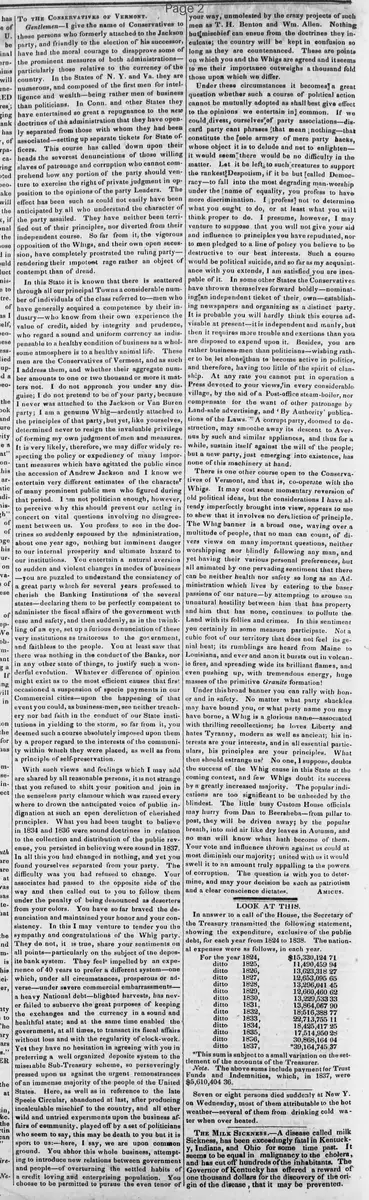
Gentlemen--I give the name of Conservatives to those persons who formerly attached to the Jackson party, and friendly to the election of his successor; have had the moral courage to disapprove some of the prominent measures of both administrations—particularly those relative to the currency of the numerous, and composed of the first men for intelligence and wealth-being rather men of business than politicians. In Conn. and other States they have entertained so great a repugnance to the new doctrines of the administration that they have openly separated from those with whom they had been associated-setting up separate tickets or State officers. This course has called down upon their heads the severest denunciations of those willing slaves of patronage and corruption who cannot comprehend how any portion of the party should venture to exercise the right of private judgment in opposition to the opinions of the party Leaders. The effect has been such as could not easily have been anticipated by all who understand the character of the party assailed. They have neither been terrified out of their principles, nor diverted from their independent course. So far from it, the vigorous opposition of the Whigs, and their own open secession, have completely prostrated the ruling party-rendering their impotent rage rather an object of contempt than of dread.
In this State it is known that there is scattered through all our principal Towns a considerable number of individuals of the class referred to--men who have generally acquired a competence by their industry-who know from their own experience the value of credit, aided by integrity and prudence, who regard a sound and uniform currency as indispensable to a healthy condition of business as a wholesome atmosphere is to a healthy animal life. These men are the Conservatives of Vermont, and as such I address them, and whether their aggregate number amounts to one or two thousand or more it matters not. I do not approach you under any disguise; I do not pretend to be of your party, because I never was attached to the Jackson or Van Buren party; I am a genuine Whig-ardently attached to the principles of that party, but yet, like yourselves, determined never to resign the invaluable privilege of forming my own judgment of men and measures. It is very likely, therefore, we may differ widely respecting the policy or expediency of many important measures which have agitated the public since the accession of Andrew Jackson and I know we entertain very different estimates of the character of many prominent public men who figured during that period. I am not politician enough, however, to perceive why this should prevent our acting in concert on vital questions involving no disagreement between us. You profess to see in the doctrines so suddenly espoused by the administration, about one year ago, nothing but imminent danger to our internal prosperity and ultimate hazard to our institutions. You entertain a natural aversion to sudden and violent changes in modes of business—you are puzzled to understand the consistency of a great party which for several years professed to cherish the Banking Institutions of the several states-declaring them to be perfectly competent to administer the fiscal affairs of the government with ease and safety, and then suddenly, as in the twinkling of an eye, set up a furious denunciation of these very institutions as traitorous to the government, and faithless to the people. You at least saw that there was nothing in the conduct of the Banks, nor in any other state of things, to justify such a wonderful evolution. Whatever difference of opinion might exist as to the most efficient causes that first occasioned a suspension of specie payments in our Commercial cities--upon the happening of that event you could, as business-men, see neither treachery nor bad faith in the conduct of our State institutions in yielding to the storm, so far from it, you deemed such a course absolutely imposed upon them by a proper regard to the interests of the community within which they were placed, as well as from a principle of self-preservation.
With such views and feelings which I may add are shared by all reasonable persons, it is not strange that you refused to shift your position and join in the senseless party clamour which was raised everywhere to drown the anticipated voice of public indignation at such an open dereliction of cherished principles. What you had been taught to believe in 1834 and 1836 were sound doctrines in relation to the collection and distribution of the public revenue, you persisted in believing were sound in 1837. In all this you had changed in nothing, and yet you found yourselves separated from your party. The difficulty was you had refused to change. Your associates had passed to the opposite side of the way and then called out to you to follow them under the penalty of being denounced as deserters from your colors. You have so far braved the denunciation and maintained your honor and your consistency. In this I may venture to tender you the sympathy and congratulations of the Whig party. They do not, it is true, share your sentiments on all points-particularly on the subject of the deposit bank system. They feel impelled by an experience of 40 years to prefer a different system-one which, under all circumstances, prosperous or adverse--under severe commercial embarrassments--a heavy National debt-blighted harvests, has never failed to subserve the great purposes of keeping the exchanges and the currency in a sound and healthful state; and at the same time enabled the government, at all times, to transact its fiscal affairs without loss and with the regularity of clock-work. Yet they have no hesitation in agreeing with you in preferring a well organized deposit system to the miserable Sub-Treasury scheme, so perseveringly pressed upon us against the urgent remonstrances of an immense majority of the people of the United States. Here, as well as in reference to the late Specie Circular, abandoned at last, after producing incalculable mischief to the country, and all other wild and untried experiments upon the business affairs of community, played off by a set of politicians who seem to say, this may be death to you but it is sport to us:-here, I say, we are upon common ground. You abhor this whole business, attempting to introduce new relations between government and people-of overturning the settled habits of a credit loving and enterprising population. You choose to be permitted to pursue the even tenor of your way, unmolested by the crazy projects of such men as T. H. Benton and Wm. Allen. Nothing but mischief can ensue from the doctrines they inculcate; the country will be kept in confusion so long as they are countenanced. These are points on which you and the Whigs are agreed and it seems to me their importance outweighs a thousand fold those upon which we differ.
Under these circumstances it becomes a great question whether such a course of political action cannot be mutually adopted as shall best give effect to the opinions we entertain in common. If we could divest ourselves of party associations--discard party cant phrases that mean nothing-that constitute the sole armory of mere party hacks, whose object it is to delude and not to enlighten—it would seem there would be no difficulty in the matter. Let it be left to such creatures to support the rankest Despotism, if it be but called Democracy-to fall into the most degrading man-worship under the name of equality, you profess to have more discrimination. I profess not to determine what you ought to do, or at least what you will think proper to do. I presume, however, I may venture to suppose that you will not give your aid and influence to principles you have repudiated, nor to men pledged to a line of policy you believe to be destructive to our best interests. Such a course would be political suicide, and so far as my acquaintance with you extends, I am satisfied you are incapable of it. In some other States the Conservatives have thrown themselves forward boldly-nominating an independent ticket of their own-establishing newspapers and organizing as a distinct party. It is probable you will hardly think this course advisable at present-it is independent and manly, but then it requires more trouble and exertions than you are disposed to expend upon it. Besides, you are rather business-men than politicians-wishing rather to be let alone than to become active in politics, and therefore, having too little of the spirit of clanship. At any rate you cannot put in operation a Press devoted to your views, in every considerable village, by the aid of a Post-office steam-boiler, nor compensate for the want of other patronage by Land-sale advertising, and 'By Authority' publications of the Laws. A corrupt party, doomed to destruction, may smooth away its descent to Avernus by such and similar appliances, and thus for a while, sustain itself against the will of the people; but a new party, just emerging into existence, has none of this machinery at hand.
There is one other course open to the Conservatives of Vermont, and that is, co-operate with the Whigs. It may cost some momentary reversion of old political ideas, but the considerations I have already imperfectly brought into view, appears to me to show that it involves no dereliction of principle. The Whig banner is a broad one, waving over a multitude of people, that no man can count, of divers views on many important questions, neither worshipping nor blindly following any man, and yet having their various personal preferences, but all animated by one pervading sentiment that there can be neither health nor safety so long as an Administration which lives by catering to the baser passions of our nature-by attempting to arouse an unnatural hostility between him that has property and him that has none, continues to pollute the Land with its follies and crimes. In this sentiment you certainly in some measure participate. Not a cubic foot of our territory that does not feel its genial heat; its rumblings are heard from Maine to Louisiana, and ever and anon it bursts out in volcanic fires, and spreading wide its brilliant flames, and even pushing up, with tremendous energy, huge masses of the primitive Granite formation!
Under this broad banner you can rally with honor and in safety. No matter what party shackles may have bound you, or what party name you may have borne, a Whig is a glorious name--associated with thrilling recollections; he loves Liberty and hates Tyranny, modern as well as ancient; his interests are your interests, and in all essential particulars, his principles are your principles. What then should estrange us? No one, I suppose, doubts the success of the Whig cause in this State at the coming contest, and few Whigs doubt its success by a greatly increased majority. The popular indications are too significant to be unheeded by the blindest. The little busy Custom House officials may hurry from Dan to Beersheba-from pillar to post, they will be driven away; by the popular breath, into mid air like dry leaves in Autumn, and no man will know what hath become of them.
Your vote and influence thrown against us could at most diminish our majority; united with us it would swell it to an amount truly appalling to the powers of corruption. The question is with you to determine, and may your decision be such as patriotism and a clear conscience dictates.
Amicus.
What sub-type of article is it?
What keywords are associated?
What entities or persons were involved?
Editorial Details
Primary Topic
Urging Vermont Conservatives To Cooperate With Whigs Against Van Buren Administration's Financial Policies
Stance / Tone
Pro Whig Alliance, Anti Administration Financial Experiments, Conciliatory To Conservatives
Key Figures
Key Arguments