Thank you for visiting SNEWPapers!
Sign up free
Alexandria Gazette
Alexandria, Alexandria County, District Of Columbia
What is this article about?
In response to the Richmond Whig editors, the writer argues that high wheat and flour prices in Richmond do not prove national prosperity or the benefits of removing bank deposits, as the local market is small, regulated by global trade, and shows depression compared to larger northern markets like Baltimore, New York, and Philadelphia.
Clipping
OCR Quality
Full Text
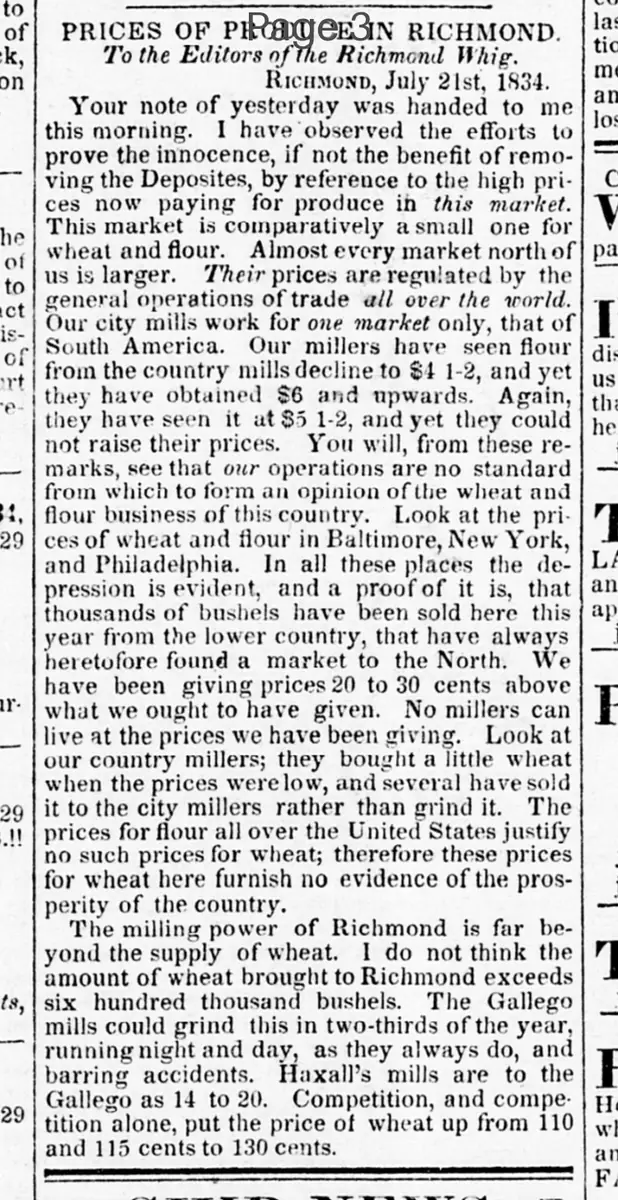
Richmond, July 21st, 1834.
Your note of yesterday was handed to me this morning. I have observed the efforts to prove the innocence, if not the benefit of removing the Deposites, by reference to the high prices now paying for produce in this market.
This market is comparatively a small one for wheat and flour. Almost every market north of us is larger. Their prices are regulated by the general operations of trade all over the world. Our city mills work for one market only, that of South America. Our millers have seen flour from the country mills decline to $4 1/2, and yet they have obtained $6 and upwards. Again, they have seen it at $5 1/2, and yet they could not raise their prices. You will, from these remarks, see that our operations are no standard from which to form an opinion of the wheat and flour business of this country. Look at the prices of wheat and flour in Baltimore, New York, and Philadelphia. In all these places the depression is evident, and a proof of it is, that thousands of bushels have been sold here this year from the lower country, that have always heretofore found a market to the North. We have been giving prices 20 to 30 cents above what we ought to have given. No millers can live at the prices we have been giving. Look at our country millers; they bought a little wheat when the prices were low, and several have sold it to the city millers rather than grind it. The prices for flour all over the United States justify no such prices for wheat; therefore these prices for wheat here furnish no evidence of the prosperity of the country.
The milling power of Richmond is far beyond the supply of wheat. I do not think the amount of wheat brought to Richmond exceeds six hundred thousand bushels. The Gallego mills could grind this in two-thirds of the year, running night and day, as they always do, and barring accidents. Haxall's mills are to the Gallego as 14 to 20. Competition, and competition alone, put the price of wheat up from 110 and 115 cents to 130 cents.
What sub-type of article is it?
What themes does it cover?
What keywords are associated?
What entities or persons were involved?
Letter to Editor Details
Recipient
To The Editors Of The Richmond Whig
Main Argument
high wheat and flour prices in richmond do not indicate national prosperity or the benefits of removing the deposits, as the local market is small, influenced by competition and global trade, while larger northern markets show evident depression.
Notable Details