Thank you for visiting SNEWPapers!
Sign up free
Story
October 6, 1887
The Frontier
O'neill, O'neill City, Holt County, Nebraska
What is this article about?
Essay by George William Curtis in Harper's Magazine discusses government roles, using New York's purchase of Niagara Falls grounds to preserve the cataract as an example of beneficial public intervention for moral and communal benefit, balancing Jeffersonian minimalism with practical necessities.
Clipping
OCR Quality
98%
Excellent
Full Text
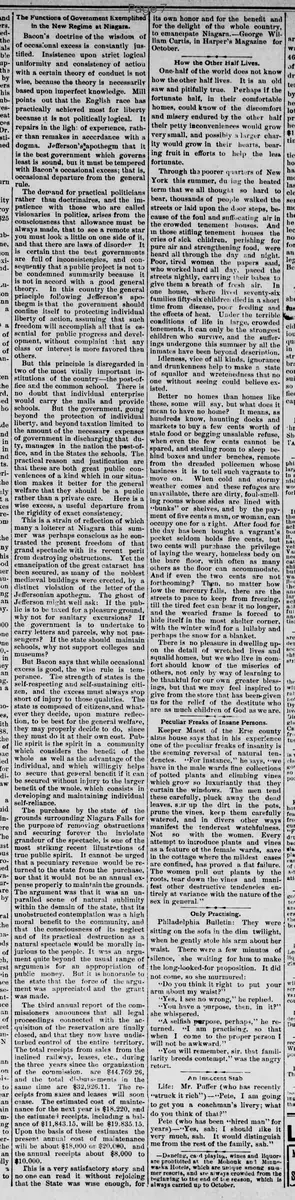
The Functions of Government Exemplified In the New Regime at Niagara.
Bacon's doctrine of the wisdom of occasional excess is constantly justified. Insistence upon strict logical uniformity and consistency of action with a certain theory of conduct is not wise, because the theory is necessarily based upon imperfect knowledge. Mill points out that the English race has practically achieved most for liberty because it is not politically logical. It repairs in the light of experience, rather than remakes in accordance with a dogma. Jefferson's apothegm that it is the best government which governs least is sound, but it must be tempered with Bacon's occasional excess; that is, occasional departure from the general rule.
The demand for practical politicians rather than doctrinaires, and the impatience with those who are called visionaries in politics, arises from the consciousness that allowance must be always made, that to see a remote star you must look a little on one side of it, and that there are laws of disorder. It is certain that the best governments are full of inconsistencies, and consequently that a public project is not to be condemned summarily because it is not in accord with a good general theory. In this country the general principle following Jefferson's apothegm is that the government should confine itself to protecting individual liberty of action, assuming that such freedom will accomplish all that is essential for public progress and development, without complaint that any class or interest is more favored than others.
But this principle is disregarded in two of the most vitally important institutions of the country-the post-office and the common school. There is no doubt that individual enterprise would carry the mails and provide schools. But the government, going beyond the protection of individual liberty, and beyond taxation limited to the amount of the necessary expenses of government in discharging that duty, manages in the nation the post-office, and in the States the schools. The practical reason and justification are that these are both great public conveniences of a kind which in our situation makes it better for the general welfare that they should be a public rather than a private care. Here is a wise excess, a useful departure from the rigidity of exact consistency.
This is a strain of reflection of which many a loiterer at Niagara this summer was perhaps conscious as he contrasted the present freedom of that grand spectacle with its recent peril from destroying obstructions. Yet the emancipation of the great cataract has been secured, as many of the noblest mediaval buildings were erected, by a distinct violation of the letter of the Jeffersonian apothegm. The ghost of Jefferson might well ask: If the public is to be taxed for a pleasure ground, why not for sanitary excursions? If the government is to undertake to carry letters and parcels, why not passengers? If the state should maintain schools, why not support colleges and museums?
But Bacon says that while occasional excess is good, the wise rule is temperance. The strength of states is the self-respecting and self-sustaining citizen, and the excess must always stop short of injury to those qualities. The state is composed of citizens, and whatever they decide, upon mature reflection, to be best for the general welfare, they may properly decide to do, since they must do it at their own cost. Public spirit is the spirit in a community which considers the benefit of the whole as well as the advantage of the individual, and which willingly helps to secure that general benefit if it can be secured without injury to the larger benefit of the whole, which consists in developing and maintaining individual self-reliance.
The purchase by the state of the grounds surrounding Niagara Falls for the purpose of removing obstructions and securing forever the inviolate grandeur of the spectacle, is one of the most striking recent illustrations of true public spirit. It cannot be urged that a pecuniary revenue would be returned to the state from the purchase, nor that it would not be an annual expense properly to maintain the grounds. The argument was that it was an unparalleled scene of natural sublimity within the domain of the state, that its unobstructed contemplation was a high moral benefit to the community, and that the consciousness of its neglect and of its practical destruction as a natural spectacle would be morally injurious to the people. It was an argument quite beyond the usual range of arguments for an appropriation of public money. But it is honorable to the state that the force of the argument was appreciated and the grant was made.
The third annual report of the commissioners announces that all legal proceedings connected with the acquisition of the reservation are finally closed, and that they now have undisturbed control of the entire territory. The total receipts from sales from the inclined railway, leases, etc., during the three years since the organization of the commission, are $44,769.26, and the total disbursements in the same time are $32,926.11. The receipts from sales and leases will soon cease. The estimated cost of maintenance for the next year is $18,220, and the estimated receipts, including a balance of $11,843.15, will be $19,835.15. Upon the basis of these estimates the present annual cost of maintenance will be about $18,000 or $20,000, and the annual receipts about $8,000 to $10,000.
This is a very satisfactory story and no one can read it without rejoicing that the State was wise enough, for its own honor and for the benefit and for the delight of the whole country, to emancipate Niagara.--George William Curtis, in Harper's Magazine for October.
Bacon's doctrine of the wisdom of occasional excess is constantly justified. Insistence upon strict logical uniformity and consistency of action with a certain theory of conduct is not wise, because the theory is necessarily based upon imperfect knowledge. Mill points out that the English race has practically achieved most for liberty because it is not politically logical. It repairs in the light of experience, rather than remakes in accordance with a dogma. Jefferson's apothegm that it is the best government which governs least is sound, but it must be tempered with Bacon's occasional excess; that is, occasional departure from the general rule.
The demand for practical politicians rather than doctrinaires, and the impatience with those who are called visionaries in politics, arises from the consciousness that allowance must be always made, that to see a remote star you must look a little on one side of it, and that there are laws of disorder. It is certain that the best governments are full of inconsistencies, and consequently that a public project is not to be condemned summarily because it is not in accord with a good general theory. In this country the general principle following Jefferson's apothegm is that the government should confine itself to protecting individual liberty of action, assuming that such freedom will accomplish all that is essential for public progress and development, without complaint that any class or interest is more favored than others.
But this principle is disregarded in two of the most vitally important institutions of the country-the post-office and the common school. There is no doubt that individual enterprise would carry the mails and provide schools. But the government, going beyond the protection of individual liberty, and beyond taxation limited to the amount of the necessary expenses of government in discharging that duty, manages in the nation the post-office, and in the States the schools. The practical reason and justification are that these are both great public conveniences of a kind which in our situation makes it better for the general welfare that they should be a public rather than a private care. Here is a wise excess, a useful departure from the rigidity of exact consistency.
This is a strain of reflection of which many a loiterer at Niagara this summer was perhaps conscious as he contrasted the present freedom of that grand spectacle with its recent peril from destroying obstructions. Yet the emancipation of the great cataract has been secured, as many of the noblest mediaval buildings were erected, by a distinct violation of the letter of the Jeffersonian apothegm. The ghost of Jefferson might well ask: If the public is to be taxed for a pleasure ground, why not for sanitary excursions? If the government is to undertake to carry letters and parcels, why not passengers? If the state should maintain schools, why not support colleges and museums?
But Bacon says that while occasional excess is good, the wise rule is temperance. The strength of states is the self-respecting and self-sustaining citizen, and the excess must always stop short of injury to those qualities. The state is composed of citizens, and whatever they decide, upon mature reflection, to be best for the general welfare, they may properly decide to do, since they must do it at their own cost. Public spirit is the spirit in a community which considers the benefit of the whole as well as the advantage of the individual, and which willingly helps to secure that general benefit if it can be secured without injury to the larger benefit of the whole, which consists in developing and maintaining individual self-reliance.
The purchase by the state of the grounds surrounding Niagara Falls for the purpose of removing obstructions and securing forever the inviolate grandeur of the spectacle, is one of the most striking recent illustrations of true public spirit. It cannot be urged that a pecuniary revenue would be returned to the state from the purchase, nor that it would not be an annual expense properly to maintain the grounds. The argument was that it was an unparalleled scene of natural sublimity within the domain of the state, that its unobstructed contemplation was a high moral benefit to the community, and that the consciousness of its neglect and of its practical destruction as a natural spectacle would be morally injurious to the people. It was an argument quite beyond the usual range of arguments for an appropriation of public money. But it is honorable to the state that the force of the argument was appreciated and the grant was made.
The third annual report of the commissioners announces that all legal proceedings connected with the acquisition of the reservation are finally closed, and that they now have undisturbed control of the entire territory. The total receipts from sales from the inclined railway, leases, etc., during the three years since the organization of the commission, are $44,769.26, and the total disbursements in the same time are $32,926.11. The receipts from sales and leases will soon cease. The estimated cost of maintenance for the next year is $18,220, and the estimated receipts, including a balance of $11,843.15, will be $19,835.15. Upon the basis of these estimates the present annual cost of maintenance will be about $18,000 or $20,000, and the annual receipts about $8,000 to $10,000.
This is a very satisfactory story and no one can read it without rejoicing that the State was wise enough, for its own honor and for the benefit and for the delight of the whole country, to emancipate Niagara.--George William Curtis, in Harper's Magazine for October.
What sub-type of article is it?
Historical Event
What themes does it cover?
Moral Virtue
Triumph
What keywords are associated?
Niagara Falls Preservation
Government Intervention
Public Spirit
State Purchase
Natural Sublimity
What entities or persons were involved?
George William Curtis
Thomas Jefferson
Francis Bacon
John Stuart Mill
Where did it happen?
Niagara Falls
Story Details
Key Persons
George William Curtis
Thomas Jefferson
Francis Bacon
John Stuart Mill
Location
Niagara Falls
Event Date
Third Annual Report
Story Details
The state purchased grounds surrounding Niagara Falls to remove obstructions and secure its grandeur, exemplifying public spirit and wise government excess beyond strict minimalism, with the commission reporting financial details after three years.