Thank you for visiting SNEWPapers!
Sign up free
Story
September 14, 1841
New Haven Daily Herald
New Haven, New Haven County, Connecticut
What is this article about?
The Montpelier Watchman reports on the Vermont election where Whigs likely failed to elect a governor, reducing their legislative majority due to voter apathy and abolitionist third-party splits exploited by Locofocos, warning of broader party destruction.
Clipping
OCR Quality
98%
Excellent
Full Text
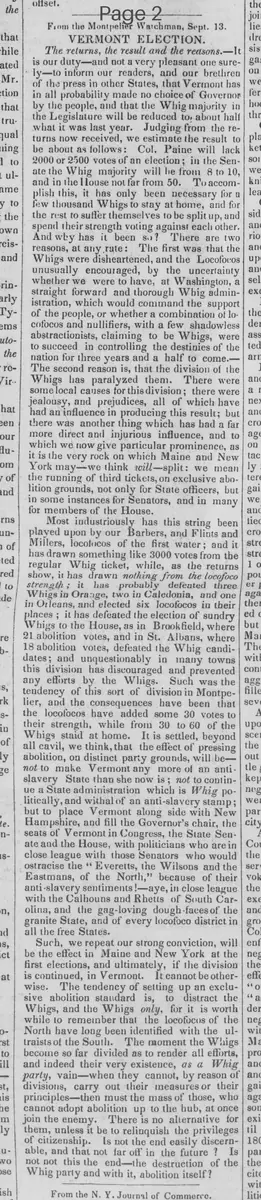
From the Montpelier Watchman, Sept. 13.
VERMONT ELECTION.
The returns, the result and the reasons.—It is our duty—and not a very pleasant one surely—to inform our readers, and our brethren of the press in other States, that Vermont has in all probability made no choice of Governor by the people, and that the Whig majority in the Legislature will be reduced to about half what it was last year. Judging from the returns now received, we estimate the result to be about as follows: Col. Paine will lack 2000 or 2500 votes of an election; in the Senate the Whig majority will be from 8 to 10, and in the House not far from 50. To accomplish this, it has only been necessary for a few thousand Whigs to stay at home, and for the rest to suffer themselves to be split up, and spend their strength voting against each other.
And why has it been so? There are two reasons, at any rate: The first was that the Whigs were disheartened, and the Locofocos unusually encouraged, by the uncertainty whether we were to have, at Washington, a straight forward and thorough Whig administration, which would command the support of the people, or whether a combination of locofocos and nullifiers, with a few shadowless abstractionists, claiming to be Whigs, were to succeed in controlling the destinies of the nation for three years and a half to come.—
The second reason is, that the division of the Whigs has paralyzed them. There were some local causes for this division; there were jealousy, and prejudices, all of which have had an influence in producing this result; but there was another thing which has had a far more direct and injurious influence, and to which we now give particular prominence, as it is the very rock on which Maine and New York may—we think will—split: we mean the running of third tickets, on exclusive abolition grounds, not only for State officers, but in some instances for Senators, and in many for members of the House.
Most industriously has this string been played upon by our Barbers, and Flints and Millers, locofocos of the first water; and it has drawn something like 3000 votes from the regular Whig ticket, while, as the returns show, it has drawn nothing from the locofoco strength; it has probably defeated three Whigs in Orange, two in Caledonia, and one in Orleans, and elected six locofocos in their places; it has defeated the election of sundry Whigs to the House, as in Brookfield, where 21 abolition votes, and in St. Albans, where 18 abolition votes, defeated the Whig candidates; and unquestionably in many towns this division has discouraged and prevented any efforts by the Whigs. Such was the tendency of this sort of division in Montpelier, and the consequences have been that the locofocos have added some 30 votes to their strength, while from 30 to 60 of the Whigs staid at home. It is settled, beyond all cavil, we think, that the effect of pressing abolition, on distinct party grounds, will be—not to make Vermont any more of an anti-slavery State than she now is; not to continue a State administration which is Whig politically, and withal of an anti-slavery stamp; but to place Vermont along side with New Hampshire, and fill the Governor's chair, the seats of Vermont in Congress, the State Senate and the House, with politicians who are in close league with those Senators who would ostracise the "Everetts, the Wilsons and the Eastmans, of the North," because of their anti-slavery sentiments!—aye, in close league with the Calhouns and Rhetts of South Carolina, and the gag-loving dough-faces of the granite State, and of every locofoco district in all the free States.
Such, we repeat our strong conviction, will be the effect in Maine and New York at the first elections, and ultimately, if the division is continued, in Vermont. It cannot be otherwise. The tendency of setting up an exclusive abolition standard is, to distract the Whigs, and the Whigs only, for it is worth while to remember that the locofocos of the North have long been identified with the ultraists of the South. The moment the Whigs become so far divided as to render all efforts, and indeed their very existence, as a Whig party, vain—when they cannot, by reason of divisions, carry out their measures or their principles—then must the mass of those, who cannot adopt abolition up to the hub, at once join the enemy. There is no alternative for them, unless it be to relinquish the privileges of citizenship. Is not the end easily discernible, and that not far off in the future? Is not this the end—the destruction of the Whig party and with it, abolition itself?
VERMONT ELECTION.
The returns, the result and the reasons.—It is our duty—and not a very pleasant one surely—to inform our readers, and our brethren of the press in other States, that Vermont has in all probability made no choice of Governor by the people, and that the Whig majority in the Legislature will be reduced to about half what it was last year. Judging from the returns now received, we estimate the result to be about as follows: Col. Paine will lack 2000 or 2500 votes of an election; in the Senate the Whig majority will be from 8 to 10, and in the House not far from 50. To accomplish this, it has only been necessary for a few thousand Whigs to stay at home, and for the rest to suffer themselves to be split up, and spend their strength voting against each other.
And why has it been so? There are two reasons, at any rate: The first was that the Whigs were disheartened, and the Locofocos unusually encouraged, by the uncertainty whether we were to have, at Washington, a straight forward and thorough Whig administration, which would command the support of the people, or whether a combination of locofocos and nullifiers, with a few shadowless abstractionists, claiming to be Whigs, were to succeed in controlling the destinies of the nation for three years and a half to come.—
The second reason is, that the division of the Whigs has paralyzed them. There were some local causes for this division; there were jealousy, and prejudices, all of which have had an influence in producing this result; but there was another thing which has had a far more direct and injurious influence, and to which we now give particular prominence, as it is the very rock on which Maine and New York may—we think will—split: we mean the running of third tickets, on exclusive abolition grounds, not only for State officers, but in some instances for Senators, and in many for members of the House.
Most industriously has this string been played upon by our Barbers, and Flints and Millers, locofocos of the first water; and it has drawn something like 3000 votes from the regular Whig ticket, while, as the returns show, it has drawn nothing from the locofoco strength; it has probably defeated three Whigs in Orange, two in Caledonia, and one in Orleans, and elected six locofocos in their places; it has defeated the election of sundry Whigs to the House, as in Brookfield, where 21 abolition votes, and in St. Albans, where 18 abolition votes, defeated the Whig candidates; and unquestionably in many towns this division has discouraged and prevented any efforts by the Whigs. Such was the tendency of this sort of division in Montpelier, and the consequences have been that the locofocos have added some 30 votes to their strength, while from 30 to 60 of the Whigs staid at home. It is settled, beyond all cavil, we think, that the effect of pressing abolition, on distinct party grounds, will be—not to make Vermont any more of an anti-slavery State than she now is; not to continue a State administration which is Whig politically, and withal of an anti-slavery stamp; but to place Vermont along side with New Hampshire, and fill the Governor's chair, the seats of Vermont in Congress, the State Senate and the House, with politicians who are in close league with those Senators who would ostracise the "Everetts, the Wilsons and the Eastmans, of the North," because of their anti-slavery sentiments!—aye, in close league with the Calhouns and Rhetts of South Carolina, and the gag-loving dough-faces of the granite State, and of every locofoco district in all the free States.
Such, we repeat our strong conviction, will be the effect in Maine and New York at the first elections, and ultimately, if the division is continued, in Vermont. It cannot be otherwise. The tendency of setting up an exclusive abolition standard is, to distract the Whigs, and the Whigs only, for it is worth while to remember that the locofocos of the North have long been identified with the ultraists of the South. The moment the Whigs become so far divided as to render all efforts, and indeed their very existence, as a Whig party, vain—when they cannot, by reason of divisions, carry out their measures or their principles—then must the mass of those, who cannot adopt abolition up to the hub, at once join the enemy. There is no alternative for them, unless it be to relinquish the privileges of citizenship. Is not the end easily discernible, and that not far off in the future? Is not this the end—the destruction of the Whig party and with it, abolition itself?
What sub-type of article is it?
Historical Event
What themes does it cover?
Misfortune
Deception
Tragedy
What keywords are associated?
Vermont Election
Whig Majority
Abolition Tickets
Locofoco Gains
Party Division
What entities or persons were involved?
Col. Paine
Barbers
Flints
Millers
Everetts
Wilsons
Eastmans
Calhouns
Rhetts
Where did it happen?
Vermont
Story Details
Key Persons
Col. Paine
Barbers
Flints
Millers
Everetts
Wilsons
Eastmans
Calhouns
Rhetts
Location
Vermont
Event Date
September 184?
Story Details
Whigs fail to elect governor due to voter apathy from national uncertainty and party splits by abolition third tickets exploited by Locofocos, reducing legislative majority and risking party destruction.