Thank you for visiting SNEWPapers!
Sign up free
The Idaho Republican
Blackfoot, Bingham County, Idaho
What is this article about?
The Republican state convention in Pocatello, Idaho, demonstrated patriotism and generosity over party politics, endorsing the convention system over direct primary for nominations. Frank Gooding was unanimously nominated for Senate amid fair proceedings and debates on women's voting preferences.
Clipping
OCR Quality
Full Text
TEACHES PATRIOTISM
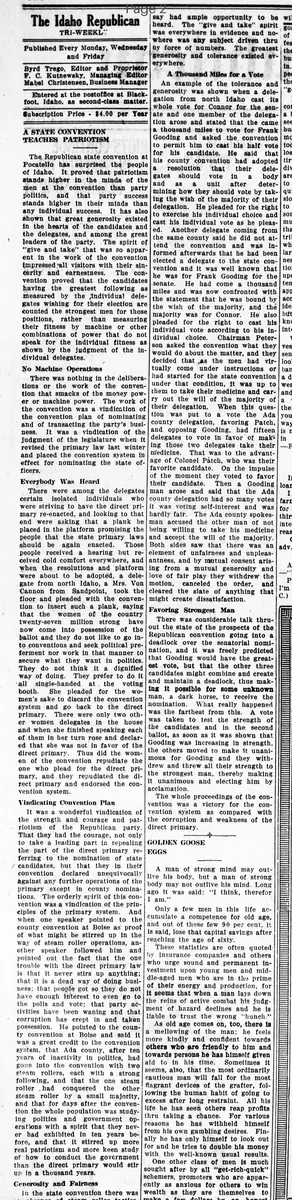
The Republican state convention at Pocatello has surprised the people of Idaho. It proved that patriotism stands higher in the minds of the men at the convention than party politics, and that party success stands higher in their minds than any individual success. It has also shown that great generosity existed in the hearts of the candidates and the delegates, and among the great leaders of the party. The spirit of "give and take" that was so apparent in the work of the convention impressed all visitors with their sincerity and earnestness. The convention proved that the candidates having the greatest following as measured by the individual delegates wishing for their election are counted the strongest men for those positions, rather than measuring their fitness by machine or other combinations of power that do not speak for the individual fitness as shown by the judgment of the individual delegates.
No Machine Operations
There was nothing in the deliberations or the work of the convention that smacks of the money power or machine power. The work of the convention was a vindication of the convention plan of nominating and of transacting the party's business. It was a vindication of the judgment of the legislature when it revised the primary law last winter and placed the convention system in effect for nominating the state officers.
Everybody Was Heard
There were among the delegates certain isolated individuals who were striving to have the direct primary re-enacted, and looking to that end were asking that a plank be placed in the platform promising the people that the state primary laws should be again enacted. Those people received a hearing but received cold comfort everywhere, and when the resolutions and platform were about to be adopted, a delegate from north Idaho, a Mrs. Von Cannon from Sandpoint, took the floor and pleaded with the convention to insert such a plank, saying that the women of the country twenty-seven million strong have now come into possession of the ballot and they do not like to go into conventions and seek political preferment nor work in that manner to secure what they want in politics. They do not think it a dignified way of doing. They prefer to do it all single-handed at the voting booth. She pleaded for the women's sake to discard the convention system and go back to the direct primary. There were only two other women delegates in the house and when she finished speaking each of them in her turn rose and declared that she was not in favor of the direct primary. Thus did the women of the convention repudiate the one who plead for the direct primary, and they repudiated the direct primary and endorsed the convention system.
Vindicating Convention Plan
It was a wonderful vindication of the strength and courage and patriotism of the Republican party. That they had the courage, not only to take a leading part in repealing the part of the direct primary referring to the nomination of state candidates, but that they in their convention declared unequivocally against any further operations of the primary except in county nominations. The orderly spirit of this convention was a vindication of the principles of the primary system. And when one speaker pointed to the county convention at Boise as proof of what might be stirred up in the way of steam roller operations, another speaker followed him and pointed out the fact that the one trouble with the direct primary law is that it never stirs up anything; that it is a dead way of doing business; that people got so they do not have enough interest to even go to the polls and vote; that party activities have been waning and that corruption has crept in and taken possession. He pointed to the county convention at Boise and said it was a great credit to the convention system, that Ada county, after ten years of inactivity in politics, had gone into the convention with two steam rollers, each with a strong following, and that the one steam roller had conquered the other steam roller by a small majority, and that for days after the convention the whole population was studying politics and government operations with a spirit that they never had exhibited in ten years before, and that it stirred up more real patriotism and more keen study of how to conduct the government than the direct primary would stir up in a thousand years.
Generosity and Fairness
In the state convention there was an absence of steam roller tactics. Everybody that had something to say had ample opportunity to be heard. The "give and take" spirit was everywhere in evidence and nowhere was any subject driven thru by force of numbers. The greatest generosity and tolerance existed everywhere.
A Thousand Miles for a Vote
An example of the tolerance and generosity was shown when a delegation from north Idaho cast its whole vote for Connor for the senate and one member of the delegation arose and stated that he came a thousand miles to vote for Frank Gooding and asked the convention to permit him to cast his half vote for his candidate. He said that his county convention had adopted a resolution that their delegates should vote in a body and as a unit after determining how they should vote by taking the wish of the majority of their delegation. He pleaded for the right to exercise his individual choice and cast his individual vote as he pleased. Another delegate coming from the same county said he did not attend the convention and was informed afterwards that he had been elected a delegate to the state convention and it was well known that he was for Frank Gooding for the Senate. He had come a thousand miles and was now confronted with the statement that he was bound by the wish of the majority, and the majority was for Connor. He also pleaded for the right to cast his individual vote according to his individual choice. Chairman Peterson asked the convention what they would do about the matter, and they decided that as the men had virtually come under instructions or had started for the state convention under that condition, it was up to them to take their medicine and carry out the will of the majority of their delegation. When this question was put to a vote the Ada county delegation, favoring Patch, and opposing Gooding, had fifteen delegates to vote in favor of making those two delegates take their medicine. That was to the advantage of Colonel Patch, who was their favorite candidate. On the impulse of the moment they voted to favor their candidate. Then a Gooding man arose and said that the Ada county delegation had so many votes it was voting self-interest and was hardly fair. The Ada county spokesman accused the other man of not being willing to take his medicine and accept the will of the majority. Both sides saw that there was an element of unfairness and unpleasantness, and by mutual consent arising from a mutual generosity and love of fair play they withdrew the motion, canceled the order, and cleared the slate of anything that might create dissatisfaction.
Favoring Strongest Man
There was considerable talk throughout the state of the prospects of the Republican convention going into a deadlock over the senatorial nomination, and it was freely predicted that Gooding would have the greatest vote, but that the other three candidates might combine and create and maintain a deadlock, thus making it possible for some unknown man, a dark horse, to receive the nomination. What really happened was the farthest from this. A vote was taken to test the strength of the candidates and in the second ballot, as soon as it was shown that Gooding was increasing in strength, the others moved to make it unanimous for Gooding and they withdrew and threw all their strength to the strongest man, thereby making it unanimous and electing him by acclamation. The whole proceedings of the convention was a victory for the convention system as compared with the corruption and weakness of the direct primary.
What sub-type of article is it?
What themes does it cover?
What keywords are associated?
What entities or persons were involved?
Where did it happen?
Story Details
Key Persons
Location
Pocatello, Idaho
Story Details
The Republican convention in Pocatello endorsed the convention system over direct primary, debated women's preferences with Mrs. Von Cannon advocating for primary but repudiated by other women delegates, showed generosity in allowing individual votes but ultimately respecting delegation majorities, and unanimously nominated Frank Gooding for Senate after ballots showed his strength.