Thank you for visiting SNEWPapers!
Sign up free
Wheeling Times And Advertiser
Wheeling, Ohio County, West Virginia
What is this article about?
This editorial contains two segments: a personal defense against attacks from the Columbus Ohio State Journal regarding past support for President Tyler, detailing evolving views on his policies like tariffs and vetoes; and a critique of Virginia's ambiguous tax law, defending Whig positions against claims of supporting repudiation.
Merged-components note: Continuation of the editorial across page 2 and 3.
Clippings
1 of 2
OCR Quality
Full Text
This is Event 2 of 2. The full text below covers all events in this component.
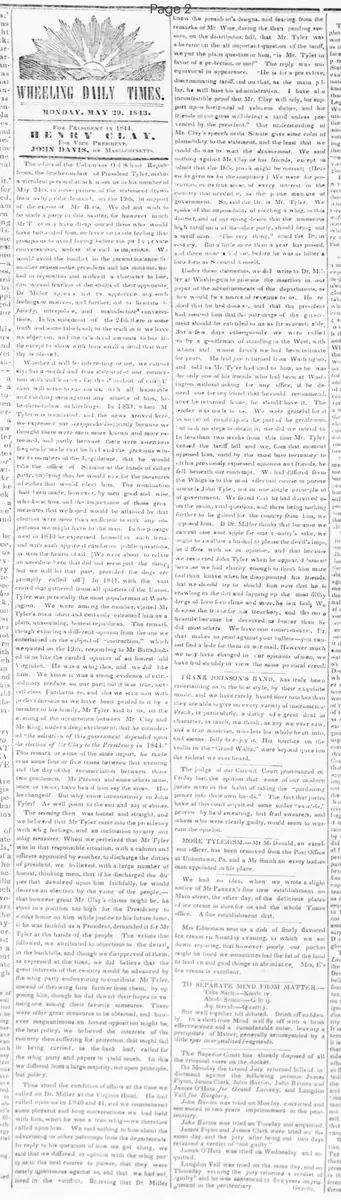
Whether it will be interesting or not, we cannot say, but a candid and true statement from our connection with Dr. Miller for the president of the union will serve to save us, with all honorable and thinking men against any attacks of him, his brother-in-law or hirelings. In 1840, when Mr. Tyler was nominated, and the news arrived here, we expressed our disapprobation; partly because we thought there were men more known and more esteemed, and partly because there were assertions frequently made that he had said the previous winter to members of the Legislature, that he would take the office of Senator at the hands of either party, implying that he would vote for the measures of either that would elect him. The nomination had been made, however, by men good and wise, who knew him, and the importance of those great measures that we hoped would be attained by that election were more than sufficient to stake any objections we might have to the man. In his passage west in 1840 he expressed himself in such terms and with such apparent candor on public questions, as won the hearts of all. [we were about to relate an anecdote here that did not seem just the thing, but we will let that pass, provided the dogs are promptly called off) In 1841, with the vast crowd that gathered from all quarters of the Union, Tyler was personally the most popular man at Washington. We were among the number, visited Mr. Tyler's room often and certainly esteemed him as a plain, unassuming, honest republican. The remark though evincing a different opinion from the one we entertained on the subject of "instruction," which we quoted on the 19th, responding to Mr. Botts, looked to us like the candid opinion of an honest old Virginian. He was a whig then, and we did like him. We know it was a strong evidence of extraordinary credulity on our part; but it was true, nevertheless. Furthermore, and this we state now with perfect fairness as we have been guided to it by a member of his family. Mr. Tyler said to us, one evening of the occurrence between Mr. Clay and Mr. King, under a deep excitement, that he considered "the salvation of this government depended upon the election of Mr. Clay to the Presidency in 1844."
This remark or some of the same import, he made to us some four or five times between that evening and the day of the reconciliation between those two gentlemen. Mr. Preston and some others must, once or twice, have heard him say the same. Has he changed? But why show inconsistency in John Tyler? As well point to the sun and say it shines. The seeming then was honest and straight, and we believed that Mr. Tyler came into the presidency with whig feelings, and an inclination to carry out whig measures. When we perceived that Mr. Tyler was in that responsible situation, with a cabinet and officers appointed by another, to discharge the duties of president, we believed, with a large number of honest, thinking men, that if he discharged those duties that devolved upon him faithfully, he would deserve an election by the voice of the people,—that however great Mr. Clay's claims might be, he stood in a position too high for the Presidency to confer honor on him while justice to his future fame, it he was faithful as a President, demanded it for Mr. Tyler at the hands of the people. The vetoes that followed, we attributed to objections to the detail in the bank bills, and though we disapproved of them, as expressed at the time, we did believe that the great interests of the country would be advanced by the whig party endeavoring to conciliate Mr. Tyler, instead of throwing him farther from them, by opposing him, though he did thwart their hopes in vetoing one among their favorite measures. There were other great measures to be obtained, and however magnanimous and honest opposition might be, the best policy, we believed the interests of the country then suffering for protection, that might fail in being carried, as the bank had, called for the whig party and papers to yield much. In this we differed from a large majority, not upon principle, but policy.
Thus stood the condition of affairs at the time we called on Dr. Miller at the Virginia Hotel. He had called upon us in 1840 and 41, and we remembered some pleasant and long conversations we had held with him, when he was a true whig—we therefore called upon him. We said nothing to him about the advertising or other patronage from the departments. In reply to his question of how we got along, we said that we differed in opinion with the whig party as to the best course to pursue, that they were nearly unanimous against us, and that we had suffered in consequence. Believing that Dr. Miller knew the president's designs, and fearing, from the remarks of Mr. Wise, during the then pending session, on the distribution bill, that Mr. Tyler was a heretic on the all important question of the tariff, we put the plain question to him. "Is Mr. Tyler in favor of protection, or not?" The reply was unequivocal in appearance. "He is for a protective, discriminating tariff, and on that, as the main pillar, he will base his administration. I have also incontestable proof that Mr. Clay will rely for support upon horizontal ad valorem duties, and his friends in Congress will defeat a tariff unless prevented by the president." Our understanding of Mr. Clay's speech in the Senate gave some color of plausibility to the statement, and the least that we could do was to wait the denouement. We said nothing against Mr. Clay or his friends, except to admit that the Dr's. prospects might be correct; (we even gave him both the simplicity) We were for protection, in its true sense, of every interest in the country that needed p., as the prime measure of government. So, said the Dr. is Mr. Tyler. We spoke of the impossibility of electing a whig, in this district, and of our strong desire that the numerous high tariff men of the other party, should bring out a tariff man. "The very thing," cried the Dr. in ecstasy. But a little more than a year has passed, and three months ago, before he was as bitter a loco foco as secured in himself.
Under these statements, we did write to Dr. Miller at Washington to procure the insertion in our paper of the advertisements of the departments, as they would be a source of revenue to us. He replied that he had done so and that the president had assured him that the patronage of the government should be extended to us as far as practicable. But a few days subsequently we were called on by a gentleman of standing in the West, with whom and whose family we had been intimate for years. He had just returned from Washington, and told us Mr. Tyler had said to him, as he was the only one of his friends who had been at Washington without asking for any office, if he desired one for any friend that he could recommend, after he returned home, he should have it. The tender was made to us. We were grateful for it as an act of friendship on the part of the gentleman, but took no steps to obtain it, nor did we intend to. In less than two weeks from this time Mr. Tyler vetoed the tariff bill and we, from that moment opposed him, until by the most base recantation to his previously expressed opinions and friends, he fell beneath our contempt. We had differed from the Whigs as to the most effectual course to pursue towards John Tyler, and in one single principle of government. We found that he had deceived us on the main, vital question, and there being nothing further to be gained for the country from him, we opposed him. If Dr. Miller thinks that because we can eat one sour apple for our country's sake, we ought to swallow a bushel to please the devil's imps, he differs with us in opinion, and that because we respected John Tyler when he appeared honest, because we had charity enough to think him more fool than knave when he disappointed his friends, that we should try to shield him now that he is crawling in the dirt and lapping up the most filthy dregs of loco foco slime and mud, he is a fool; We despise the traitor for his treachery, and the more heartily because he deceived us longer than he did most others. We have one consciousness, Dr., that makes us proof against your bullets—you cannot find a hole for them in our mail. However much we may have changed in our opinions of men, we have had steadily in view the same political creed.
Difficulty of construing them—a complexity illustrated by the fact that not only did the candidates differ as to their true intent, but the commissioners of the revenue, and even the most astute members of the legal profession, were not unfrequently puzzled to define their real meaning—a want of perspicuity glaring that already has required two circulars from the Auditor of Public Accounts to elucidate and explain some of the clauses of the law—the last of these circulars differing in some respects from the first, and, after months of deliberation, embodying rules of construction which are expressed with a hesitation and doubt fully justified by the ambiguity of the tax.
The tax law misrepresented? Where is the evidence of that? Its erroneous principles were scanned and exposed—its flagrant and oppressive inequalities were exhibited and denounced—but we have yet to see the evidence that it was generally 'misrepresented' by Whig commentators, either in the press or on the stump. That it may have been misunderstood by some of them, is probable—but that it was misunderstood by some of its champions, is clear—but surely it is not very wonderful that it should have been so when even its authors did not comprehend it themselves.
While on this subject we take occasion to add, that the position of the Whigs was, by some of their opponents, most grossly misrepresented; and the consequences of this misrepresentation are even now seen in the erroneous assumptions of editors in distant States, who regard the election as having turned on the policy of Repudiation. In other words, it is assumed that the Whigs were opposed to raising a sufficient amount of money by taxes, to meet the obligations of the State, and that their success there would have resulted in a failure to redeem and maintain the plighted faith and honor of Virginia.—No impression can be more unfounded, while we admit that, from the tenor of our opponents' arguments, it has been very naturally imbibed by those who are ignorant of the facts. The objection of the Whigs to the Tax law of the last session rested on other and more honorable grounds. They objected to it, because of the novel, unequal and oppressive principles which it embodied; and because, in our opinion, by the tax on State bonds, it sanctioned the very doctrine of repudiation, which it was the alleged object of its authors to avert. The Whigs are as decidedly in favor of maintaining the honor of the State, and of preserving its faith inviolate, as their opponents can possibly be. We will not say that they are more so—because, in this question, we are happy to believe, however widely the two parties may differ on other subjects, there is but one view in the Old Dominion.—Lynchburgh Virginian.
What sub-type of article is it?
What keywords are associated?
What entities or persons were involved?
Editorial Details
Primary Topic
Ambiguity Of Virginia Tax Law And Whig Opposition
Stance / Tone
Defensive Of Whig Position Against Misrepresentations
Key Figures
Key Arguments