Thank you for visiting SNEWPapers!
Sign up free
Story
June 28, 1865
The Potter Journal
Coudersport, Potter County, Pennsylvania
What is this article about?
The article critiques the Democratic Party's miscalculation in declaring the Civil War a failure at the 1864 Chicago convention, their initial support for President Andrew Johnson as a loyal Democrat, and subsequent abandonment when he upheld Union policies like the amnesty proclamation.
Clipping
OCR Quality
98%
Excellent
Full Text
Another Failure.
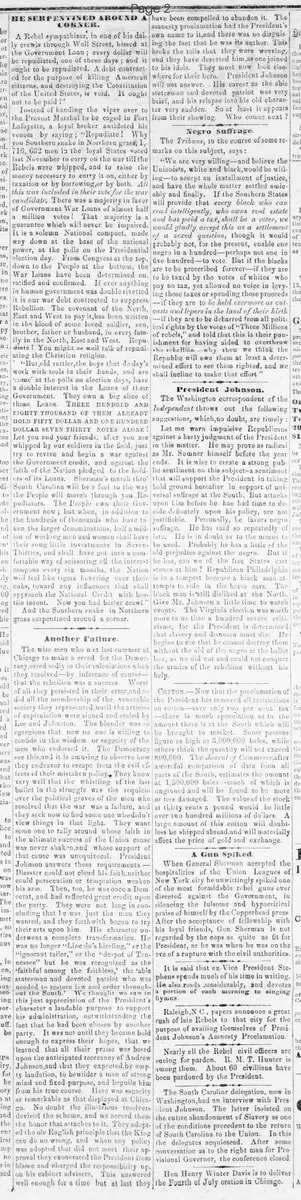
The wise men who met last summer at Chicago to make a creed for the Democracy, erred sadly in their calculations when they resolved—by inference of course—that the rebellion was a success. Worst of all they persisted in their error, and so did all the membership of the venerable society they represented, until the articles of capitulation were signed and sealed by Lee and Johnston. The blunder was so egregious that now no one is willing to confide in the wisdom or sagacity of the men who endorsed it. The Democracy see this, and it is amusing to observe how they endeavor to escape from the evil effects of their mistaken policy. They know very well that the whistling of the last bullet in the struggle was the requiem over the political graves of the men who resolved that the war was a failure, and they seek now to find some one who didn't view things in that light. They want some one to rally around whose faith in the ultimate success of the Union cause was never shaken, and whose support of that cause was unequivocal. President Johnson answers these requirements—Disaster could not cloud his faith, neither could persecution or temptation weaken his arm. Then, too, he was once a Democrat, and had reflected great credit upon the party. They were not long in concluding that he was just the man they wanted, and they forthwith began to try their arts upon him. His character underwent a complete transformation. He was no longer "Lincoln's hireling," or the "ignorant tailor," or the "despot of Tennessee" but he was recognized as the 'faithful among the faithless,' the 'able statesman and devoted patriot who was needed to restore law and order throughout the South.' We thought we saw in this just appreciation of the President's character a laudable purpose to support his administration, notwithstanding the fact that he had been chosen by another party. It was not until they became bold enough to express their hopes, that we learned that all their praise was based upon the anticipated recreancy of Andrew Johnson, and that they expected, by empty laudation, to bewilder a man of strong mind and fixed purpose, and beguile him from his true course. Here was sagacity as remarkable as that displayed at Chicago. No doubt the illustrious resolvers devised the scheme, and we accord them the honor that attaches to it. They adopted the old English principle that the King can do no wrong, and when any policy was adopted that did not meet their approval they exonerated the President from blame and charged the responsibility upon his cabinet advisers. This answered well enough for a time but at last they have been compelled to abandon it. The amnesty proclamation had the President's own name to it, and there was no disguising the fact that he was its author. This broke the toils that they were weaving and they have deserted him, as one joined to his idols. They must now look elsewhere for their hero. President Johnson will not answer. His career as the able statesman and devoted patriot was very brief, and his relapse into his old character very sudden. So at least it appears from their showing. Who comes next?
The wise men who met last summer at Chicago to make a creed for the Democracy, erred sadly in their calculations when they resolved—by inference of course—that the rebellion was a success. Worst of all they persisted in their error, and so did all the membership of the venerable society they represented, until the articles of capitulation were signed and sealed by Lee and Johnston. The blunder was so egregious that now no one is willing to confide in the wisdom or sagacity of the men who endorsed it. The Democracy see this, and it is amusing to observe how they endeavor to escape from the evil effects of their mistaken policy. They know very well that the whistling of the last bullet in the struggle was the requiem over the political graves of the men who resolved that the war was a failure, and they seek now to find some one who didn't view things in that light. They want some one to rally around whose faith in the ultimate success of the Union cause was never shaken, and whose support of that cause was unequivocal. President Johnson answers these requirements—Disaster could not cloud his faith, neither could persecution or temptation weaken his arm. Then, too, he was once a Democrat, and had reflected great credit upon the party. They were not long in concluding that he was just the man they wanted, and they forthwith began to try their arts upon him. His character underwent a complete transformation. He was no longer "Lincoln's hireling," or the "ignorant tailor," or the "despot of Tennessee" but he was recognized as the 'faithful among the faithless,' the 'able statesman and devoted patriot who was needed to restore law and order throughout the South.' We thought we saw in this just appreciation of the President's character a laudable purpose to support his administration, notwithstanding the fact that he had been chosen by another party. It was not until they became bold enough to express their hopes, that we learned that all their praise was based upon the anticipated recreancy of Andrew Johnson, and that they expected, by empty laudation, to bewilder a man of strong mind and fixed purpose, and beguile him from his true course. Here was sagacity as remarkable as that displayed at Chicago. No doubt the illustrious resolvers devised the scheme, and we accord them the honor that attaches to it. They adopted the old English principle that the King can do no wrong, and when any policy was adopted that did not meet their approval they exonerated the President from blame and charged the responsibility upon his cabinet advisers. This answered well enough for a time but at last they have been compelled to abandon it. The amnesty proclamation had the President's own name to it, and there was no disguising the fact that he was its author. This broke the toils that they were weaving and they have deserted him, as one joined to his idols. They must now look elsewhere for their hero. President Johnson will not answer. His career as the able statesman and devoted patriot was very brief, and his relapse into his old character very sudden. So at least it appears from their showing. Who comes next?
What sub-type of article is it?
Historical Event
Deception Fraud
What themes does it cover?
Deception
Misfortune
Fortune Reversal
What keywords are associated?
Democratic Party
Civil War
Andrew Johnson
Chicago Convention
Political Blunder
Amnesty Proclamation
What entities or persons were involved?
President Johnson
Lee
Johnston
Lincoln
Where did it happen?
Chicago
Story Details
Key Persons
President Johnson
Lee
Johnston
Lincoln
Location
Chicago
Event Date
Last Summer
Story Details
Democratic Party leaders at Chicago convention misjudged the Civil War's outcome, later tried to co-opt unwavering Unionist Democrat Andrew Johnson, praised him conditionally, but abandoned him after his amnesty proclamation upheld Union policy.