Thank you for visiting SNEWPapers!
Sign up free
The Enquirer
Richmond, Henrico County, Virginia
What is this article about?
In the U.S. House of Representatives on January 30, Mr. Lucas debates against validating fraudulent land claims by Georgia land companies under the 1795 act, citing deception on land quantities and other defects, opposing any compromise.
Clipping
OCR Quality
Full Text
OF THE UNITED STATES.
Wednesday, January 30.
Debate on the Georgia Claims.
(Continued.)
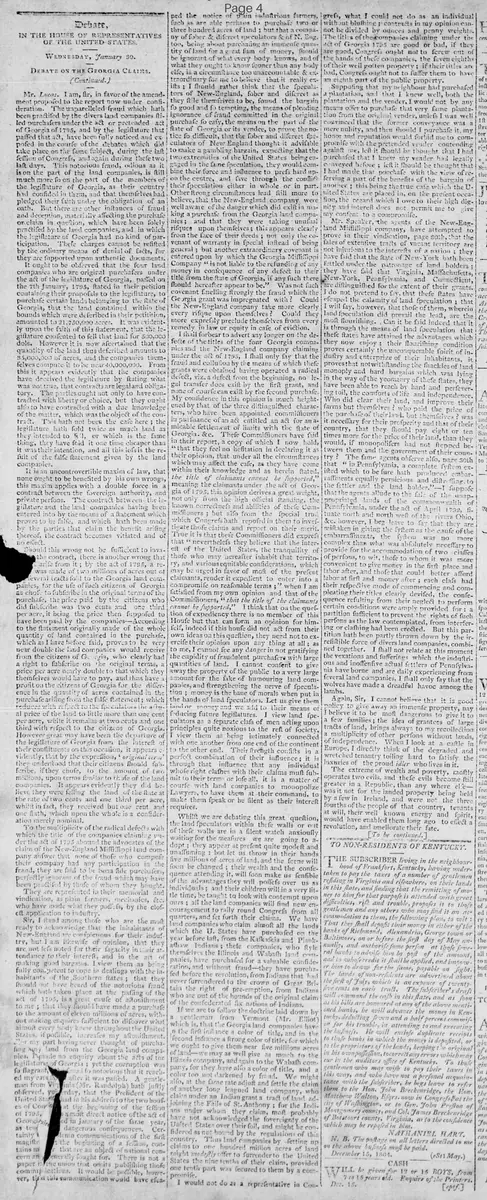
Mr. Lucas. I am, sir, in favor of the amendment proposed to the report now under consideration. The unparalleled fraud which hath been practiced by the divers land companies filled purchasers under the act or pretended act of Georgia of 1795, and by the legislature that passed that act, have been fully noticed and exposed in the course of the debates which did take place on the same subject, during the last session of Congress, and again during these two last days. This notorious fraud, odious as it is on the part of the land companies, is still much more so on the part of the members of the legislature of Georgia, as their country had confided in them, and that themselves had pledged their faith under the obligation of an oath. But there are other instances of fraud and deception, materially affecting the purchase or claim in question, which have been solely practiced by the land companies, and in which the legislature of Georgia had no kind of participation. These charges cannot be resisted by the ordinary means of denial of facts, for they are supported upon authentic documents.
It ought to be observed that the four land companies who are original purchasers under the acts of the legislature of Georgia, passed on the 7th January, 1795, stated in their petition containing their proposals to the legislature, to purchase certain lands belonging to the state of Georgia, that the land contained within the bounds which were described in their petition, amounted to 21,750,000 acres. It was evidently upon the faith of this statement, that the legislature consented to sell that land for 500,000 dols. However it is now ascertained that the quantity of the land thus described amounts to 35,000,000 of acres, and the companies themselves compute it to be near 40,000,000. From this it appears evidently that the companies have deceived the legislature by stating what was not true, that contracts are legal and obligatory. The parties ought not only to have contracted with liberty or choice, but they ought also to have contracted with a due knowledge of the matter, which was the object of the contract. This hath not been the case here: the legislature hath sold twice as much land as they intended to sell, or which is the same thing, they have sold it one time cheaper than it was their intention, and all this loss is the result of the false statement given by the land companies.
It is an incontrovertible maxim of law, that none ought to be benefited by his own wrongs, this maxim applies with a double force in a contract between the sovereign authority, and private persons. The contract between the legislature and the land companies having been entered into by the means of a statement which proves to be false, and which hath been made by the parties that claim the benefit arising thereof, the contract becomes vitiated and of no effect.
Should this wrong not be sufficient to invalidate the contract, there is another wrong that arises from it; by the act of 1795, a reservation was made of two millions of acres out of several tracts sold to the Georgia land companies, for the use of such citizens of Georgia as chose to subscribe in the original terms of the purchase, the price paid by the citizens who did subscribe was two cents and one third per acre, it being the price then supposed to have been paid by the companies--According to the statement originally made of the whole quantity of land contained in the purchase, which as I have before said, proves to be very near double the land companies would receive from the citizens of Georgia, who clearly had a right to subscribe on the original terms, a price per acre nearly double to that which they themselves would have to pay, and thus have a profit on the citizens of Georgia for the difference in the quantity of acres contained in the purchase arising from the false statement; which reduces with respect to the speculators the actual price of the land to little more than one cent per acre, while it remains at two cents and one third with respect to the citizens of Georgia.
However great may have been the departure of the legislature of Georgia from the interest of their constituents on this occasion, it appears evidently, that by the expression, 'original terms' they understood that their citizens should subscribe, if they chose, to the amount of two millions, upon terms similar to those of the land companies. It appears evidently they did believe they were selling the land of the state at the rate of two cents and one third per acre, whilst in fact, they received but one cent and one sixth, which upon the whole is a consideration merely nominal.
To the multiplicity of the radical defects with which the title of the companies claiming under the act of 1795 abound the advocates of the claim of the New-England Mississippi land company answer that none of those who compose their company had any participation in the fraud, they are said to be bona fide purchasers, perfectly ignorant of the fraud which may have been practiced by those of whom they bought. They are represented in their memorial and vindication, as plain farmers, mechanics, &c. who have made what they possess, by the closest application to industry.
Sir. I stand among those who are the most ready to acknowledge that the inhabitants of New-England are conspicuous for their industry, but I am likewise of opinion, that they are not less noted for their sagacity in their attendance to their interest, and in the art of making good bargains. I view them as being fully competent to cope in dealings with the inhabitants of the Southern states; that they should not have heard of the notorious fraud which hath taken place at the passing of the act of 1795, is a great cause of astonishment to me; that they would have made a purchase to the amount of eleven millions of acres, without making enquiries sufficient to discover what almost every body knew throughout the United States, if possible, increases my astonishment.
For my part having never thought of purchasing any land from the Georgia land companies, I made no enquiry about the acts of the legislature of Georgia; yet the corruption was so flagrant, and so notorious that it reached my ears in after it was passed. A gentleman from Virginia (Mr. Randolph) hath justly observed, yesterday, that the President of the United States had in his address to the two houses of Congress at the beginning of the session of 1795, a most direct notice of the act of Georgia passed in January of the same year, as being of dangerous consequences. Certainly condemn communications of the first magistrate at the beginning of a session, contains matters that are an object of national concern and generally sought for. There is not a paper in the union that omits publishing those communications. It would be possible, however, that this communication would have escaped the notice or plain industrious farmers such as are able perhaps to purchase two or three hundred acres of land; but that a company of sober & discreet speculators & of N. England too, being about purchasing an immense quantity of land for a great sum of money, should be ignorant of what every body knows, and of what they ought to know sooner than any body else, is a circumstance too unaccountable & extraordinary for me to believe that it really exists: I should rather think that the speculators of New-England, sober and discreet as they stile themselves to be, found the bargain so good and so tempting, the means of pleading ignorance of fraud committed in the original purchase so easy, the means on the part of the state of Georgia or its vendee, to prove the notice so difficult, that the sober and discreet speculators of New England thought it advisable to make a gambling bargain, expecting that the two extremities of the United States being engaged in the same speculation, they would combine their force and influence to press hard upon the centre, and save through the confines their speculation either in whole or in part.
Other strong circumstances lead still more to believe, that the New-England company were well aware of the danger which did exist in making a purchase from the Georgia land companies; and that they were taking unusual risques upon themselves: this appears clearly from the face of their deeds; not only the covenant of warranty in special instead of being general; but another extraordinary covenant is entered upon by which the Georgia Mississippi Company "is not liable to the refunding of any money in consequence of any defect in their title from the state of Georgia, if any such there should hereafter appear to be." Was not such covenant smelling strongly the fraud which the Georgia grant was impregnated with? Could the New-England company take more clearly every risque upon themselves? Could they more expressly preclude themselves from every remedy in law or equity in case of eviction.
I shall forbear to advert any longer on the defects of the titles of the four Georgia companies and the New-England company claiming under the act of 1795. I shall only say that the fraud and collusion by the means of which these grants were obtained having operated a radical defect, viz. a defeat from the beginning, no legal transfer does exist by the first grant, and none of course can exist by the second purchase. My confidence in this opinion is much heightened by that of the three distinguished characters, who have been appointed commissioners in pursuance of an act entitled an act for an amicable settlement of limits with the state of Georgia, &c. These Commissioners have said in their report, a copy of which I now hold, "that they feel no hesitation in declaring it as their opinion, that under all the circumstances which may affect the case, as they have come within their knowledge and as herein stated, the title of claimants cannot be supported," meaning the claimants under the act of Georgia of 1795, this opinion derives a great weight, not only from the high official standing, the known correctness and abilities of these Commissioners; but also from the special trust which Congress hath reposed in them to investigate those claims and report on their merit.
True it is that these Commissioners did express that "nevertheless they believe that the interest of the United States, the tranquility of those who may hereafter inhabit that territory, and various equitable considerations, which may be urged in favor of most of the present claimants, render it expedient to enter into a compromise on reasonable terms;" when I am satisfied from my own opinion and that of the Commissioners, "that the title of the claimants cannot be supported," I think that on the question of expediency there is no member of this House but that can form an opinion for himself, indeed if this house did not act from their own ideas on this question, they need not to exercise their opinion upon any thing at all; as to me, I cannot see any danger in not gratifying the cupidity of fraudulent purchasers with large quantities of land. I cannot consent to give away the property of the public to a very large amount for the sake of humouring land companies, and strengthening the nerve of peculation; money is the bane of morals when put in the hands of land speculators. Let us give them land or money and we add to their means of seducing future legislatures. I view land speculators as a separate class of men acting upon principles quite noxious to the rest of society. I view them as being intimately connected with one another from one end of the continent to the other end. Their strength consists in a perfect combination of their influence; it is through that influence that any individual whose right clashes with their claims must submit to their term or lose all, it is a matter of course with land companies to monopolize Lawyers, to have them at their command, to make them speak or be silent as their interest requires.
Whilst we are debating this great question the land speculators within these walls or out of these walls are in a silent watch anxiously waiting for the measures we are going to adopt; they appear at present quite modest and unassuming: but let us throw in their hands five millions of acres of land, and the scene will soon be changed; their wealth and the consequence attending it, will soon make us sensible of the advantages they will possess over us as individuals; and their children will in a very little time, be taught to look with contempt upon ours: all the land companies will find new encouragement to rally round Congress from all quarters, and set forth their claims. We have land companies who claim almost all the lands which the U. States have purchased on the year before last, from the Kaskaskia and Piankashaw Indians: these companies, who style themselves the Illinois and Wabash land companies, have purchased for a valuable consideration, and without fraud--they have purchased before the revolution, from Indians that had never surrendered to the crown of Great Britain the right of pre-emption, from Indians who are out of the bounds of the original claim of the confederated six nations of Indians.
If we are to follow the doctrine laid down by a gentleman from Vermont (Mr. Elliot) which is, that the Georgia land companies have in the first instance a color of title, and in the second instance a strong color of title, for which we ought to give them near five millions acres of land we may as well give as much to the Illinois company, and again to the Wabash company, for they have also a color of title, and a color too not darkened by fraud. We might also, at the same rate adjust and settle the claim of another long leagued land company, who claim under an Indian grant a tract of land adjoining the Falls of St. Anthony; for the Indians under whom they claim, most probably have not acknowledged the sovereignty of the United States over their soil, and might be considered as not bound by the regulations of this country. Thus land companies by setting up claims to one hundred million acres of land might modestly offer to surrender to the United States the nine tenths of their claim, provided one tenth part was secured to them by a compromise.
I would not do as a representative in Congress, what I could not do as an individual without blushing; contracts in my opinion cannot be divided by ounces and penny weights. The titles of the companies claiming under the act of Georgia 1795 are good or bad, if they are good, Congress ought not to screw out of the hands of these companies, the seven eighths of their well gotten property; if their titles are bad, Congress ought not to suffer them to have an eighth part of the public property.
Supposing that my neighbour had purchased a plantation, and that I knew well, both the plantation and the vender. I would not by any means offer to purchase that very same plantation from the original vender, unless I was well convinced that the former conveyance was a mere nullity, and then should I purchase it, my honor and reputation would forbid me to compromise with the pretended vender contending against me, lest it should be thought that I had purchased that I knew my vender had illegally conveyed before: lest it should be thought that I had made that purchase with the view of reserving a part of the benefits of the bargain of another: this being the true case which the United States are placed in, on the present occasion, the regard which I owe to their high dignity and interest does not permit me to give my consent to a compromise.
Mr. Speaker, the agents of the New-England Mississippi company, have attempted to prove in their vindication, page 50th, that the sales of extensive tracts of vacant territory are not injurious to the interests of a nation; they have said that the state of New-York hath been settled under the patronage of land holders; they have said that Virginia, Massachusetts, New-York, Pennsylvania, and Connecticut, are distinguished for the extent of their grants.
I do not pretend to say, that these states have escaped the calamity of land speculation: that I will say however, that those of them, wherein land speculation did prevail the least, are the most flourishing. Can it be said indeed that it is through the means of land speculation that these states have attained the advantages which they now enjoy: their flourishing condition proves certainly the unconquerable spirit of industry and enterprise of their inhabitants, it proves that notwithstanding the shackles of land monopoly and hard bargains which was lying in the way of the yeomanry of these states, they have been able to reach by hard and persevering toil, the comforts of life and independence.
Who did clear their land, and improve their farms but themselves? who paid the price of the purchase of their land, but themselves? was it necessary for their prosperity and that of their country, that they should pay eight or ten times more for the price of their land, than they would, if monopolizers had not stepped between them and the government of their country? The same agents observe also, page 50th that "in Pennsylvania, a complete system existed which to be sure hath produced embarrassments equally pernicious and distressing, to the settler and the land holder."--I suppose that the agents allude to the sale of the unappropriated lands of the commonwealth of Pennsylvania, under the act of April 1792, situate north and north west of the rivers Ohio, &c. however, I beg leave to say that they are mistaken in giving the system as the cause of the embarrassments, the system was no more complex than what was absolutely necessary to provide for the accommodation of two classes of persons, to wit, those to whom it was more convenient to give money in the first place and labor after, and those that could better afford labor at first and money after: each class had their respective mode of commencing and completing their titles clearly devised, the consequence resulting from their neglect to perform certain conditions were amply provided for: a partition sufficient to prevent the rights of such persons as the law contemplated, from interfering or clashing had been erected. But this partition hath been partly thrown down by the irresistible force of divers land companies, combined together. I shall not relate at this moment the vexations and sufferings which the industrious and inoffensive actual settlers of Pennsylvania have borne and are daily experiencing from several land companies, I shall only say that the wolves have made a dreadful havoc among the lambs.
Again, Sir, I cannot believe that it is good policy to give away an immense property, nay I believe it to be most dangerous to give it to a few families; the idea of grantees of large tracts of land, brings always to my recollection a multiplicity of other persons without lands, of independence. When I look at a castle in Europe, I directly think of the degraded and wretched tenantry toiling hard to satisfy the luxuries of the proud idler who lives in it.
The extreme of wealth and poverty, mostly operates two evils, and these evils become still greater in a Republic, than any where else--was it not for the landed property being held by a few in Ireland, and were not the three fourths of the people of that country, tenants at will, their well known energy and spirit, would have enabled them long ago to effect a revolution, and ameliorate their fate.
[To be continued.]
What sub-type of article is it?
What keywords are associated?
What entities or persons were involved?
Where did it happen?
Domestic News Details
Primary Location
United States House Of Representatives
Event Date
Wednesday, January 30.
Key Persons
Outcome
ongoing debate; mr. lucas opposes compromise, arguing titles are invalid due to fraud; no resolution in this segment.
Event Details
Mr. Lucas argues in favor of an amendment against the Georgia land claims, detailing fraud by land companies in misstating land quantities to the Georgia legislature in 1795, invalidating contracts; criticizes New-England company's claimed ignorance; cites commissioners' opinion that titles cannot be supported; warns against compromising public lands to speculators.