Thank you for visiting SNEWPapers!
Sign up free
Poem
October 8, 1835
Virginia Free Press
Charles Town, Jefferson County, West Virginia
What is this article about?
Biographical note on Charles Wolf, author of 'Burial of Sir John Moore', introducing his unfinished elegiac song 'Stanzas' mourning the death of Mary, composed for the Irish air 'Gramachree', with last lines possibly by Dr. James Stuart.
Clipping
OCR Quality
98%
Excellent
Full Text
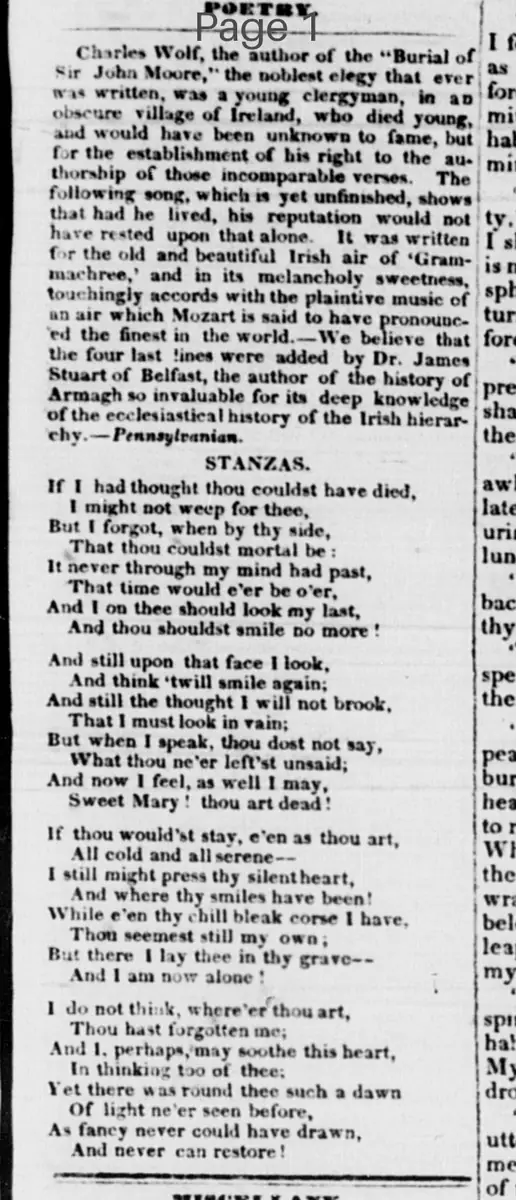
Charles Wolf, the author of the "Burial of Sir John Moore," the noblest elegy that ever was written, was a young clergyman, in an obscure village of Ireland, who died young, and would have been unknown to fame, but for the establishment of his right to the authorship of those incomparable verses. The following song, which is yet unfinished, shows that had he lived, his reputation would not have rested upon that alone. It was written for the old and beautiful Irish air of 'Gramachree,' and in its melancholy sweetness, touchingly accords with the plaintive music of an air which Mozart is said to have pronounced the finest in the world. We believe that the four last lines were added by Dr. James Stuart of Belfast, the author of the history of Armagh so invaluable for its deep knowledge of the ecclesiastical history of the Irish hierarchy. — Pennsylvanian.
STANZAS.
If I had thought thou couldst have died,
I might not weep for thee;
But I forgot, when by thy side,
That thou couldst mortal be:
It never through my mind had past,
That time would e'er be o'er.
And I on thee should look my last,
And thou shouldst smile no more.
And still upon that face I look,
And think 'twill smile again;
And still the thought I will not brook,
That I must look in vain:
But when I speak, thou dost not say,
What thou ne'er left'st unsaid;
And now I feel, as well I may,
Sweet Mary! thou art dead!
If thou would'st stay, e'en as thou art,
All cold and all serene—
I still might press thy silent heart,
And where thy smiles have been!
While e'en thy chill bleak corse I have,
Thou seemest still my own;
But there I lay thee in thy grave—
And I am now alone.
I do not think, where'er thou art,
Thou hast forgotten me;
And I, perhaps, may soothe this heart,
In thinking too of thee:
Yet there was round thee such a dawn
Of light ne'er seen before,
As fancy never could have drawn,
And never can restore!
STANZAS.
If I had thought thou couldst have died,
I might not weep for thee;
But I forgot, when by thy side,
That thou couldst mortal be:
It never through my mind had past,
That time would e'er be o'er.
And I on thee should look my last,
And thou shouldst smile no more.
And still upon that face I look,
And think 'twill smile again;
And still the thought I will not brook,
That I must look in vain:
But when I speak, thou dost not say,
What thou ne'er left'st unsaid;
And now I feel, as well I may,
Sweet Mary! thou art dead!
If thou would'st stay, e'en as thou art,
All cold and all serene—
I still might press thy silent heart,
And where thy smiles have been!
While e'en thy chill bleak corse I have,
Thou seemest still my own;
But there I lay thee in thy grave—
And I am now alone.
I do not think, where'er thou art,
Thou hast forgotten me;
And I, perhaps, may soothe this heart,
In thinking too of thee:
Yet there was round thee such a dawn
Of light ne'er seen before,
As fancy never could have drawn,
And never can restore!
What sub-type of article is it?
Elegy
Song
What themes does it cover?
Death Mourning
Love Courtship
What keywords are associated?
Charles Wolf
Burial Sir John Moore
Elegy Mary
Gramachree
Death Mourning
Irish Air
What entities or persons were involved?
Charles Wolf (Four Last Lines By Dr. James Stuart)
Poem Details
Title
Stanzas.
Author
Charles Wolf (Four Last Lines By Dr. James Stuart)
Subject
Mourning The Death Of Mary
Form / Style
Written For The Irish Air 'Gramachree'
Key Lines
If I Had Thought Thou Couldst Have Died,
Sweet Mary! Thou Art Dead!
But There I Lay Thee In Thy Grave—
And I Am Now Alone.
Yet There Was Round Thee Such A Dawn
Of Light Ne'er Seen Before,