Thank you for visiting SNEWPapers!
Sign up free
Story
February 19, 1950
Atlanta Daily World
Atlanta, Fulton County, Georgia
What is this article about?
Charles D. Proctor, a 27-year-old Negro scientist at Loyola University, reports promising results from experiments with phenol sulfadiazine, a sulfa compound that saved 71 of 90 mice infected with polio, compared to only 1 untreated control. Next tests on monkeys and dogs planned in Chicago.
Clipping
OCR Quality
95%
Excellent
Full Text
SCIENTIST
DEVELOPS
DRUG
TO
FIGHT
POLIO
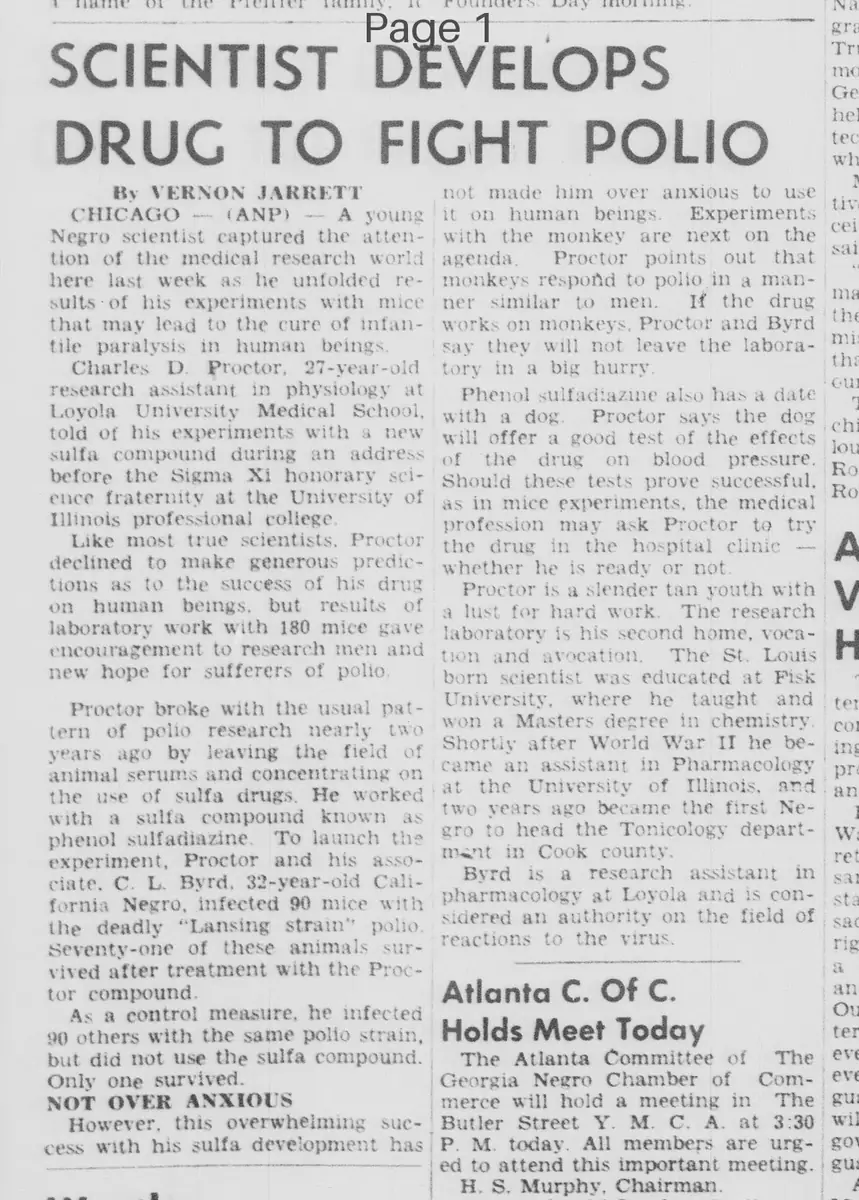
CHICAGO -(ANP)- A young Negro scientist captured the attention of the medical research world here last week as he unfolded results of his experiments with a drug that may lead to the cure of infantile paralysis in human beings.
Charles D. Proctor, 27-year-old research assistant in physiology at Loyola University Medical School told of his experiments with a new sulfa compound during an address before the Sigma Xi honorary science fraternity at the University of Illinois professional college.
Like most true scientists, Proctor declined to make generous predictions as to the success of his drug on human beings, but results of laboratory work with 180 mice gave encouragement to research men and new hope for sufferers of polio.
Proctor broke with the usual pattern of polio research nearly two years ago by leaving the field of animal serums and concentrating on the use of sulfa drugs. He worked with a sulfa compound known as phenol sulfadiazine. To launch the experiment, Proctor and his associate, C. L. Byrd, 32-year-old California Negro, infected 90 mice with the deadly "Lansing strain" polio.
Seventy-one of these animals survived after treatment with the Proctor compound.
As a control measure, he infected 90 others with the same polio strain, but did not use the sulfa compound. Only one survived.
NOT OVER ANXIOUS
However, this overwhelming success with his sulfa development has not made him over anxious to use it on human beings. Experiments with the monkey are next on the agenda.
Proctor points out that monkeys respond to polio in a manner similar to men. If the drug works on monkeys, Proctor and Byrd say they will not leave the laboratory in a big hurry.
Phenol sulfadiazine also has a date with a dog. Proctor says the dog will offer a good test of the effects of the drug on blood pressure.
Should these tests prove successful, as in mice experiments, the medical profession may ask Proctor to try the drug in the hospital clinic - whether he is ready or not.
Proctor is a slender tan youth with a lust for hard work. The research laboratory is his second home, vocation and avocation. The St. Louis born scientist was educated at Fisk University, where he taught and won a Masters degree in chemistry.
Shortly after World War II he became an assistant in Pharmacology at the University of Illinois, and two years ago became the first Negro to head the Toxicology department in Cook County.
Byrd is a research assistant in pharmacology at Loyola and is considered an authority on the field of reactions to the virus.
DEVELOPS
DRUG
TO
FIGHT
POLIO
CHICAGO -(ANP)- A young Negro scientist captured the attention of the medical research world here last week as he unfolded results of his experiments with a drug that may lead to the cure of infantile paralysis in human beings.
Charles D. Proctor, 27-year-old research assistant in physiology at Loyola University Medical School told of his experiments with a new sulfa compound during an address before the Sigma Xi honorary science fraternity at the University of Illinois professional college.
Like most true scientists, Proctor declined to make generous predictions as to the success of his drug on human beings, but results of laboratory work with 180 mice gave encouragement to research men and new hope for sufferers of polio.
Proctor broke with the usual pattern of polio research nearly two years ago by leaving the field of animal serums and concentrating on the use of sulfa drugs. He worked with a sulfa compound known as phenol sulfadiazine. To launch the experiment, Proctor and his associate, C. L. Byrd, 32-year-old California Negro, infected 90 mice with the deadly "Lansing strain" polio.
Seventy-one of these animals survived after treatment with the Proctor compound.
As a control measure, he infected 90 others with the same polio strain, but did not use the sulfa compound. Only one survived.
NOT OVER ANXIOUS
However, this overwhelming success with his sulfa development has not made him over anxious to use it on human beings. Experiments with the monkey are next on the agenda.
Proctor points out that monkeys respond to polio in a manner similar to men. If the drug works on monkeys, Proctor and Byrd say they will not leave the laboratory in a big hurry.
Phenol sulfadiazine also has a date with a dog. Proctor says the dog will offer a good test of the effects of the drug on blood pressure.
Should these tests prove successful, as in mice experiments, the medical profession may ask Proctor to try the drug in the hospital clinic - whether he is ready or not.
Proctor is a slender tan youth with a lust for hard work. The research laboratory is his second home, vocation and avocation. The St. Louis born scientist was educated at Fisk University, where he taught and won a Masters degree in chemistry.
Shortly after World War II he became an assistant in Pharmacology at the University of Illinois, and two years ago became the first Negro to head the Toxicology department in Cook County.
Byrd is a research assistant in pharmacology at Loyola and is considered an authority on the field of reactions to the virus.
What sub-type of article is it?
Medical Curiosity
Personal Triumph
Biography
What themes does it cover?
Triumph
Recovery
What keywords are associated?
Polio Research
Sulfa Drug
Mouse Experiments
Phenol Sulfadiazine
Medical Breakthrough
What entities or persons were involved?
Charles D. Proctor
C. L. Byrd
Where did it happen?
Chicago
Story Details
Key Persons
Charles D. Proctor
C. L. Byrd
Location
Chicago
Story Details
Charles D. Proctor experiments with phenol sulfadiazine show 71 of 90 polio-infected mice survive treatment, versus 1 of 90 untreated; next tests on monkeys and dogs before human trials.