Thank you for visiting SNEWPapers!
Sign up free
Literary
October 28, 1825
The National Republican And Ohio Political Register
Cincinnati, Hamilton County, Ohio
What is this article about?
In a letter dated July 29, 1825, from Castleton, the author describes a visit to Haddon Hall, an ancient preserved manor of the Vernons and Rutlands, detailing its rooms, furniture, and history, evoking feudal life. He then tours Chatsworth, the Duke of Devonshire's lavish estate where Mary Queen of Scots was imprisoned, critiquing its extravagance and social implications.
Clipping
OCR Quality
98%
Excellent
Full Text
From the New-York Statesman.
LETTERS FROM EUROPE.
NO. XVI.
Castleton, 29th of July, 1825.
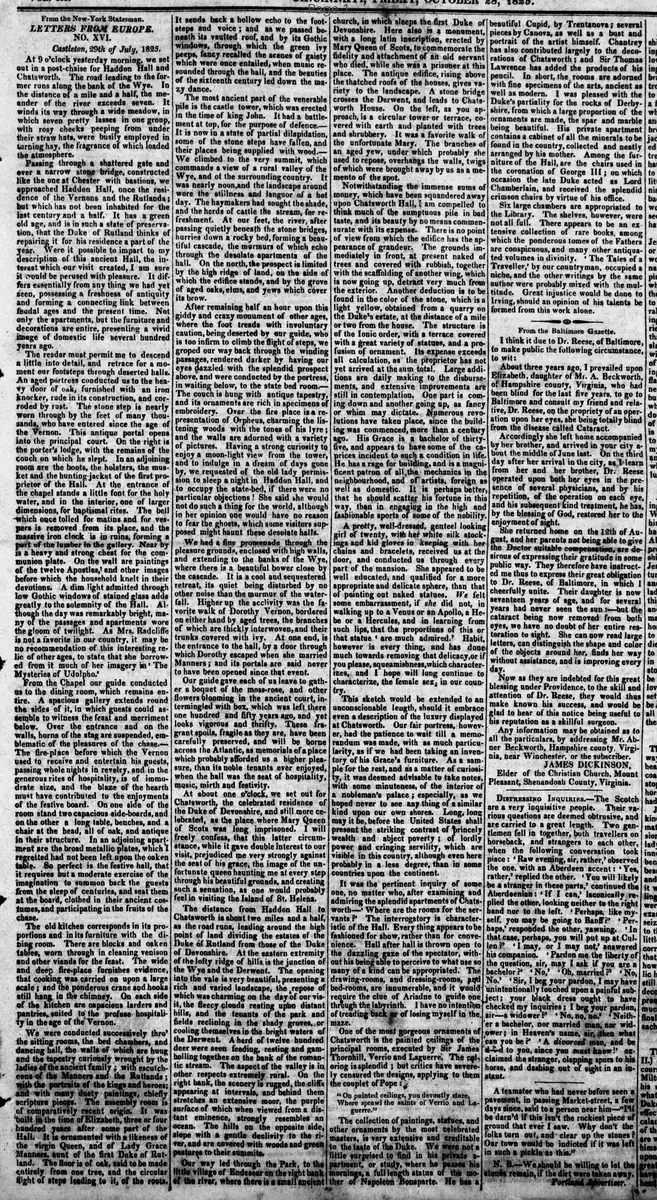
At 9 o'clock yesterday morning, we set out in a post-chaise for Haddon Hall and Chatsworth. The road leading to the former runs along the bank of the Wye. In the distance of a mile and a half, the meander of the river exceeds seven. It winds its way through a wide meadow, in which seven pretty lasses in one group, with rosy cheeks peeping from under their straw hats, were busily employed in turning hay, the fragrance of which loaded the atmosphere.
Passing through a shattered gate and over a narrow stone bridge, constructed like the one at Chester with bastions, we approached Haddon Hall, once the residence of the Vernons and the Rutlands; but which has not been inhabited for the last century and a half. It has a green old age, and is in such a state of preservation, that the Duke of Rutland thinks of repairing it for his residence a part of the year. Were it possible to impart to my description of this ancient Hall, the interest which our visit created, I am sure it would be perused with pleasure. It differs essentially from any thing we had yet seen, possessing a freshness of antiquity and forming a connecting link between feudal ages and the present time. Not only the apartments, but the furniture and decorations are entire, presenting a vivid image of domestic life several hundred years ago.
The reader must permit me to descend a little into detail, and retrace for a moment our footsteps through deserted halls. An aged portress conducted us to the heavy door of oak, furnished with an iron knocker, rude in its construction, and corroded by rust. The stone step is nearly worn through by the feet of many thousands, who have entered since the age of the Vernon. This antique portal opens into the principal court. On the right is the porter's lodge, with the remains of the couch on which he slept. In an adjoining room are the boots, the holsters, the musket and the hunting-jacket of the first proprietor of the Hall. At the entrance of the chapel stands a little font for the holy water, and in the interior, one of larger dimensions for baptismal rites. The bell which once tolled for matins and for vespers is removed from its place, and the massive iron clock is in ruins, forming a part of the lumber in the gallery. Near by is a heavy and strong chest for the communion plate. On the wall are paintings of the twelve Apostles, and other images before which the household knelt in their devotions. A dim light admitted through low Gothic windows of stained glass adds greatly to the solemnity of the Hall. Although the day was remarkably bright, many of the passages and apartments wore the gloom of twilight. As Mrs. Radcliffe is not a favorite in our country, it may be no recommendation of this interesting relic of other ages, to state that she borrowed from it much of her imagery in 'The Mysteries of Udolpho.'
From the Chapel our guide conducted us to the dining room, which remains entire. A spacious gallery extends round the sides of it, in which guests could assemble to witness the feast and merriment below. Over the entrance and on the walls, horns of the stag are suspended, emblematic of the pleasures of the chase. The fire-place before which the Vernon used to receive and entertain his guests, passing whole nights in revelry, and in the generous rites of hospitality, is of moderate size, and the blaze of the hearth must have contributed to the enjoyments of the festive board. On one side of the room stand two capacious side-boards, and on the other a long table, benches, and a chair at the head, all of oak, and antique in their structure. In an adjoining apartment are the broad metallic plates, which I regretted had not been left upon the oaken table. So perfect is the festive hall, that it requires but a moderate exercise of the imagination to summon back the guests from the sleep of centuries, and seat them at the board, clothed in their ancient costumes, and participating in the fruits of the chase.
The old kitchen corresponds in its proportions and in its furniture with the dining room. There are blocks and oaken tables, worn through in cleaning venison and other viands for the feast. The wide and deep fire place furnishes evidence, that cooking was carried on upon a large scale; and the ponderous crane and hooks still hang in the chimney. On each side of the kitchen are capacious larders and pantries, suited to the profuse hospitality in the age of the Vernon.
We were conducted successively through the sitting rooms, the bed chambers, and dancing hall, the walls of which are hung and the tapestry curiously wrought by the ladies of the ancient family; with escutcheons of the Manners and the Rutlands; with the portraits of the kings and heroes; and with many dusty paintings, chiefly scripture pieces. The assembly room is of comparatively recent origin. It was built in the time of Elizabeth, three or four hundred years after some part of the Hall. It is ornamented with a likeness of the virgin Queen, and of Lady Grace Manners, aunt of the first Duke of Rutland. The floor is of oak, said to be made entirely from one tree, and the circular flight of steps leading to it, of the roots.
It sends back a hollow echo to the footsteps and voice; and as we passed beneath its vaulted roof, and by its Gothic windows, through which the green ivy peeps, fancy recalled the scenes of gaiety which were once enacted, when music resounded through the hall, and the beauties of the sixteenth century led down the mazy dance.
The most ancient part of the venerable pile is the castle tower, which was erected in the time of king John. It had a battlement at top, for the purpose of defence. It is now in a state of partial dilapidation, some of the stone steps have fallen, and their places being supplied with wood. We climbed to the very summit, which commands a view of a rural valley of the Wye, and of the surrounding country. It was nearly noon, and the landscape around wore the stillness and languor of a hot day. The haymakers had sought the shade, and the herds of cattle the stream, or refreshment. At our feet, the river, after passing quietly beneath the stone bridges, hurries down a rocky bed, forming a beautiful cascade, the murmurs of which echo through the desolate apartments of the hall. On the north, the prospect is limited by the high ridge of land, on the side of which the edifice stands, and by the grove of aged oaks, elms, and yews which cover its brow.
After remaining half an hour upon this giddy and crazy monument of other ages, where the foot treads with involuntary caution, being deserted by our guide, who is too infirm to climb the flight of steps, we groped our way back through the winding passages, rendered darker by having our eyes dazzled with the splendid prospect above, and were conducted by the portress, in waiting below, to the state bed room. The couch is hung with antique tapestry, and its ornaments are rich in specimens of embroidery. Over the fire place is a representation of Orpheus, charming the listening woods with the tones of his lyre; and the walls are adorned with a variety of pictures. Having a strong curiosity to enjoy a moon-light view from the tower, and to indulge in a dream of days gone by, we requested of the old lady permission to sleep a night in Haddon Hall, and to occupy the state-bed, if there were no particular objections! She said she would not do such a thing for the world, although in her opinion one would have no reason to fear the ghosts, which some visitors supposed might haunt these desolate halls.
We had a fine promenade through the pleasure grounds, enclosed with high walls, and extending to the banks of the Wye, where there is a beautiful bower close by the cascade. It is a cool and sequestered retreat, its quiet being disturbed by no other noise than the murmur of the water-fall. Higher up the acclivity was the favorite walk of Dorothy Vernon, bordered on either hand by aged trees, the branches of which are thickly interwove, and their trunks covered with ivy. At one end, is the entrance to the hall, by a door through which Dorothy escaped when she married Manners; and its portals are said never to have been opened since that event.
Our guide gave each of us leave to gather a bouquet of the moss-rose, and other flowers blooming in the ancient court, intermingled with box, which was left there one hundred and fifty years ago, and yet looks vigorous and thrifty. These fragrant spoils, fragile as they are, have been carefully preserved, and will be borne across the Atlantic, as memorials of a place which probably afforded us a higher pleasure, than its noble tenants ever enjoyed, when the hall was the seat of hospitality, music, mirth and festivity.
At about one o'clock, we set out for Chatsworth, the celebrated residence of the Duke of Devonshire, and still more celebrated, as the place where Mary Queen of Scots was long imprisoned. I will freely confess, that this latter circumstance, while it gave double interest to our visit, prejudiced me very strongly against the seat of his grace; the image of the unfortunate queen haunting me at every step through his beautiful grounds, and creating such a sensation, as one would probably feel in visiting the Island of St. Helena.
The distance from Haddon Hall to Chatsworth is about two miles and a half, as the road runs, leading around the high point of land dividing the estates of the Duke of Rutland from those of the Duke of Devonshire. At the eastern extremity of the lofty ridge of hills, is the junction of the Wye and the Derwent. The opening into the vale is very beautiful, presenting a rich and varied landscape, the repose of which was charming on the day of our visit, the fleecy clouds resting upon distant hills, and the tenants of the park and fields reclining in the shady groves, or cooling themselves in the bright waters of the Derwent. A herd of twelve hundred deer were seen feeding, resting and gambolling together on the bank of the romantic stream. The aspect of the valley is in other respects extremely rural. On the right bank, the scenery is rugged, the cliffs appearing at intervals, and behind them stretches an extensive moor, the purple surface of which when viewed from a distant eminence, strongly resembles an ocean. The hills on the opposite side, slope with a gentle declivity to the river, and are covered with woods and green pastures to their summits.
Our way led through the Park, to the little village of Edensor on the right bank of the river, where there is a small ancient church, in which sleeps the first Duke of Devonshire. Here also is a monument, with a long latin inscription, erected by Mary Queen of Scots, to commemorate the fidelity and attachment of an old servant who died, while she was a prisoner at this place. The antique edifice, rising above the thatched roofs of the houses, gives variety to the landscape. A stone bridge crosses the Derwent, and leads to Chatsworth House. On the left, as you approach, is a circular tower or terrace, covered with earth and planted with trees and shrubbery. It was a favorite walk of the unfortunate Mary. The branches of an aged yew, under which probably she used to repose, overhangs the walls, twigs of which were brought away by us as a memento of the spot.
Notwithstanding the immense sums of money, which have been squandered away upon Chatsworth Hall, I am compelled to think much of the sumptuous pile in bad taste, and its beauty by no means commensurate with its expense. There is no point of view from which the edifice has the appearance of grandeur. The grounds immediately in front, at present naked of trees and covered with rubbish, together with the scaffolding of another wing, which is now going up, detract very much from the exterior. Another deduction is to be found in the color of the stone, which is a light yellow, obtained from a quarry on the Duke's estate, at the distance of a mile or two from the house. The structure is of the Ionic order, with a terrace covered with a great variety of statues, and a profusion of ornament. Its expense exceeds all calculation, as the proprietor has not yet arrived at the sum total. Large additions are daily making to the disbursements, and extensive improvements are still in contemplation. One part is coming down and another going up, as fancy or whim may dictate. Numerous revolutions have taken place, since the building was commenced, more than a century ago. His Grace is a bachelor of thirty-five, and appears to have some of the caprices incident to such a condition in life. He has a rage for building, and is a magnificent patron of all the mechanics in the neighbourhood, and of artists, foreign as well as domestic. It is perhaps better that he should scatter his fortune in this way, than in engaging in the high and fashionable sports of some of the nobility.
A pretty, well-dressed, genteel looking girl of twenty, with her white silk stockings and kid gloves in keeping with her chains and bracelets, received us at the door, and conducted us through every part of the mansion. She appeared to be well educated, and qualified for a more appropriate and delicate sphere, than that of pointing out naked statues. We felt some embarrassment, if she did not, in walking up to a Venus or an Apollo, a Hebe or a Hercules, and in learning from such lips, that the proportions of this or that statue 'are much admired. Habit, however is every thing, and has done much towards removing that delicacy, or if you please, squeamishness, which characterizes, and I hope will long continue to characterize, the female sex, in our country.
This sketch would be extended to an unconscionable length, should it embrace even a description of the luxury displayed at Chatsworth. Our fair portress, however, had the patience to wait till a memorandum was made, with as much particularity, as if we had been taking an inventory of his Grace's furniture. As a sample for the rest, and as a matter of curiosity, it was deemed advisable to take notes, with some minuteness, of the interior of a nobleman's palace; especially, as we hoped never to see any thing of a similar kind upon our own shores. Long, long may it be, before the United States shall present the striking contrast of princely wealth and abject poverty; of lordly power and cringing servility, which are visible in this country, although even here probably in a less degree, than in some countries upon the continent.
It was the pertinent inquiry of some one, no matter who, after examining and admiring the splendid apartments of Chatsworth—Where are the rooms for the servants? The interrogatory is characteristic of the Hall. Every thing appears to be fashioned for show, rather than for convenience. Hall after hall is thrown open to the dazzling gaze of the spectator, without his being able to perceive to what use so many of a kind can be appropriated. The drawing-rooms, and dressing-rooms, and bed-rooms, are innumerable, and it would require the clue of Ariadne to guide one through the labyrinth. I have no intention of treading back or of losing myself in the maze.
One of the most gorgeous ornaments of Chatsworth is the painted ceilings of the principal rooms, executed by Sir James Thornhill, Verrio and Laguerre. The coloring is splendid; but critics have severely censured the designs, applying to them the couplet of Pope:
"On painted ceilings, you devoutly stare.
Where sprawl the saints of Verrio and Laguerre."
The collection of paintings, statues, and other ornaments by the most celebrated masters, is very extensive and creditable to the taste of the Duke. We were not a little surprised to find in his private apartment, or study, where he passes his mornings, a full length statue of the mother of Napoleon Bonaparte. He has a beautiful Cupid, by Canova, as well as a bust and portrait of the artist himself. Chantrey has also contributed largely to the decorations of Chatsworth: and Sir Thomas Lawrence has added the products of his pencil. In short, the rooms are adorned with fine specimens of the arts, ancient as well as modern. I was pleased with the Duke's partiality for the rocks of Derbyshire, from which a large proportion of the ornaments are made, the spar and marble being beautiful. His private apartment contains a cabinet of all the minerals to be found in the country, collected and neatly arranged by his mother. Among the furniture of the Hall, are the chairs used in the coronation of George III; on which occasion the late Duke acted as Lord Chamberlain, and received the splendid crimson chairs by virtue of his office.
Six large chambers are appropriated to the Library. The shelves, however, were not all full. There appears to be an extensive collection of rare books, among which the ponderous tomes of the Fathers are conspicuous, and many other antiquated volumes in divinity. The 'Tales of a Traveller,' by our countryman, occupied a niche, and the other writings by the same author were probably mixed with the multitude. Great injustice would be done to Irving, should an opinion of his talents be formed from this work alone.
LETTERS FROM EUROPE.
NO. XVI.
Castleton, 29th of July, 1825.
At 9 o'clock yesterday morning, we set out in a post-chaise for Haddon Hall and Chatsworth. The road leading to the former runs along the bank of the Wye. In the distance of a mile and a half, the meander of the river exceeds seven. It winds its way through a wide meadow, in which seven pretty lasses in one group, with rosy cheeks peeping from under their straw hats, were busily employed in turning hay, the fragrance of which loaded the atmosphere.
Passing through a shattered gate and over a narrow stone bridge, constructed like the one at Chester with bastions, we approached Haddon Hall, once the residence of the Vernons and the Rutlands; but which has not been inhabited for the last century and a half. It has a green old age, and is in such a state of preservation, that the Duke of Rutland thinks of repairing it for his residence a part of the year. Were it possible to impart to my description of this ancient Hall, the interest which our visit created, I am sure it would be perused with pleasure. It differs essentially from any thing we had yet seen, possessing a freshness of antiquity and forming a connecting link between feudal ages and the present time. Not only the apartments, but the furniture and decorations are entire, presenting a vivid image of domestic life several hundred years ago.
The reader must permit me to descend a little into detail, and retrace for a moment our footsteps through deserted halls. An aged portress conducted us to the heavy door of oak, furnished with an iron knocker, rude in its construction, and corroded by rust. The stone step is nearly worn through by the feet of many thousands, who have entered since the age of the Vernon. This antique portal opens into the principal court. On the right is the porter's lodge, with the remains of the couch on which he slept. In an adjoining room are the boots, the holsters, the musket and the hunting-jacket of the first proprietor of the Hall. At the entrance of the chapel stands a little font for the holy water, and in the interior, one of larger dimensions for baptismal rites. The bell which once tolled for matins and for vespers is removed from its place, and the massive iron clock is in ruins, forming a part of the lumber in the gallery. Near by is a heavy and strong chest for the communion plate. On the wall are paintings of the twelve Apostles, and other images before which the household knelt in their devotions. A dim light admitted through low Gothic windows of stained glass adds greatly to the solemnity of the Hall. Although the day was remarkably bright, many of the passages and apartments wore the gloom of twilight. As Mrs. Radcliffe is not a favorite in our country, it may be no recommendation of this interesting relic of other ages, to state that she borrowed from it much of her imagery in 'The Mysteries of Udolpho.'
From the Chapel our guide conducted us to the dining room, which remains entire. A spacious gallery extends round the sides of it, in which guests could assemble to witness the feast and merriment below. Over the entrance and on the walls, horns of the stag are suspended, emblematic of the pleasures of the chase. The fire-place before which the Vernon used to receive and entertain his guests, passing whole nights in revelry, and in the generous rites of hospitality, is of moderate size, and the blaze of the hearth must have contributed to the enjoyments of the festive board. On one side of the room stand two capacious side-boards, and on the other a long table, benches, and a chair at the head, all of oak, and antique in their structure. In an adjoining apartment are the broad metallic plates, which I regretted had not been left upon the oaken table. So perfect is the festive hall, that it requires but a moderate exercise of the imagination to summon back the guests from the sleep of centuries, and seat them at the board, clothed in their ancient costumes, and participating in the fruits of the chase.
The old kitchen corresponds in its proportions and in its furniture with the dining room. There are blocks and oaken tables, worn through in cleaning venison and other viands for the feast. The wide and deep fire place furnishes evidence, that cooking was carried on upon a large scale; and the ponderous crane and hooks still hang in the chimney. On each side of the kitchen are capacious larders and pantries, suited to the profuse hospitality in the age of the Vernon.
We were conducted successively through the sitting rooms, the bed chambers, and dancing hall, the walls of which are hung and the tapestry curiously wrought by the ladies of the ancient family; with escutcheons of the Manners and the Rutlands; with the portraits of the kings and heroes; and with many dusty paintings, chiefly scripture pieces. The assembly room is of comparatively recent origin. It was built in the time of Elizabeth, three or four hundred years after some part of the Hall. It is ornamented with a likeness of the virgin Queen, and of Lady Grace Manners, aunt of the first Duke of Rutland. The floor is of oak, said to be made entirely from one tree, and the circular flight of steps leading to it, of the roots.
It sends back a hollow echo to the footsteps and voice; and as we passed beneath its vaulted roof, and by its Gothic windows, through which the green ivy peeps, fancy recalled the scenes of gaiety which were once enacted, when music resounded through the hall, and the beauties of the sixteenth century led down the mazy dance.
The most ancient part of the venerable pile is the castle tower, which was erected in the time of king John. It had a battlement at top, for the purpose of defence. It is now in a state of partial dilapidation, some of the stone steps have fallen, and their places being supplied with wood. We climbed to the very summit, which commands a view of a rural valley of the Wye, and of the surrounding country. It was nearly noon, and the landscape around wore the stillness and languor of a hot day. The haymakers had sought the shade, and the herds of cattle the stream, or refreshment. At our feet, the river, after passing quietly beneath the stone bridges, hurries down a rocky bed, forming a beautiful cascade, the murmurs of which echo through the desolate apartments of the hall. On the north, the prospect is limited by the high ridge of land, on the side of which the edifice stands, and by the grove of aged oaks, elms, and yews which cover its brow.
After remaining half an hour upon this giddy and crazy monument of other ages, where the foot treads with involuntary caution, being deserted by our guide, who is too infirm to climb the flight of steps, we groped our way back through the winding passages, rendered darker by having our eyes dazzled with the splendid prospect above, and were conducted by the portress, in waiting below, to the state bed room. The couch is hung with antique tapestry, and its ornaments are rich in specimens of embroidery. Over the fire place is a representation of Orpheus, charming the listening woods with the tones of his lyre; and the walls are adorned with a variety of pictures. Having a strong curiosity to enjoy a moon-light view from the tower, and to indulge in a dream of days gone by, we requested of the old lady permission to sleep a night in Haddon Hall, and to occupy the state-bed, if there were no particular objections! She said she would not do such a thing for the world, although in her opinion one would have no reason to fear the ghosts, which some visitors supposed might haunt these desolate halls.
We had a fine promenade through the pleasure grounds, enclosed with high walls, and extending to the banks of the Wye, where there is a beautiful bower close by the cascade. It is a cool and sequestered retreat, its quiet being disturbed by no other noise than the murmur of the water-fall. Higher up the acclivity was the favorite walk of Dorothy Vernon, bordered on either hand by aged trees, the branches of which are thickly interwove, and their trunks covered with ivy. At one end, is the entrance to the hall, by a door through which Dorothy escaped when she married Manners; and its portals are said never to have been opened since that event.
Our guide gave each of us leave to gather a bouquet of the moss-rose, and other flowers blooming in the ancient court, intermingled with box, which was left there one hundred and fifty years ago, and yet looks vigorous and thrifty. These fragrant spoils, fragile as they are, have been carefully preserved, and will be borne across the Atlantic, as memorials of a place which probably afforded us a higher pleasure, than its noble tenants ever enjoyed, when the hall was the seat of hospitality, music, mirth and festivity.
At about one o'clock, we set out for Chatsworth, the celebrated residence of the Duke of Devonshire, and still more celebrated, as the place where Mary Queen of Scots was long imprisoned. I will freely confess, that this latter circumstance, while it gave double interest to our visit, prejudiced me very strongly against the seat of his grace; the image of the unfortunate queen haunting me at every step through his beautiful grounds, and creating such a sensation, as one would probably feel in visiting the Island of St. Helena.
The distance from Haddon Hall to Chatsworth is about two miles and a half, as the road runs, leading around the high point of land dividing the estates of the Duke of Rutland from those of the Duke of Devonshire. At the eastern extremity of the lofty ridge of hills, is the junction of the Wye and the Derwent. The opening into the vale is very beautiful, presenting a rich and varied landscape, the repose of which was charming on the day of our visit, the fleecy clouds resting upon distant hills, and the tenants of the park and fields reclining in the shady groves, or cooling themselves in the bright waters of the Derwent. A herd of twelve hundred deer were seen feeding, resting and gambolling together on the bank of the romantic stream. The aspect of the valley is in other respects extremely rural. On the right bank, the scenery is rugged, the cliffs appearing at intervals, and behind them stretches an extensive moor, the purple surface of which when viewed from a distant eminence, strongly resembles an ocean. The hills on the opposite side, slope with a gentle declivity to the river, and are covered with woods and green pastures to their summits.
Our way led through the Park, to the little village of Edensor on the right bank of the river, where there is a small ancient church, in which sleeps the first Duke of Devonshire. Here also is a monument, with a long latin inscription, erected by Mary Queen of Scots, to commemorate the fidelity and attachment of an old servant who died, while she was a prisoner at this place. The antique edifice, rising above the thatched roofs of the houses, gives variety to the landscape. A stone bridge crosses the Derwent, and leads to Chatsworth House. On the left, as you approach, is a circular tower or terrace, covered with earth and planted with trees and shrubbery. It was a favorite walk of the unfortunate Mary. The branches of an aged yew, under which probably she used to repose, overhangs the walls, twigs of which were brought away by us as a memento of the spot.
Notwithstanding the immense sums of money, which have been squandered away upon Chatsworth Hall, I am compelled to think much of the sumptuous pile in bad taste, and its beauty by no means commensurate with its expense. There is no point of view from which the edifice has the appearance of grandeur. The grounds immediately in front, at present naked of trees and covered with rubbish, together with the scaffolding of another wing, which is now going up, detract very much from the exterior. Another deduction is to be found in the color of the stone, which is a light yellow, obtained from a quarry on the Duke's estate, at the distance of a mile or two from the house. The structure is of the Ionic order, with a terrace covered with a great variety of statues, and a profusion of ornament. Its expense exceeds all calculation, as the proprietor has not yet arrived at the sum total. Large additions are daily making to the disbursements, and extensive improvements are still in contemplation. One part is coming down and another going up, as fancy or whim may dictate. Numerous revolutions have taken place, since the building was commenced, more than a century ago. His Grace is a bachelor of thirty-five, and appears to have some of the caprices incident to such a condition in life. He has a rage for building, and is a magnificent patron of all the mechanics in the neighbourhood, and of artists, foreign as well as domestic. It is perhaps better that he should scatter his fortune in this way, than in engaging in the high and fashionable sports of some of the nobility.
A pretty, well-dressed, genteel looking girl of twenty, with her white silk stockings and kid gloves in keeping with her chains and bracelets, received us at the door, and conducted us through every part of the mansion. She appeared to be well educated, and qualified for a more appropriate and delicate sphere, than that of pointing out naked statues. We felt some embarrassment, if she did not, in walking up to a Venus or an Apollo, a Hebe or a Hercules, and in learning from such lips, that the proportions of this or that statue 'are much admired. Habit, however is every thing, and has done much towards removing that delicacy, or if you please, squeamishness, which characterizes, and I hope will long continue to characterize, the female sex, in our country.
This sketch would be extended to an unconscionable length, should it embrace even a description of the luxury displayed at Chatsworth. Our fair portress, however, had the patience to wait till a memorandum was made, with as much particularity, as if we had been taking an inventory of his Grace's furniture. As a sample for the rest, and as a matter of curiosity, it was deemed advisable to take notes, with some minuteness, of the interior of a nobleman's palace; especially, as we hoped never to see any thing of a similar kind upon our own shores. Long, long may it be, before the United States shall present the striking contrast of princely wealth and abject poverty; of lordly power and cringing servility, which are visible in this country, although even here probably in a less degree, than in some countries upon the continent.
It was the pertinent inquiry of some one, no matter who, after examining and admiring the splendid apartments of Chatsworth—Where are the rooms for the servants? The interrogatory is characteristic of the Hall. Every thing appears to be fashioned for show, rather than for convenience. Hall after hall is thrown open to the dazzling gaze of the spectator, without his being able to perceive to what use so many of a kind can be appropriated. The drawing-rooms, and dressing-rooms, and bed-rooms, are innumerable, and it would require the clue of Ariadne to guide one through the labyrinth. I have no intention of treading back or of losing myself in the maze.
One of the most gorgeous ornaments of Chatsworth is the painted ceilings of the principal rooms, executed by Sir James Thornhill, Verrio and Laguerre. The coloring is splendid; but critics have severely censured the designs, applying to them the couplet of Pope:
"On painted ceilings, you devoutly stare.
Where sprawl the saints of Verrio and Laguerre."
The collection of paintings, statues, and other ornaments by the most celebrated masters, is very extensive and creditable to the taste of the Duke. We were not a little surprised to find in his private apartment, or study, where he passes his mornings, a full length statue of the mother of Napoleon Bonaparte. He has a beautiful Cupid, by Canova, as well as a bust and portrait of the artist himself. Chantrey has also contributed largely to the decorations of Chatsworth: and Sir Thomas Lawrence has added the products of his pencil. In short, the rooms are adorned with fine specimens of the arts, ancient as well as modern. I was pleased with the Duke's partiality for the rocks of Derbyshire, from which a large proportion of the ornaments are made, the spar and marble being beautiful. His private apartment contains a cabinet of all the minerals to be found in the country, collected and neatly arranged by his mother. Among the furniture of the Hall, are the chairs used in the coronation of George III; on which occasion the late Duke acted as Lord Chamberlain, and received the splendid crimson chairs by virtue of his office.
Six large chambers are appropriated to the Library. The shelves, however, were not all full. There appears to be an extensive collection of rare books, among which the ponderous tomes of the Fathers are conspicuous, and many other antiquated volumes in divinity. The 'Tales of a Traveller,' by our countryman, occupied a niche, and the other writings by the same author were probably mixed with the multitude. Great injustice would be done to Irving, should an opinion of his talents be formed from this work alone.
What sub-type of article is it?
Essay
Journey Narrative
What themes does it cover?
Nature
Social Manners
Political
What keywords are associated?
Travel Letter
Haddon Hall
Chatsworth
Duke Of Devonshire
Mary Queen Of Scots
Vernon Family
Rutland
Derbyshire
Feudal Architecture
Aristocratic Luxury
What entities or persons were involved?
From The New York Statesman
Literary Details
Title
Letters From Europe. No. Xvi.
Author
From The New York Statesman
Subject
Description Of Visits To Haddon Hall And Chatsworth
Key Lines
It Differs Essentially From Any Thing We Had Yet Seen, Possessing A Freshness Of Antiquity And Forming A Connecting Link Between Feudal Ages And The Present Time.
So Perfect Is The Festive Hall, That It Requires But A Moderate Exercise Of The Imagination To Summon Back The Guests From The Sleep Of Centuries, And Seat Them At The Board, Clothed In Their Ancient Costumes, And Participating In The Fruits Of The Chase.
I Will Freely Confess, That This Latter Circumstance, While It Gave Double Interest To Our Visit, Prejudiced Me Very Strongly Against The Seat Of His Grace; The Image Of The Unfortunate Queen Haunting Me At Every Step Through His Beautiful Grounds.
Long, Long May It Be, Before The United States Shall Present The Striking Contrast Of Princely Wealth And Abject Poverty; Of Lordly Power And Cringing Servility, Which Are Visible In This Country.
"On Painted Ceilings, You Devoutly Stare. Where Sprawl The Saints Of Verrio And Laguerre."