Thank you for visiting SNEWPapers!
Sign up free
Story
March 20, 1895
The Morning News
Savannah, Chatham County, Georgia
What is this article about?
Savannah city council increases monthly appropriation to the hospital from $300 to $400 after a conference with county commissioners and hospital managers, who presented financial needs due to reduced income and rising costs for charity patients.
Clipping
OCR Quality
95%
Excellent
Full Text
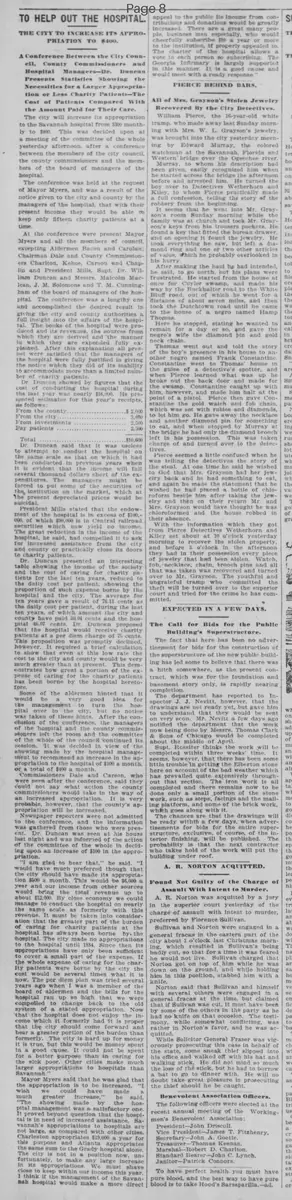
TO HELP OUT THE HOSPITAL.
THE CITY TO INCREASE ITS APPROPRIATION TO $400.
A Conference Between the City Council, County Commissioners and Hospital Managers—Dr. Duncan Presents Statistics Showing the Necessities for a Larger Appropriation or Less Charity Patients—The Cost of Patients Compared With the Amount Paid for Their Care.
The city will increase its appropriation to the Savannah hospital from $300 monthly to $400. This was decided upon at a meeting of the committee of the whole yesterday afternoon, after a conference between the members of the city council, the county commissioners and the members of the board of managers of the hospital.
The conference was held at the request of Mayor Myers, and was a result of the notice given to the city and county by the managers of the hospital, that with their present income they would be able to keep only fifteen charity patients at a time.
At the conference were present Mayor Myers and all the members of council, excepting Aldermen Bacon and Carolan, Chairman Dale and County Commissioners Charlton, Kehoe, Carson and Chaplin and President Mills, Supt. Dr. William Duncan and Messrs. Malcolm Maclean, J. M. Solomons and T. M. Cunningham of the board of managers of the hospital. The conference was a lengthy one and accomplished the desired result in giving the city and county authorities a full insight into the affairs of the hospital. The books of the hospital were produced and its revenues, the sources from which they are derived and the manner in which they are expended fully explained. After this explanation all present were satisfied that the managers of the hospital were fully justified in giving the notice which they did of its inability to accommodate more than a limited number of charity patients.
Dr. Duncan showed by figures that the cost of conducting the hospital during the last year was nearly $16,000. He presented estimates for this year's receipts, as follows:
From the county ................................ $2,000
From the city .................................. 3,600
From investments ............................... 2,500
Pay patients ................................... 2,500
Total ........................................ $10,600
Dr. Duncan said that it was useless to attempt to conduct the hospital on the same scale as that on which it had been conducted in previous years when it is evident that the income will fall several thousand dollars short of the expenditures. The managers might be forced to put some of the securities of the institution on the market, which at the present depreciated prices would be suicidal.
President Mills stated that the endowment of the hospital is in excess of $100,000, of which $90,000 is in Central railroad securities which now yield no income. The great reduction in the income of the hospital, he said, had compelled it to ask for increased assistance from the city and county or practically close its doors to charity patients.
Dr. Duncan presented an interesting table showing the income of the society and the cost of caring for charity patients for the last ten years, reduced to the daily cost per patient, showing the proportion of such expense borne by the hospital and the city. The average for ten years gave a result of 76.11 cents as the daily cost per patient, during the last ten years, of which amount the city and county have paid 30.04 cents and the hospital 46.07 cents. Dr. Duncan proposed that the hospital would receive charity patients at a per diem charge of 75 cents. This proposition was promptly declined, however. It required a brief calculation to show that even at this low rate the cost to the city and county would be very much greater than at present. This demonstrates how great a portion of the expense of caring for the charity patients has been borne by the hospital heretofore.
Some of the aldermen hinted that it would be a very good idea for the management to turn the hospital over to the city, but no notice was taken of these hints. After the conclusion of the conference, the managers of the hospital and the county commissioners left the room and the committee of the whole of the council continued its session. It was decided in view of the showing made by the hospital management to recommend an increase in the appropriation to the hospital of $100 a month, or a total of $400 a month.
Commissioners Dale and Carson, who were seen after the conference, said they could not say what action the county commissioners would take in the way of an increased appropriation. It is very probable, however, that the county's appropriation will be increased.
Newspaper reporters were not admitted to the conference, and the information was gathered from those who were present. Dr. Duncan was seen at his house last night and was informed of the action of the committee of the whole in deciding upon an increase of $100 in the appropriation.
"I am glad to hear that," he said. "I would have much preferred though that the city should have made its appropriation $500 a month. This would be $6,000 a year and our income from other sources would bring the total revenue up to about $12,000. By close economy we could manage to conduct the hospital on nearly the same scale as formerly with this revenue. It must be taken into consideration that the greater part of the burden of caring for charity patients at the hospital has always been borne by the hospital. The city made no appropriations to the hospital until 1884. Since then its appropriations have only been sufficient to cover a small part of the expense. If the whole expense of caring for the charity patients were borne by the city the cost would be several times what it is now. The per diem plan was tried several years ago when I was a member of the board of aldermen and the bills for the hospital ran up so high that we were compelled to change back to the old system of a stated appropriation. Now that the hospital does not enjoy the income which it formerly had it is proper that the city should come forward and bear a greater portion of the burden than formerly. The city is hard up for money it is true, but this would be money spent in a good cause. It could not be spent for a better purpose than in caring for the sick poor. Other cities make much larger appropriations to hospitals than Savannah."
Mayor Myers said that he was glad that the appropriation is to be increased. "I wish we could have made a much greater increase," he said. "The showing made by the hospital management was a satisfactory one. It proved beyond question that the hospital is in need of increased assistance. Savannah's appropriations to hospitals are not large, as compared with other cities. Charleston appropriates $19,000 a year for this purpose and Atlanta appropriates the same sum to the Grady hospital alone. The city is not in a position now, unfortunately, to make any large increase in its appropriations. We must shave close to keep within our income this year. I think if the management of the Savannah hospital would make a more direct appeal to the public its income from contributions and donations would be greatly increased. There are a great many people, business men especially, who would cheerfully subscribe $50 a year or more to the institution, if properly appealed to. The charter of the hospital allows a vote to each person so subscribing. The Georgia Infirmary is largely supported in this manner. It is a good cause and would meet with a ready response."
THE CITY TO INCREASE ITS APPROPRIATION TO $400.
A Conference Between the City Council, County Commissioners and Hospital Managers—Dr. Duncan Presents Statistics Showing the Necessities for a Larger Appropriation or Less Charity Patients—The Cost of Patients Compared With the Amount Paid for Their Care.
The city will increase its appropriation to the Savannah hospital from $300 monthly to $400. This was decided upon at a meeting of the committee of the whole yesterday afternoon, after a conference between the members of the city council, the county commissioners and the members of the board of managers of the hospital.
The conference was held at the request of Mayor Myers, and was a result of the notice given to the city and county by the managers of the hospital, that with their present income they would be able to keep only fifteen charity patients at a time.
At the conference were present Mayor Myers and all the members of council, excepting Aldermen Bacon and Carolan, Chairman Dale and County Commissioners Charlton, Kehoe, Carson and Chaplin and President Mills, Supt. Dr. William Duncan and Messrs. Malcolm Maclean, J. M. Solomons and T. M. Cunningham of the board of managers of the hospital. The conference was a lengthy one and accomplished the desired result in giving the city and county authorities a full insight into the affairs of the hospital. The books of the hospital were produced and its revenues, the sources from which they are derived and the manner in which they are expended fully explained. After this explanation all present were satisfied that the managers of the hospital were fully justified in giving the notice which they did of its inability to accommodate more than a limited number of charity patients.
Dr. Duncan showed by figures that the cost of conducting the hospital during the last year was nearly $16,000. He presented estimates for this year's receipts, as follows:
From the county ................................ $2,000
From the city .................................. 3,600
From investments ............................... 2,500
Pay patients ................................... 2,500
Total ........................................ $10,600
Dr. Duncan said that it was useless to attempt to conduct the hospital on the same scale as that on which it had been conducted in previous years when it is evident that the income will fall several thousand dollars short of the expenditures. The managers might be forced to put some of the securities of the institution on the market, which at the present depreciated prices would be suicidal.
President Mills stated that the endowment of the hospital is in excess of $100,000, of which $90,000 is in Central railroad securities which now yield no income. The great reduction in the income of the hospital, he said, had compelled it to ask for increased assistance from the city and county or practically close its doors to charity patients.
Dr. Duncan presented an interesting table showing the income of the society and the cost of caring for charity patients for the last ten years, reduced to the daily cost per patient, showing the proportion of such expense borne by the hospital and the city. The average for ten years gave a result of 76.11 cents as the daily cost per patient, during the last ten years, of which amount the city and county have paid 30.04 cents and the hospital 46.07 cents. Dr. Duncan proposed that the hospital would receive charity patients at a per diem charge of 75 cents. This proposition was promptly declined, however. It required a brief calculation to show that even at this low rate the cost to the city and county would be very much greater than at present. This demonstrates how great a portion of the expense of caring for the charity patients has been borne by the hospital heretofore.
Some of the aldermen hinted that it would be a very good idea for the management to turn the hospital over to the city, but no notice was taken of these hints. After the conclusion of the conference, the managers of the hospital and the county commissioners left the room and the committee of the whole of the council continued its session. It was decided in view of the showing made by the hospital management to recommend an increase in the appropriation to the hospital of $100 a month, or a total of $400 a month.
Commissioners Dale and Carson, who were seen after the conference, said they could not say what action the county commissioners would take in the way of an increased appropriation. It is very probable, however, that the county's appropriation will be increased.
Newspaper reporters were not admitted to the conference, and the information was gathered from those who were present. Dr. Duncan was seen at his house last night and was informed of the action of the committee of the whole in deciding upon an increase of $100 in the appropriation.
"I am glad to hear that," he said. "I would have much preferred though that the city should have made its appropriation $500 a month. This would be $6,000 a year and our income from other sources would bring the total revenue up to about $12,000. By close economy we could manage to conduct the hospital on nearly the same scale as formerly with this revenue. It must be taken into consideration that the greater part of the burden of caring for charity patients at the hospital has always been borne by the hospital. The city made no appropriations to the hospital until 1884. Since then its appropriations have only been sufficient to cover a small part of the expense. If the whole expense of caring for the charity patients were borne by the city the cost would be several times what it is now. The per diem plan was tried several years ago when I was a member of the board of aldermen and the bills for the hospital ran up so high that we were compelled to change back to the old system of a stated appropriation. Now that the hospital does not enjoy the income which it formerly had it is proper that the city should come forward and bear a greater portion of the burden than formerly. The city is hard up for money it is true, but this would be money spent in a good cause. It could not be spent for a better purpose than in caring for the sick poor. Other cities make much larger appropriations to hospitals than Savannah."
Mayor Myers said that he was glad that the appropriation is to be increased. "I wish we could have made a much greater increase," he said. "The showing made by the hospital management was a satisfactory one. It proved beyond question that the hospital is in need of increased assistance. Savannah's appropriations to hospitals are not large, as compared with other cities. Charleston appropriates $19,000 a year for this purpose and Atlanta appropriates the same sum to the Grady hospital alone. The city is not in a position now, unfortunately, to make any large increase in its appropriations. We must shave close to keep within our income this year. I think if the management of the Savannah hospital would make a more direct appeal to the public its income from contributions and donations would be greatly increased. There are a great many people, business men especially, who would cheerfully subscribe $50 a year or more to the institution, if properly appealed to. The charter of the hospital allows a vote to each person so subscribing. The Georgia Infirmary is largely supported in this manner. It is a good cause and would meet with a ready response."
What sub-type of article is it?
Historical Event
What themes does it cover?
Misfortune
Triumph
What keywords are associated?
Hospital Funding
Savannah Hospital
City Appropriation
Charity Patients
Financial Conference
Dr Duncan Statistics
What entities or persons were involved?
Mayor Myers
Dr. William Duncan
President Mills
Chairman Dale
County Commissioners Charlton
Kehoe
Carson
Chaplin
Aldermen Bacon
Carolan
Malcolm Maclean
J. M. Solomons
T. M. Cunningham
Where did it happen?
Savannah
Story Details
Key Persons
Mayor Myers
Dr. William Duncan
President Mills
Chairman Dale
County Commissioners Charlton
Kehoe
Carson
Chaplin
Aldermen Bacon
Carolan
Malcolm Maclean
J. M. Solomons
T. M. Cunningham
Location
Savannah
Event Date
Yesterday Afternoon
Story Details
Conference between city council, county commissioners, and hospital managers results in city increasing monthly appropriation to Savannah hospital from $300 to $400 due to financial shortfalls and need for more charity patient support; Dr. Duncan presents costs and statistics showing hospital's burden.