Thank you for visiting SNEWPapers!
Sign up free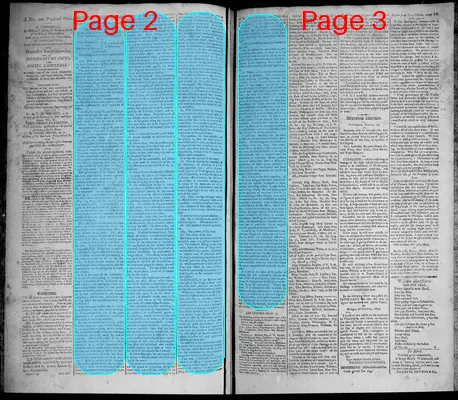
Alexandria Advertiser And Commercial Intelligencer
Alexandria, Virginia
What is this article about?
Excerpt from Chief Justice Marshall's 1803 Supreme Court opinion in Marbury v. Madison, arguing that Marbury has a legal right to his justice of the peace commission, violated by the Secretary of State, and that U.S. laws provide a remedy, including mandamus, as the government is one of laws, not men.
Merged-components note: These two components are a continuation of the same Supreme Court opinion on Mandamus, split across pages 2 and 3, with sequential reading order; merge into one coherent story.
Clippings
1 of 2
OCR Quality
Full Text
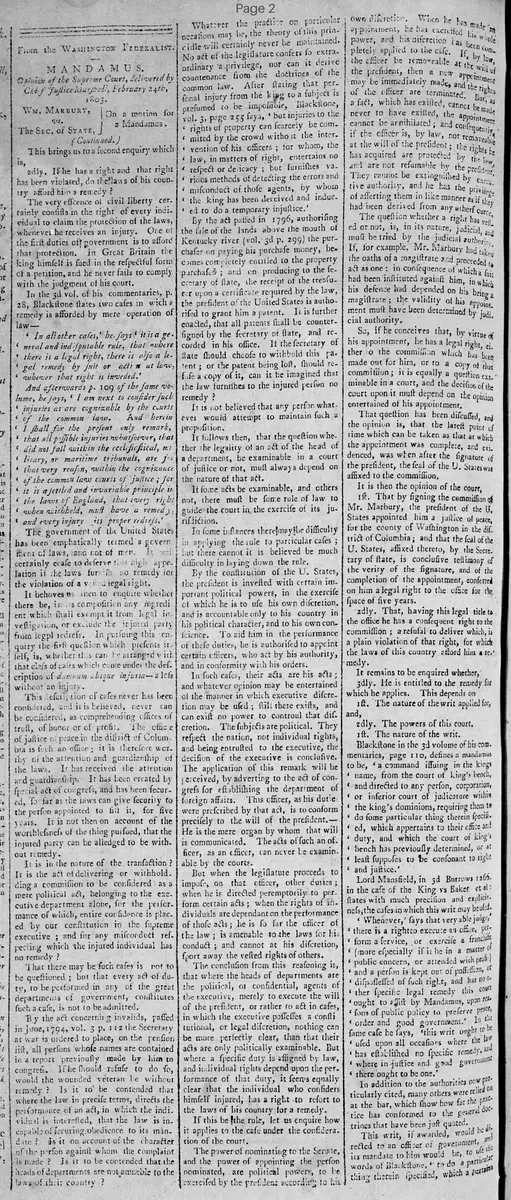
MANDAMUS.
Opinion of the Supreme Court, delivered by
Chief Justice Marshall, February 24th,
1803.
WM. MARBURY,
On a motion for
a Mandamus.
vs.
The Sec. of State,
(Continued.)
This brings us to a second enquiry which is,
2dly. If he has a right and that right has been violated, do the laws of his country afford him a remedy?
The very essence of civil liberty certainly consists in the right of every individual to claim the protection of the laws, whenever he receives an injury. One of the first duties of government is to afford that protection. In Great Britain the king himself is sued in the respectful form of a petition, and he never fails to comply with the judgment of his court.
In the 3d vol. of his commentaries, p. 28, Blackstone states two cases in which a remedy is afforded by mere operation of law--
In all other cases,' he says 'it is a general and indisputable rule, that where there is a legal right, there is also a legal remedy by suit or action at law, whenever that right is invaded.'
And afterwards p. 109 of the same volume, he says, 'I am next to consider such injuries as are cognizable by the courts of the common law. And herein I shall for the present only remark, that all possible injuries whatsoever, that did not fall within the ecclesiastical, military, or maritime tribunals, are for that very reason, within the cognizance of the common law courts of justice; for it is a settled and invariable principle in the laws of England, that every right when withheld, must have a remedy: and every injury: its proper redress.'
The government of the United States has been emphatically termed a government of laws, and not of men. It will certainly cease to deserve this high appellation if the laws furnish no remedy for the violation of a vested legal right.
It behoves us then to enquire whether there be, in its composition any ingredient which shall exempt it from legal investigation, or exclude the injured party from legal redress. In pursuing this enquiry the first question which presents itself, is, whether this can be arranged with that class of cases which come under the description of damnum absque injuria--a loss without an injury.
This description of cases never has been considered, and it is believed, never can be considered, as comprehending offices of trust, of honor or of profit. The office of justice of peace in the district of Columbia is such an office; it is therefore worthy of the attention and guardianship of the laws. It has received the attention and guardianship. It has been created by special act of congress, and has been secured, so far as the laws can give security to the person appointed to fill it, for five years. It is not then on account of the worthlessness of the thing pursued, that the injured party can be alleged to be without remedy.
It is in the nature of the transaction? It is the act of delivering or withholding a commission to be considered as a mere political act, belonging to the executive department alone, for the performance of which, entire confidence is placed by our constitution in the supreme executive; and for any misconduct respecting which the injured individual has no remedy?
That there may be such cases is not to be questioned; but that every act of duty, to be performed in any of the great departments of government, constitutes such a case, is not to be admitted.
By the act concerning invalids, passed in June, 1794, vol. 3 p. 112 the Secretary at war is ordered to place, on the pension list, all persons whose names are contained in a report previously made by him to congress. If he should refuse to do so, would the wounded veteran be without remedy? Is it to be contended that where the law in precise terms, directs the performance of an act, in which the individual is interested, that the law is incapable of securing obedience to its mandate? is it on account of the character of the person against whom the complaint is made? Is it to be contended that the heads of departments are not amenable to the laws of their country?
Whatever the practice on particular occasions may be, the theory of this principle will certainly never be maintained. No act of the legislature confers so extraordinary a privilege, nor can it derive countenance from the doctrines of the common law. After stating that personal injury from the king to a subject is presumed to be impossible, Blackstone, vol. 3, page 255 says, 'but injuries to the rights of property can scarcely be committed by the crown without the intervention of its officers; for whom, the law, in matters of right, entertains no respect or delicacy; but furnishes various methods of detecting the errors and misconduct of those agents, by whom the king has been deceived and induced to do a temporary injustice.'
By the act passed in 1796, authorizing the sale of the lands above the mouth of Kentucky river (vol. 3d p. 299) the purchaser on paying his purchase money, becomes completely entitled to the property purchased; and on producing to the secretary of state, the receipt of the treasurer upon a certificate required by the law, the president of the United States is authorized to grant him a patent. It is further enacted, that all patents shall be countersigned by the secretary of state, and recorded in his office. If the secretary of state should choose to withhold this patent; or the patent being lost, should refuse a copy of it, can it be imagined that the law furnishes to the injured person no remedy?
It is not believed that any person whatever would attempt to maintain such a proposition.
It follows then, that the question whether the legality of an act of the head of a department, be examinable in a court of justice or not, must always depend on the nature of that act.
If some acts be examinable, and others not, there must be some rule of law to guide the court in the exercise of its jurisdiction.
In some instances there may be difficulty in applying the rule to particular cases; but there cannot it is believed be much difficulty in laying down the rule.
By the constitution of the U. States, the president is invested with certain important political powers, in the exercise of which he is to use his own discretion, and is accountable only to his country in his political character, and to his own conscience. To aid him in the performance of these duties, he is authorized to appoint certain officers, who act by his authority, and in conformity with his orders. In such cases, their acts are his acts; and whatever opinion may be entertained of the manner in which executive discretion may be used; still there exists, and can exist no power to control that discretion. The subjects are political. They respect the nation, not individual rights, and being entrusted to the executive, the decision of the executive is conclusive.
The application of this remark will be perceived, by adverting to the act of congress for establishing the department of foreign affairs. This officer, as his duties were prescribed by that act, is to conform precisely to the will of the president.-- He is the mere organ by whom that will is communicated. The acts of such an officer, as an officer, can never be examinable by the courts.
But when the legislature proceeds to impose, on that officer, other duties; when he is directed peremptorily to perform certain acts; when the rights of individuals are dependent on the performance of those acts; he is so far the officer of the law; is amenable to the laws for his conduct; and cannot at his discretion, sport away the vested rights of others.
The conclusion from this reasoning is, that where the heads of departments are the political, or confidential, agents of the executive, merely to execute the will of the president, or rather to act in cases, in which the executive possesses a constitutional, or legal discretion, nothing can be more perfectly clear, than that their acts are only politically examinable. But where a specific duty is assigned by law, and individual rights depend upon the performance of that duty, it seems equally clear that the individual who considers himself injured, has a right to resort to the laws of his country for a remedy.
If this be the rule, let us enquire how it applies to the case under the consideration of the court.
The power of nominating to the Senate, and the power of appointing the person nominated, are political powers, to be exercised by the president according to his own discretion.
When he has made an appointment, he has exercised his whole power, and his discretion has been completely applied to the case.
If, by law, the officer be removable at the will of the president, then a new appointment may be immediately made, and the rights of the officer are terminated.
But, as the rights which he has exercised cannot be never appointment cannot be annihilated; and consequently if the officer is, by law, not removable at the will of the president; the rights he has acquired are protected by the law and are not resumable by the president, They cannot be extinguished by executive authority, and he has the privilege of asserting them in like manner as if had been derived from any other source.
The question whether a right has vested or not, is, in its nature, judicial, and must be tried by the judicial authority.
If, for example, Mr. Marbury had taken the oaths of a magistrate and proceeded to act as one: in consequence of which a suit had been instituted against him, in which his defence had depended on his being a magistrate; the validity of his appointment must have been determined by judicial authority.
So, if he conceives that, by virtue of his appointment, he has a legal right, either to the commission which has been made out for him, or to a copy of that commission; it is equally a question examinable in a court, and the decision of the court upon it must depend on the opinion entertained of his appointment.
That question has been discussed, and an opinion is, that the latest point of time which can be taken as that at which the appointment was complete, and evidenced, was when after the signature of the president, the seal of the U. States was affixed to the commission.
It is then the opinion of the court,
1st. That by signing the commission of Mr. Marbury, the president of the U. States appointed him a justice of peace, for the county of Washington in the district of Columbia; and that the Seal of the U. States, affixed thereto, by the Secretary of state, is conclusive testimony of the verity of the signature, and of the completion of the appointment, conferred on him a legal right to the office for the space of five years.
2dly. That, having this legal title to the office he has a consequent right to the commission; a refusal to deliver which, is a plain violation of that right, for which the laws of his country afford him a remedy.
It remains to be enquired whether,
3dly. He is entitled to the remedy for which he applies. This depends on
1st. The nature of the writ applied for, and,
2dly. The powers of this court.
1st. The nature of the writ.
Blackstone in the 3d volume of his commentaries, page 110, defines a mandamus to be, 'a command issuing in the kings name, from the court of king's bench, and directed to any person, corporation, or inferior court of judicature within the king's dominions, requiring them to do some particular thing therein specified, which appertains to their office and duty, and which the court of king's bench has previously determined, or at least supposes to be consonant to right and justice.'
Lord Mansfield, in 3d Burrows 1266, in the case of the King vs Baker et al: states with much precision and explicitness,the cases in which this writ may be used.
'Whenever,' says that very able judge, there is a right to execute an office, perform a service, or exercise a franchise (more especially if it be in a matter of public concern, or attended with prof) and a person is kept out of possession, or dispossessed of such right, and has no other specific legal remedy this court ought to assist by Mandamus, upon reason and good government.' In the same case he says, this writ ought to be used upon all occasions where the law has established no specific remedy, and where in justice and good government there ought to be one.
In addition to the authorities now particularly cited, many others were relied on at the bar, which show how far the practice has conformed to the general doctrines that have been just quoted.
This writ, if awarded, would be directed to an officer of government, and its mandate to him would be, to use the words of Blackstone, "to do a particular thing therein specified, which appertains It is the duty of the person applying for a writ of mandamus, to shew that there is no other specific and legal remedy. With respect to the officer to whom it would be directed. The intimate political relation, subsisting between the President of the United States and the heads of departments, necessarily renders any legal investigation of the acts of one of these high officers peculiarly irksome, as well as delicate; and excites some hesitation with respect to the propriety of entering into such investigation. Impressions are often received without much reflection or examination, and it is not wonderful that in such case as this, the assertion, by an individual, of his legal claims, in a court of justice; to which claims it is the duty of that court to attend; should at first view be considered by some, as an attempt to intrude into the cabinet, and to intermeddle with the prerogatives of the executive. It is scarcely necessary for the court to disclaim all pretensions to such a jurisdiction. An extravagance, so absurd and excessive, could not have been entertained for a moment. The province of the court is solely to decide on the rights of individuals, not to enquire how the executive, or executive officers perform duties in which they have a discretion. Questions, in their nature political, or which are, by the constitution and laws, submitted to the executive, can never be made in this court. But, if this be not such a question; if, so far from being an intrusion into the secrets of the cabinet, it respects a paper, which, according to law, is upon record, and to copy which, the law gives a right on the payment of ten cents; if it be no intermeddling with a subject, over which the executive can be considered as having exercised any control; what is there in the exalted station of the officer, which shall bar a citizen from asserting, in a court of justice, his legal rights, or shall forbid a court to listen to the claim; or to issue a mandamus, directing the performance of a duty, not depending on executive discretion, but on particular acts of congress and the general principles of law? If one of the heads of departments commits any illegal act, under color of his office, by which an individual sustains an injury, it cannot be pretended that his office alone exempts him from being sued in the ordinary mode of proceeding, and being compelled to obey the judgment of the law. How then can that office exempt him from this particular mode of deciding upon the legality of his conduct, if the case be such as would, were any other individual the party complained of, authorize the process? It is not by the office of the person to whom the writ is directed, but the nature of the thing to be done, that the propriety or impropriety of issuing a mandamus, is to be determined. Where the head of a department acts in a case, in which executive discretion is to be exercised; in which he is the mere organ of executive will; it is again repeated, that any application to a court to control, in any respect, his conduct, would be rejected without hesitation. To be continued.
What sub-type of article is it?
What themes does it cover?
What keywords are associated?
What entities or persons were involved?
Where did it happen?
Story Details
Key Persons
Location
District Of Columbia
Event Date
1803 02 24
Story Details
The Supreme Court opinion holds that Marbury's appointment as justice of the peace is complete upon signing and sealing, granting him a legal right to the commission; withholding it violates his rights, and laws provide a remedy via mandamus against executive officers for non-discretionary duties.