Thank you for visiting SNEWPapers!
Sign up free
Story
September 13, 1941
The Guardian
Boston, Suffolk County, Massachusetts
What is this article about?
Essay reflecting on how ancient civilizations laid foundations for modern society, emphasizing that history shows steady progress in democracy and human behavior despite catastrophes, not mere repetition.
Merged-components note: section title merged with following philosophical article on history and civilization; content thematically matches
Clipping
OCR Quality
85%
Good
Full Text
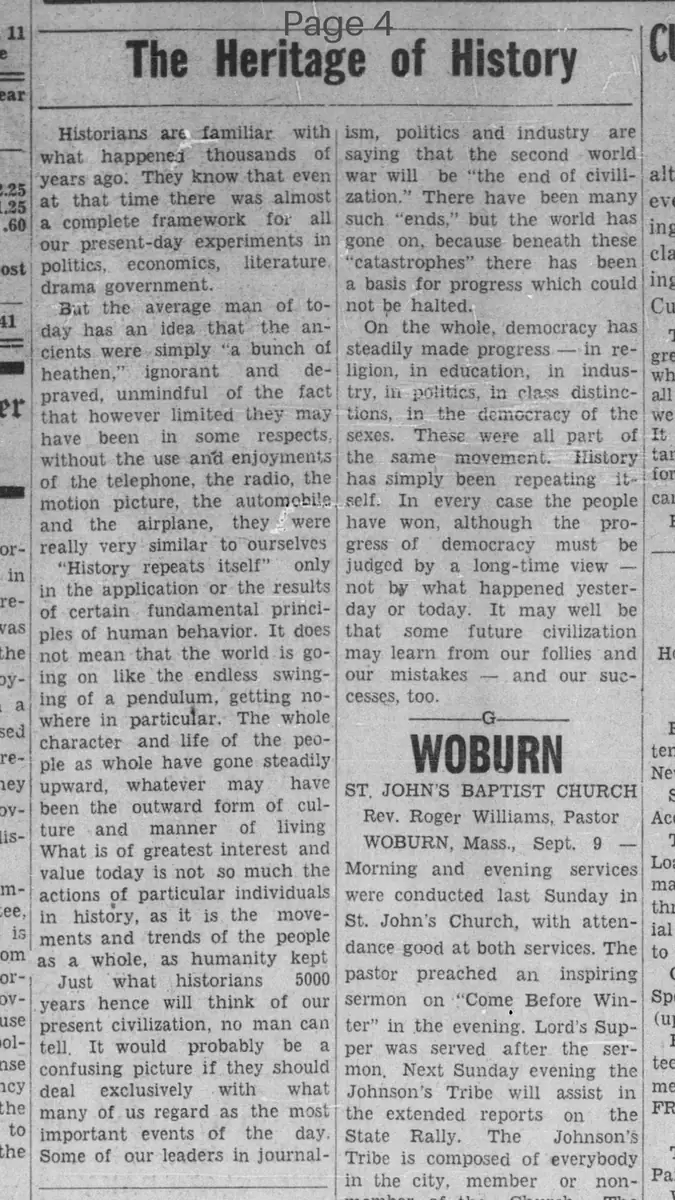
The Heritage of History
Historians are familiar with what happened thousands of years ago. They know that even at that time there was almost a complete framework for all our present-day experiments in politics, economics, literature, drama government. But the average man of to-day has an idea that the an-cients were simply "a bunch of heathen," ignorant and de-praved, unmindful of the fact that however limited they may have been in some respects, without the use and enjoyments of the telephone, the radio, the motion picture, the automobile and the airplane, they were really very similar to ourselves. "History repeats itself" only in the application or the results of certain fundamental princi-ples of human behavior. It does not mean that the world is go-ing on like the endless swing-ing of a pendulum, getting no-where in particular. The whole character and life of the peo-ple as whole have gone steadily upward, whatever may have been the outward form of cul-ture and manner of living. What is of greatest interest and value today is not so much the actions of particular individuals in history, as it is the move-ments and trends of the people as a whole, as humanity kept Just what historians 5000 years hence will think of our present civilization, no man can tell. It would probably be a confusing picture if they should deal exclusively with what many of us regard as the most important events of the day. Some of our leaders in journal-ism, politics and industry are saying that the second world war will be "the end of civili-zation." There have been many such "ends," but the world has gone on, because beneath these "catastrophes" there has been a basis for progress which could not be halted. On the whole, democracy has steadily made progress - in re-ligion, in education, in indus-try, in politics, in class distinc-tions, in the democracy of the sexes. These were all part of the same movement. History has simply been repeating it-self. In every case the people have won, although the pro-gress of democracy must be judged by a long-time view - not by what happened yester-day or today. It may well be that some future civilization may learn from our follies and our mistakes - and our suc-cesses, too.
G
Historians are familiar with what happened thousands of years ago. They know that even at that time there was almost a complete framework for all our present-day experiments in politics, economics, literature, drama government. But the average man of to-day has an idea that the an-cients were simply "a bunch of heathen," ignorant and de-praved, unmindful of the fact that however limited they may have been in some respects, without the use and enjoyments of the telephone, the radio, the motion picture, the automobile and the airplane, they were really very similar to ourselves. "History repeats itself" only in the application or the results of certain fundamental princi-ples of human behavior. It does not mean that the world is go-ing on like the endless swing-ing of a pendulum, getting no-where in particular. The whole character and life of the peo-ple as whole have gone steadily upward, whatever may have been the outward form of cul-ture and manner of living. What is of greatest interest and value today is not so much the actions of particular individuals in history, as it is the move-ments and trends of the people as a whole, as humanity kept Just what historians 5000 years hence will think of our present civilization, no man can tell. It would probably be a confusing picture if they should deal exclusively with what many of us regard as the most important events of the day. Some of our leaders in journal-ism, politics and industry are saying that the second world war will be "the end of civili-zation." There have been many such "ends," but the world has gone on, because beneath these "catastrophes" there has been a basis for progress which could not be halted. On the whole, democracy has steadily made progress - in re-ligion, in education, in indus-try, in politics, in class distinc-tions, in the democracy of the sexes. These were all part of the same movement. History has simply been repeating it-self. In every case the people have won, although the pro-gress of democracy must be judged by a long-time view - not by what happened yester-day or today. It may well be that some future civilization may learn from our follies and our mistakes - and our suc-cesses, too.
G
What sub-type of article is it?
Historical Event
Curiosity
What themes does it cover?
Triumph
Moral Virtue
Fate Providence
What keywords are associated?
History
Democracy
Civilization
Progress
Ancient Societies
Human Behavior
Story Details
Story Details
Historians recognize ancient frameworks for modern society; average people undervalue ancients' similarities to us. History repeats principles of behavior, showing steady upward progress in democracy despite catastrophes, judged over long term.