Thank you for visiting SNEWPapers!
Sign up free
Editorial
October 21, 1820
Daily National Intelligencer
Washington, District Of Columbia
What is this article about?
An editorial critiques the Edinburgh Review's views on impending European conflicts between despotism and liberty, arguing against US entanglement or alliance, especially with England. It reprints and endorses an article from the National Advocate emphasizing US neutrality, reliance on example, and sympathy without intervention.
Clipping
OCR Quality
98%
Excellent
Full Text
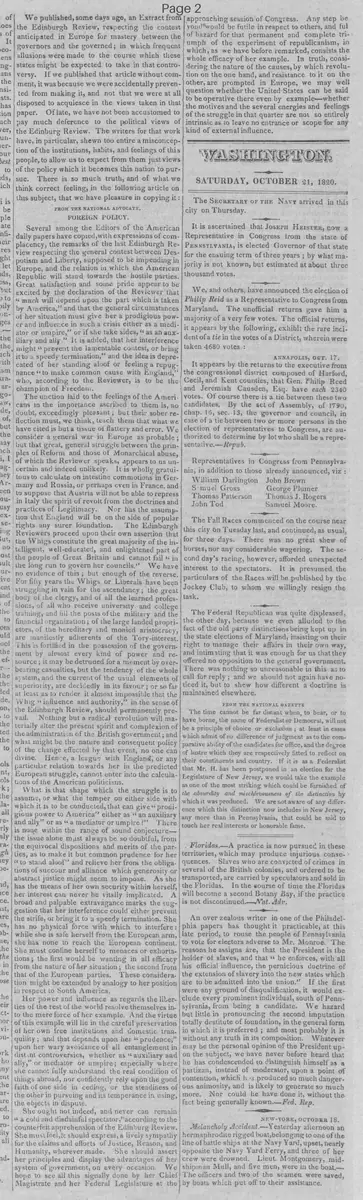
We published, some days ago, an Extract from the Edinburgh Review, respecting the contest anticipated in Europe for mastery between the governors and the governed; in which frequent allusions were made to the course which these states might be expected to take in that controversy. If we published that article without comment, it was because we were accidentally prevented from making it, and not that we were at all disposed to acquiesce in the views taken in that paper. Of late, we have not been accustomed to pay much deference to the political views of the Edinburgh Review. The writers for that work have, in particular, shewn too entire a misconception of the institutions, habits, and feelings of this people, to allow us to expect from them just views of the policy which it becomes this nation to pursue. There is so much truth, and of what we think correct feeling, in the following article on this subject, that we have pleasure in copying it:
FROM THE NATIONAL ADVOCATE,
FOREIGN POLICY.
Several among the Editors of the American daily papers have copied, with expressions of complacency, the remarks of the last Edinburgh Review respecting the general contest between Despotism and Liberty, supposed to be impending in Europe, and the relation in which the American Republic will stand towards the hostile parties. Great satisfaction and some pride appear to be excited by the declaration of the Reviewer that "much will depend upon the part which is taken by America," and that the general circumstances of her situation must give her a prodigious power and influence in such a crisis either as a mediator or umpire," or if she take sides, "as an auxiliary and ally." It is added, that her interference might "prevent the lamentable contest, or bring it to a speedy termination," and the idea is deprecated of her standing aloof or feeling a repugnance "to make common cause with England," who, according to the Reviewer, is to be the champion of Freedom.
The unction laid to the feelings of the Americans in the importance ascribed to them is, no doubt, exceedingly pleasant; but their sober reflection must, we think, teach them that what we have cited is but a tissue of flattery and error. We consider a general war in Europe as probable; but that great, general struggle between the principles of Reform and those of Monarchical abuse, of which the Reviewer speaks, appears to us uncertain and indeed unlikely. It is wholly gratuitous to calculate on intestine commotions in Germany and Russia, or perhaps even in France, and to suppose that Austria will not be able to repress in Italy the spirit of revolt from the doctrines and practices of Legitimacy. Nor has the assumption that England will be on the side of popular rights any surer foundation. The Edinburgh Reviewers proceed upon their own assertion that the Whigs constitute the great majority of the intelligent, well-educated, and enlightened part of the people of Great Britain and cannot fail "in the long run to govern her councils." We have no evidence of this; but enough of the reverse. For fifty years the Whigs or Liberals have been struggling in vain for the ascendancy; the great body of the clergy, and of all the learned professions, of all who receive university and college training, and fill the posts of the military and the financial organization; of the large landed proprietors, of the hereditary and monied aristocracy, are manifestly adherents of the Tory-interest. This is fortified in the possession of the government by almost every kind of power and resource; it may be detruded for a moment by overbearing casualties, but the tendency of the whole system, and the current of the usual elements of superiority, are decidedly in its favour; or so far at least as to render it almost impossible that the Whig "influence and authority," in the sense of the Edinburgh Review, should permanently prevail. Nothing but a radical revolution will materially alter the present spirit and complexion of the administration of the British government; and what might be the nature and consequent policy of the change effected by that event, no one can divine. Hence, a league with England, or any particular relation towards her in the predicted European struggle, cannot enter into the calculations of the American politicians.
What is that shape which the struggle is to assume, or what the temper on either side with which it is to be conducted, that can give "prodigious power to America" either as "an auxiliary and ally" or as "a mediator or umpire?" There is none within the range of sound conjecture—the issue alone must always be so doubtful, from the equivocal dispositions and merits of the parties, as to make it but common prudence for her "to stand aloof" and relieve her from the obligations of succour and alliance which generosity or abstract justice might seem to impose. As she has the means of her own security within herself, her interest can never be vitally implicated. A broad and palpable extravagance marks the suggestion that her interference could either prevent the strife, or bring it to a speedy termination. She has no physical force with which to interfere: while she is safe herself from the European arm, she has none to reach the European continent. She must confine herself to menaces or exhortations; the first would be wanting in all efficacy from the nature of her situation; the second from that of the European parties. These considerations might be extended by analogy to her position in respect to South America.
Her power and influence as regards the liberties of the rest of the world resolve themselves into the mere force of her example. And the virtue of this example will lie in the careful preservation of her own free institutions and domestic tranquility; and that depends upon her "prudence;" upon her wary avoidance of all entanglement in distant controversies, whether as "auxiliary and ally," or mediator or umpire; especially where she cannot fully understand the real condition of things abroad, nor confidently rely upon the good faith of one side in ceding, or the steadiness of the other in pursuing and its temperance in using, the objects in dispute.
She ought not indeed, and never can remain "a cold and disdainful spectator," according to the counterfeit apprehension of the Edinburgh Review. She must feel, & should express, a lively sympathy for the claims and efforts of Justice, Reason, and Humanity, wherever made. She should assert her principles and display the advantages of her system of government, on every occasion. We hope to see all this signally done by her Chief Magistrate and her Federal Legislature at the approaching session of Congress. Any step beyond would be futile in respect to others, and full of hazard for that permanent and complete triumph of the experiment of republicanism, in which, as we have before remarked, consists the whole efficacy of her example. In truth, considering the nature of the causes, by which revolution on the one hand, and resistance to it on the other, are prompted in Europe, we may well question whether the United States can be said to be operative there even by example—whether the motives and the several energies and feelings of the struggle in that quarter are not so entirely intrinsic as to leave no entrance or scope for any kind of external influence.
FROM THE NATIONAL ADVOCATE,
FOREIGN POLICY.
Several among the Editors of the American daily papers have copied, with expressions of complacency, the remarks of the last Edinburgh Review respecting the general contest between Despotism and Liberty, supposed to be impending in Europe, and the relation in which the American Republic will stand towards the hostile parties. Great satisfaction and some pride appear to be excited by the declaration of the Reviewer that "much will depend upon the part which is taken by America," and that the general circumstances of her situation must give her a prodigious power and influence in such a crisis either as a mediator or umpire," or if she take sides, "as an auxiliary and ally." It is added, that her interference might "prevent the lamentable contest, or bring it to a speedy termination," and the idea is deprecated of her standing aloof or feeling a repugnance "to make common cause with England," who, according to the Reviewer, is to be the champion of Freedom.
The unction laid to the feelings of the Americans in the importance ascribed to them is, no doubt, exceedingly pleasant; but their sober reflection must, we think, teach them that what we have cited is but a tissue of flattery and error. We consider a general war in Europe as probable; but that great, general struggle between the principles of Reform and those of Monarchical abuse, of which the Reviewer speaks, appears to us uncertain and indeed unlikely. It is wholly gratuitous to calculate on intestine commotions in Germany and Russia, or perhaps even in France, and to suppose that Austria will not be able to repress in Italy the spirit of revolt from the doctrines and practices of Legitimacy. Nor has the assumption that England will be on the side of popular rights any surer foundation. The Edinburgh Reviewers proceed upon their own assertion that the Whigs constitute the great majority of the intelligent, well-educated, and enlightened part of the people of Great Britain and cannot fail "in the long run to govern her councils." We have no evidence of this; but enough of the reverse. For fifty years the Whigs or Liberals have been struggling in vain for the ascendancy; the great body of the clergy, and of all the learned professions, of all who receive university and college training, and fill the posts of the military and the financial organization; of the large landed proprietors, of the hereditary and monied aristocracy, are manifestly adherents of the Tory-interest. This is fortified in the possession of the government by almost every kind of power and resource; it may be detruded for a moment by overbearing casualties, but the tendency of the whole system, and the current of the usual elements of superiority, are decidedly in its favour; or so far at least as to render it almost impossible that the Whig "influence and authority," in the sense of the Edinburgh Review, should permanently prevail. Nothing but a radical revolution will materially alter the present spirit and complexion of the administration of the British government; and what might be the nature and consequent policy of the change effected by that event, no one can divine. Hence, a league with England, or any particular relation towards her in the predicted European struggle, cannot enter into the calculations of the American politicians.
What is that shape which the struggle is to assume, or what the temper on either side with which it is to be conducted, that can give "prodigious power to America" either as "an auxiliary and ally" or as "a mediator or umpire?" There is none within the range of sound conjecture—the issue alone must always be so doubtful, from the equivocal dispositions and merits of the parties, as to make it but common prudence for her "to stand aloof" and relieve her from the obligations of succour and alliance which generosity or abstract justice might seem to impose. As she has the means of her own security within herself, her interest can never be vitally implicated. A broad and palpable extravagance marks the suggestion that her interference could either prevent the strife, or bring it to a speedy termination. She has no physical force with which to interfere: while she is safe herself from the European arm, she has none to reach the European continent. She must confine herself to menaces or exhortations; the first would be wanting in all efficacy from the nature of her situation; the second from that of the European parties. These considerations might be extended by analogy to her position in respect to South America.
Her power and influence as regards the liberties of the rest of the world resolve themselves into the mere force of her example. And the virtue of this example will lie in the careful preservation of her own free institutions and domestic tranquility; and that depends upon her "prudence;" upon her wary avoidance of all entanglement in distant controversies, whether as "auxiliary and ally," or mediator or umpire; especially where she cannot fully understand the real condition of things abroad, nor confidently rely upon the good faith of one side in ceding, or the steadiness of the other in pursuing and its temperance in using, the objects in dispute.
She ought not indeed, and never can remain "a cold and disdainful spectator," according to the counterfeit apprehension of the Edinburgh Review. She must feel, & should express, a lively sympathy for the claims and efforts of Justice, Reason, and Humanity, wherever made. She should assert her principles and display the advantages of her system of government, on every occasion. We hope to see all this signally done by her Chief Magistrate and her Federal Legislature at the approaching session of Congress. Any step beyond would be futile in respect to others, and full of hazard for that permanent and complete triumph of the experiment of republicanism, in which, as we have before remarked, consists the whole efficacy of her example. In truth, considering the nature of the causes, by which revolution on the one hand, and resistance to it on the other, are prompted in Europe, we may well question whether the United States can be said to be operative there even by example—whether the motives and the several energies and feelings of the struggle in that quarter are not so entirely intrinsic as to leave no entrance or scope for any kind of external influence.
What sub-type of article is it?
Foreign Affairs
War Or Peace
What keywords are associated?
Foreign Policy
European Conflict
Us Neutrality
Edinburgh Review
Whigs Tories
American Example
Non Intervention
What entities or persons were involved?
Edinburgh Review
National Advocate
Whigs
Tories
England
America
Europe
Editorial Details
Primary Topic
Us Neutrality In Potential European Conflicts
Stance / Tone
Advocacy For Non Entanglement And Reliance On Example
Key Figures
Edinburgh Review
National Advocate
Whigs
Tories
England
America
Europe
Key Arguments
Edinburgh Review Misrepresents Us Institutions And Policy
European Struggle Between Reform And Monarchy Is Unlikely
England Unlikely To Champion Popular Rights Due To Tory Dominance
Us Should Avoid Alliances Or Mediation In European Affairs
Us Lacks Physical Power To Influence European Conflicts
Us Influence Lies In Preserving Its Own Free Institutions As Example
Express Sympathy For Justice Without Intervention
Non Entanglement Preserves Domestic Tranquility
Hope For Presidential And Congressional Assertion Of Principles
Us Example May Have Limited Impact On Intrinsic European Struggles