Thank you for visiting SNEWPapers!
Sign up free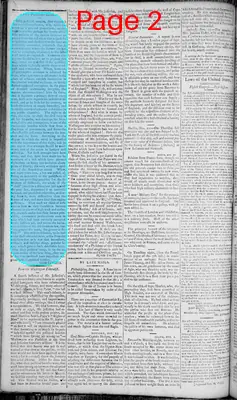
Editorial
December 3, 1803
Jenks' Portland Gazette
Portland, Cumberland County, Maine
What is this article about?
An editorial defends the right to criticize corrupt public officials as essential to liberty, condemning Republican leaders for hypocritical enforcement of sedition laws after previously opposing them, predicting their downfall by popular favor.
Clipping
OCR Quality
98%
Excellent
Full Text
For the PORTLAND GAZETTE.
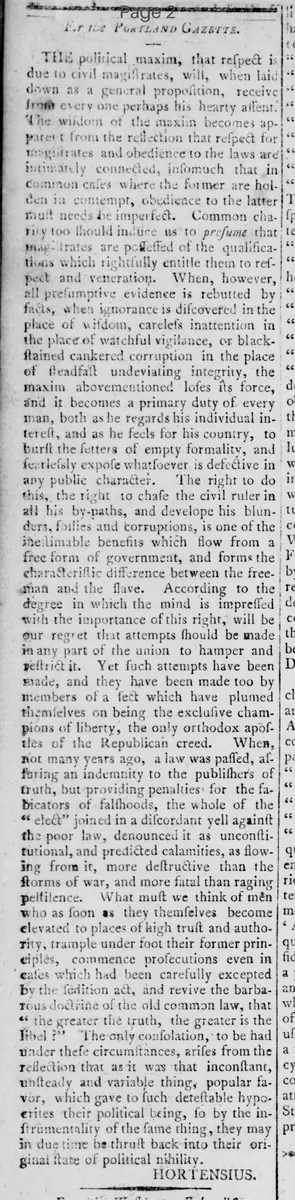
THE political maxim, that respect is due to civil magistrates, will, when laid down as a general proposition, receive from every one perhaps his hearty assent. The wisdom of the maxim becomes apparent from the reflection that respect for magistrates and obedience to the laws are intimately connected, insomuch that in common cases where the former are held in contempt, obedience to the latter must needs be imperfect. Common charity too should induce us to presume that magistrates are possessed of the qualifications which rightfully entitle them to respect and veneration. When, however, all presumptive evidence is rebutted by facts, when ignorance is discovered in the place of wisdom, careless inattention in the place of watchful vigilance, or black-stained cankered corruption in the place of steadfast undeviating integrity, the maxim abovementioned loses its force, and it becomes a primary duty of every man, both as he regards his individual interest, and as he feels for his country, to burst the fetters of empty formality, and fearlessly expose whatsoever is defective in any public character. The right to do this, the right to chase the civil ruler in all his by-paths, and develope his blunders, follies and corruptions, is one of the inestimable benefits which flow from a free form of government, and forms the characteristic difference between the freeman and the slave. According to the degree in which the mind is impressed with the importance of this right, will be our regret that attempts should be made in any part of the union to hamper and restrict it. Yet such attempts have been made, and they have been made too by members of a sect which have plumed themselves on being the exclusive champions of liberty, the only orthodox apostles of the Republican creed. When not many years ago, a law was passed, assuring an indemnity to the publishers of truth, but providing penalties for the fabricators of falsehoods, the whole of the elect joined in a discordant yell against the poor law, denounced it as unconstitutional, and predicted calamities, as flowing from it, more destructive than the storms of war, and more fatal than raging pestilence. What must we think of men who as soon as they themselves become elevated to places of high trust and authority, trample under foot their former principles, commence prosecutions even in cases which had been carefully excepted by the sedition act, and revive the barbarous doctrine of the old common law, that 'the greater the truth, the greater is the libel?' The only consolation, to be had under these circumstances, arises from the reflection that as it was that inconstant, unsteady and variable thing, popular favor, which gave to such detestable hypocrites their political being, so by the instrumentality of the same thing, they may in due time be thrust back into their original state of political nihility.
HORTENSIUS.
THE political maxim, that respect is due to civil magistrates, will, when laid down as a general proposition, receive from every one perhaps his hearty assent. The wisdom of the maxim becomes apparent from the reflection that respect for magistrates and obedience to the laws are intimately connected, insomuch that in common cases where the former are held in contempt, obedience to the latter must needs be imperfect. Common charity too should induce us to presume that magistrates are possessed of the qualifications which rightfully entitle them to respect and veneration. When, however, all presumptive evidence is rebutted by facts, when ignorance is discovered in the place of wisdom, careless inattention in the place of watchful vigilance, or black-stained cankered corruption in the place of steadfast undeviating integrity, the maxim abovementioned loses its force, and it becomes a primary duty of every man, both as he regards his individual interest, and as he feels for his country, to burst the fetters of empty formality, and fearlessly expose whatsoever is defective in any public character. The right to do this, the right to chase the civil ruler in all his by-paths, and develope his blunders, follies and corruptions, is one of the inestimable benefits which flow from a free form of government, and forms the characteristic difference between the freeman and the slave. According to the degree in which the mind is impressed with the importance of this right, will be our regret that attempts should be made in any part of the union to hamper and restrict it. Yet such attempts have been made, and they have been made too by members of a sect which have plumed themselves on being the exclusive champions of liberty, the only orthodox apostles of the Republican creed. When not many years ago, a law was passed, assuring an indemnity to the publishers of truth, but providing penalties for the fabricators of falsehoods, the whole of the elect joined in a discordant yell against the poor law, denounced it as unconstitutional, and predicted calamities, as flowing from it, more destructive than the storms of war, and more fatal than raging pestilence. What must we think of men who as soon as they themselves become elevated to places of high trust and authority, trample under foot their former principles, commence prosecutions even in cases which had been carefully excepted by the sedition act, and revive the barbarous doctrine of the old common law, that 'the greater the truth, the greater is the libel?' The only consolation, to be had under these circumstances, arises from the reflection that as it was that inconstant, unsteady and variable thing, popular favor, which gave to such detestable hypocrites their political being, so by the instrumentality of the same thing, they may in due time be thrust back into their original state of political nihility.
HORTENSIUS.
What sub-type of article is it?
Press Freedom
Partisan Politics
What keywords are associated?
Press Freedom
Political Hypocrisy
Sedition Act
Republican Principles
Civil Magistrates
Libel Laws
Public Criticism
What entities or persons were involved?
Civil Magistrates
Republican Creed
Hortensius
Editorial Details
Primary Topic
Defense Of The Right To Criticize Public Officials And Republican Hypocrisy On Sedition Laws
Stance / Tone
Strongly Critical Of Political Hypocrisy And Supportive Of Free Press Rights
Key Figures
Civil Magistrates
Republican Creed
Hortensius
Key Arguments
Respect For Magistrates Is Connected To Obedience To Laws, But Must Yield To Exposure Of Corruption.
The Right To Criticize Rulers Is A Key Benefit Of Free Government.
Republicans Hypocritically Oppose Sedition Laws When Out Of Power But Enforce Them Harshly When In Authority.
They Revive The Doctrine That Truth Can Be Libel.
Popular Favor Will Eventually Remove Such Hypocrites From Power.