Thank you for visiting SNEWPapers!
Sign up free
The Cheyenne Daily Leader
Cheyenne, Laramie County, Wyoming
What is this article about?
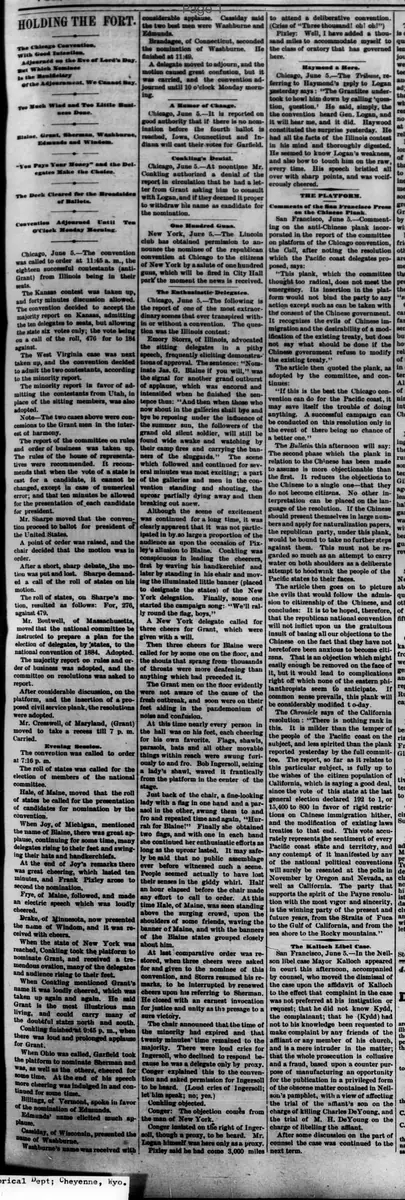
Detailed report on the opening day of the 1880 Republican National Convention in Chicago, including resolutions of delegate contests from Kansas, West Virginia, Illinois, and Utah; adoption of rules and platform; nomination speeches for presidential candidates Blaine, Grant, Sherman, Washburne, Edmunds, and Windom amid enthusiastic applause; and adjournment until Monday. Includes rumors, denials, and vivid descriptions of excitement.
Merged-components note: Merged sequential reading order components covering the Republican National Convention in Chicago into a single coherent story unit, as they share the same focused subject matter and flow narratively.
Clipping
OCR Quality
Full Text
The Chicago Convention With Good Humor
The Adjournment But Which Nominee Is the Beneficiary of the Adjournment. We Cannot Say Too Much Wind and Too Little Business Done.
Blaine, Grant, Sherman, Washburne, Edmunds and Windom.
"You Pays Your Money" and the Delegates Make the Choice.
The Deck Cleared for the Broadsides of Ballots.
Convention Adjournment Until Ten O'Clock Monday Morning.
Chicago, June 5.—The convention was called to order at 11:45 a. m., the eighteen successful contestants (anti-Grant) from Illinois being in their seats.
The Kansas contest was taken up, and forty minutes discussion allowed.
The convention decided to accept the majority report on Kansas, admitting the ten delegates to seats, but allowing the state six votes only; the vote being on a call of the roll, 476 for to 184 against.
The West Virginia case was next taken up, and the convention decided to admit the two contestants, according to the minority report.
The minority report in favor of admitting the contestants from Utah, in place of the sitting members, was also adopted.
Note—The two cases above were concessions to the Grant men in the interest of harmony.
The report of the committee on rules and order of business was taken up.
The rules of the house of representatives were recommended. It recommends that when the vote of a state is cast for a candidate, it cannot be changed, except in case of numerical error; and that ten minutes be allowed for the presentation of each candidate for president.
Mr. Sharpe moved that the convention proceed to ballot for president of the United States.
A point of order was raised, and the chair decided that the motion was in order.
After a short, sharp debate, the motion was put and lost. Sharpe demanded a call of the roll of states on his motion.
The roll of states, on Sharpe's motion, resulted as follows: For, 276; against, 479.
Mr. Boutwell, of Massachusetts, moved that the national committee be instructed to prepare a plan for the election of delegates, by states, to the national convention of 1884. Adopted.
The majority report on rules and order of business was adopted, and the committee on resolutions was asked to report.
After considerable discussion, on the platform, and the insertion of a proposed civil service plank, the resolutions were adopted.
Mr. Cresswell, of Maryland, (Grant) moved to take a recess till 7 p. m. Carried.
Evening Session.
The convention was called to order at 7:16 p. m.
The roll of states was called for the election of members of the national committee.
Hale, of Maine, moved that the roll of states be called for the presentation of candidates for nomination by the convention.
When Joy, of Michigan, mentioned the name of Blaine, there was great applause, continuing for some time, many delegates rising to their feet and swinging their hats and handkerchiefs.
At the end of Joy's remarks there was great cheering, which lasted ten minutes, and Frank Pixley arose to second the nomination.
Frye, of Maine, followed, and made an electric speech which was loudly cheered.
Drake, of Minnesota, now presented the name of Windom, and it was received with cheers.
When the state of New York was reached, Conkling took the platform to nominate Grant, and received a tremendous ovation, many of the delegates and audience rising to their feet.
When Conkling mentioned Grant's name it was loudly cheered, which was taken up again and again. He said Grant is the most illustrious man living, and could carry many of the doubtful states north and south.
Conkling finished at 9:45 p. m., when there was loud and prolonged applause for Grant.
When Ohio was called, Garfield took the platform to nominate Sherman and was, as well as the others, cheered for some time. At the end of his speech more cheering was indulged in and continued for some time.
Billings, of Vermont, spoke in favor of the nomination of Edmunds.
Edmunds' name elicited much applause.
Cassiday, of Wisconsin, presented the name of Washburne.
Washburne's name was received with considerable applause.
Cassiday said the two best men were Washburne and Edmunds.
Brandagee, of Connecticut, seconded the nomination of Washburne. He finished at 11:49.
A delegate moved to adjourn, and the motion caused great confusion, but it was carried, and the convention adjourned until 10 o'clock Monday morning.
A Rumor of Change.
Chicago, June 5.—It is reported on good authority that if there is no nomination before the fourth ballot is reached, Iowa, Connecticut and Indiana will cast their votes for Garfield.
Conkling's Denial.
Chicago, June 5.—At noontime Mr. Conkling authorized a denial of the report in circulation that he had a letter from Grant asking him to consult with Logan, and if they deemed it proper to withdraw his name as candidate for the nomination.
One Hundred Guns.
New York, June 5.—The Lincoln club has obtained permission to announce the nominee of the republican convention at Chicago to the citizens of New York by a salute of one hundred guns, which will be fired in City Hall park the moment the news is received.
The Enthusiastic Delegates.
Chicago, June 5.—The following is the report of one of the most extraordinary scenes that ever transpired within or without a convention. The question was the Illinois contest:
Emory Storrs, of Illinois, advocated the sitting delegates in a pithy speech, frequently eliciting demonstrations of approval. The sentence: "Nominate Jas. G. Blaine if you will," was the signal for another grand outburst of applause, which was encored and intensified when he finished the sentence thus: "And then when those who now shout in the galleries shall by and by be reposing under the influence of the summer sun, the followers of the grand old silent soldier, will still be found wide awake and watching by their camp fires and carrying the banners of the sluggards." The scene which followed and continued for several minutes was most exciting; a part of the galleries and men in the convention standing and shouting, the uproar partially dying away and then breaking out anew.
Although the scene of excitement was continued for a long time, it was clearly apparent that it was not participated in by so large a proportion of the audience as upon the occasion of Pixley's allusion to Blaine. Conkling was conspicuous in leading the cheerers, first by waving his handkerchief and later by standing in his chair and moving the illuminated little banner (placed to designate the states) of the New York delegation.
Finally, some one started the campaign song: "We'll rally round the flag, boys,"
A New York delegate called for three cheers for Grant, which were given with a will.
Then three cheers for Blaine were called for by some one on the floor, and the shouts that sprang from thousands of throats were more deafening than anything which had preceded it.
The Grant men on the floor evidently were not aware of the cause of the fresh outbreak, and soon were on their feet aiding in the pandemonium of noise and confusion.
At this time nearly every person in the hall was on his feet, each cheering for his own favorite. Flags, shawls, parasols, hats and all other movable things within reach were swung furiously to and fro. Bob Ingersoll, seizing a lady's shawl, waved it frantically from the platform in the center of the stage.
Just back of the chair, a fine-looking lady with a flag in one hand and a parasol in the other, swung them to and fro and repeated time and again, "Hurray for Blaine!" Finally she obtained two flags, and with one in each hand she continued her enthusiastic efforts as long as the uproar lasted. It may safely be said that no public assemblage ever before witnessed such a scene.
People seemed actually to have lost their senses in the giddy whirl. Half an hour elapsed before the chair made any effort to call to order. At this time Hale, of Maine, was seen standing above the surging crowd, upon the shoulders of some friends, waving the banner of Maine, and with the banners of the Blaine states grouped closely about him.
At last comparative order was restored, when three cheers were asked for and given to the nominee of this convention, and Storrs resumed his remarks, to be interrupted by renewed cheers upon his referring to Sherman.
He closed with an earnest invocation for justice and unity as the presage to a sure victory.
The chair announced that the time of the minority had expired and that twenty minutes' time remained to the majority. There were loud cries for Ingersoll, who declined to respond because he was a delegate only by proxy.
Conger explained this to the convention and asked permission for Ingersoll to be heard. (Loud cries of Ingersoll; let him speak; no; yes.)
Conkling objected.
Conger: The objection comes from the man of New York.
Conger insisted on the right of Ingersoll, though a proxy, to be heard. Mr. Logan himself was here only as a proxy.
Pixley said he had come 3,000 miles to attend a deliberative convention. (Cries of "Three thousand! oh! oh!")
Pixley: Well, I have added a thousand miles to accommodate myself to the class of oratory that has governed here.
Haywood a Hero.
Chicago, June 5. The Tribune, referring to Haywood's reply to Logan yesterday says: "The Grantites undertook to howl him down by calling 'question, question.' He said, simply, the convention heard Gen. Logan, and it will hear me, and it did. Haywood constituted the surprise yesterday. He had all the facts of the Illinois contest in his mind and thoroughly digested.
He seemed to know Logan's weakness, and also how to touch him on the raw, every time. His speech bristled all over with sharp points, and was vociferously cheered."
What sub-type of article is it?
What themes does it cover?
What keywords are associated?
What entities or persons were involved?
Where did it happen?
Story Details
Key Persons
Location
Chicago
Event Date
June 5
Story Details
The Republican National Convention in Chicago resolves delegate contests from various states, adopts rules and platform including civil service plank, hears nomination speeches for presidential candidates with enthusiastic applause especially for Blaine and Grant, and adjourns until Monday amid excitement and rumors of potential shifts in support.