Thank you for visiting SNEWPapers!
Sign up free
The National Intelligencer And Washington Advertiser
Washington, District Of Columbia
What is this article about?
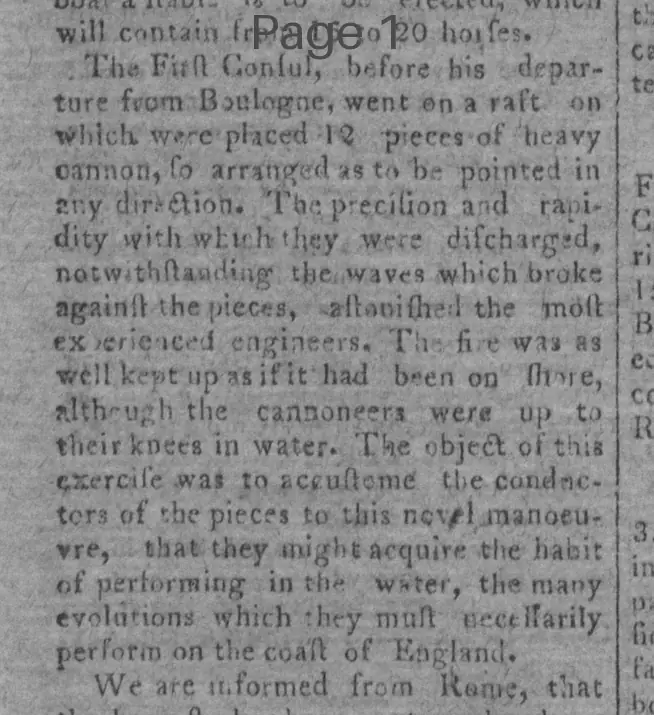
The First Consul tested heavy cannon on a raft at Boulogne, demonstrating precision firing in rough waters to train artillerymen for operations on England's coast.
Clipping
OCR Quality
Full Text
What sub-type of article is it?
What keywords are associated?
What entities or persons were involved?
Where did it happen?
Foreign News Details
Primary Location
Boulogne
Key Persons
Outcome
the exercise successfully accustomed the cannoneers to performing evolutions in water for coastal operations.
Event Details
The First Consul, before his departure from Boulogne, went on a raft with 12 pieces of heavy cannon arranged to point in any direction. The precision and rapidity of their discharge, despite waves breaking against the pieces, astonished experienced engineers. The fire was maintained as well as on shore, with cannoneers up to their knees in water. The purpose was to train the conductors to perform necessary evolutions in water for operations on the coast of England.