Thank you for visiting SNEWPapers!
Sign up free
Editorial
October 28, 1836
The Hillsborough Recorder
Hillsboro, Orange County, North Carolina
What is this article about?
An 1836 editorial from Orange County, North Carolina, urges freemen to support Hugh L. White over Martin Van Buren in the presidential election, highlighting White's alignment with state interests on public lands distribution, surplus revenue, opposition to abolition, tariffs, and internal improvements, while criticizing Van Buren's positions.
Clipping
OCR Quality
95%
Excellent
Full Text
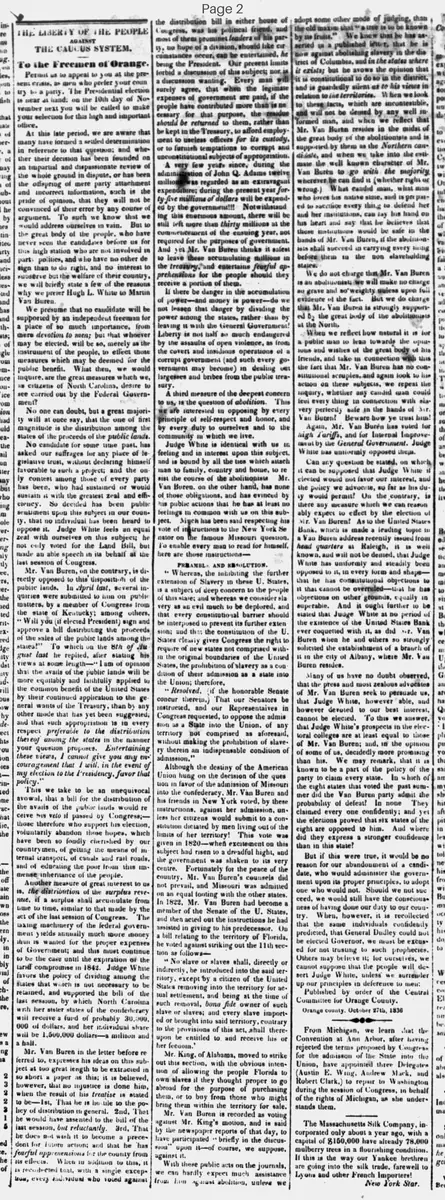
THE LIBERTY OF THE PEOPLE AGAINST THE CAUCUS SYSTEM.
To the Freemen of Orange.
Permit us to appeal to you at the present crisis, as men who prefer your country to a party. The Presidential election is near at hand: on the 10th day of November next you will be called to make your selection for this high and important office. At this late period, we are aware that many have formed a settled determination in reference to that question; and whether their decision has been founded on an impartial and dispassionate review of the whole ground in dispute, or has been the offspring of mere party attachment and incorrect information, such is the pride of opinion, that they will not be convinced of their error by any course of argument. To such we know that we would address ourselves in vain. But to the great body of the people, who have never seen the candidates before us for this high station who are not involved in party politics, and who have no other design than to do right, and no interest to subserve but the welfare of their country, we will briefly state a few of the reasons why we prefer Hugh L. White to Martin Van Buren. We presume that no candidate will be supported by an independent freeman for a place of so much importance, from mere devotion to men: but that whoever may be elected, will be so, merely as the instrument of the people, to effect those measures which may be deemed for the public benefit. What then, we would inquire, are the great measures which we, as citizens of North Carolina, desire to see carried out by the Federal Government? No one can doubt, but a great majority will at once say, that the one of first magnitude is the distribution among the states of the proceeds of the public lands. No candidate for some time past, has asked our suffrages for any place of legislative trust, without declaring himself favorable to such a project; and the only contest among those of every party has been, who had sustained or would sustain it with the greatest zeal and efficiency. So decided has been public sentiment upon this subject in our county, that no individual has been heard to oppose it. Judge White feels an equal zeal with ourselves on this subject; he not only voted for the Land Bill, but made an able speech in its behalf at the last session of Congress. Mr. Van Buren, on the contrary, is directly opposed to this disposition of the public lands. In April last, several inquiries were submitted to him on public matters, by a member of Congress from the state of Kentucky; among others, "Will you (if elected President) sign and approve a bill distributing the proceeds of the sales of the public lands among the states?" To which on the 8th of August last he replied, after stating his views at some length—"I am of opinion that the avails of the public lands will be more equitably and faithfully applied to the common benefit of the United States by their continued application to the general wants of the Treasury, than by any other mode that has yet been suggested; and that such appropriation is in every respect preferable to the distribution thereof among the states in the manner your question proposes. Entertaining these views, I cannot give you any encouragement that I will, in the event of my election to the Presidency, favor that policy." This we take to be an unequivocal avowal, that a bill for the distribution of the avails of the public lands would receive his veto if passed by Congress; those therefore who support his election, voluntarily abandon those hopes, which have been so fondly cherished by our countrymen, of getting the means of internal transport, of canals and rail roads, and of educating the poor from this immense inheritance of the people. Another measure of great interest to us is, the distribution of the surplus revenue, if a surplus shall accumulate from time to time, similar to that made by the act of the last session of Congress. The taxing machinery of the federal government yields annually much more money than is wanted for the proper expenses of Government; and this must continue to be the case until the expiration of the tariff compromise in 1842. Judge White favors the policy of dividing among the States that which is not necessary to be retained, and supported the bill of the last session, by which North Carolina with her sister states of the confederacy will receive a fund of probably $30,000,000 of dollars, and her individual share will be $1,500,000 dollars—a million and a half. Mr. Van Buren in the letter before referred to, expresses his ideas on this subject at too great length to be extracted in so short a paper as this; it is believed, however, that no injustice is done him, when the result of his treatise is stated to be—1st, That he is hostile to the policy of distribution in general. 2nd, That he would have assented to the bill of the last session, but reluctantly. 3rd, That he does not wish it to become a precedent for future action; and that he has fearful apprehensions for the country from its effects. When in addition to this, it is recollected that, with a single exception, every individual who voted against the distribution bill in either house of Congress, was his political friend, and most of them prominent leaders of his party, no hope of a division, should like circumstances occur, can be entertained, he being the President. Our present limits forbid a discussion of this subject; nor is a discussion wanting. Every man will surely agree, that when the legitimate expenses of government are paid, if the people have contributed more than is necessary for that purpose, the residue should be returned to them, rather than be kept in the Treasury, to afford employment to useless officers for its custody, or to furnish temptations to corrupt and unconstitutional subjects of appropriation. A very few years since, during the administration of John Q. Adams twelve millions was regarded as an extravagant expenditure; during the present year forty-five millions of dollars will be expended by the government!!! Notwithstanding this enormous amount, there will be still left more than thirty millions at the commencement of the ensuing year, not required for the purposes of government. And yet Mr. Van Buren thinks it safest to leave these accumulating millions in the treasury, and entertains fearful apprehensions for the people should they receive a portion of them. If there be danger in the accumulation of power—and money is power—do we not lessen that danger by dividing the power among the states, rather than by leaving it with the General Government! Liberty is not half so much endangered by the assaults of open violence, as from the covert and insidious operations of a corrupt government (and such every government may become) in dealing out largesses and bribes from the public treasury. A third measure of the deepest concern to us, is the question of abolition. This we are interested in opposing by every principle of self-respect and honor, and by every duty to ourselves and to the community in which we live. Judge White is identical with us in feeling and in interest upon this subject, and is bound by all the ties which attach man to family, country and home, to resist the course of the abolitionists. Mr. Van Buren, on the other hand, has none of those obligations, and has evinced by his public actions that he has at least no feelings in common with us on this subject. Much has been said respecting his vote of instructions to the New York Senator on the famous Missouri question. To enable every man to read for himself, here are those instructions—
PREAMBLE AND RESOLUTION.
"Whereas, the inhibiting the further extension of Slavery in these U. States, is a subject of deep concern to the people of this state; and whereas we consider slavery as an evil much to be deplored, and that every constitutional barrier should be interposed to prevent its further extension; and that the constitution of the U. States clearly gives Congress the right to require of new states not comprised within the original boundaries of the United States, the prohibition of slavery as a condition of their admission as a state into the Union; therefore,
"Resolved, if the honorable Senate concur therein,) That our Senators be instructed, and our Representatives in Congress requested, to oppose the admission as a State into the Union, of any territory not comprised as aforesaid, without making the prohibition of slavery therein an indispensable condition of admission."
Although the destiny of the American Union hung on the decision of the question in favor of the admission of Missouri into the confederacy, Mr. Van Buren and his friends in New York voted, by these instructions, against her admission, unless her citizens would submit to a constitution dictated by men living out of the limits of her territory! This vote was given in 1820—when excitement on this subject had risen to a dreadful height, and the government was shaken to its very centre. Fortunately for the peace of the country, Mr. Van Buren's counsels did not prevail, and Missouri was admitted on an equal footing with the other states. In 1822, Mr. Van Buren had become a member of the Senate of the U. States, and then acted out the instructions he had assisted in giving to his predecessor. On a bill relating to the territory of Florida, he voted against striking out the 11th section as follows—
"No slave or slaves shall, directly or indirectly, be introduced into the said territory, except by a citizen of the United States removing into the territory for actual settlement, and being at the time of such removal, bona fide owner of such slave or slaves; and every slave imported or brought into said territory, contrary to the provisions of this act, shall thereupon be entitled to, and receive his or her freedom."
Mr. King, of Alabama, moved to strike out this section, with the obvious intention of allowing the people Florida to own slaves if they thought proper to go abroad for the purpose of purchasing them, or to buy from those who might bring them within the territory for sale. Mr. Van Buren is recorded as voting against Mr. King's motion, and is said by the newspaper reports of that day, to have participated "briefly in the discussion" upon it—of course, we suppose, against it. With these public acts on the journals, we can hardly expect much assistance from him against abolition, unless we adopt some other mode of judging, than the old maxim that "a tree is to be known by its fruits." We knew that he has asserted in a published letter, that he is now against abolishing slavery in the district of Columbia, and in the states where it exists; but he avows the opinion that it is constitutional to do so in the district, and is guardedly silent as to his views in relation to the territories. When we look to these facts, which are incontestable, and will not be denied by any well informed man, and when we reflect that Mr. Van Buren resides in the midst of the great body of the abolitionists and is supported by them as the Northern candidate, and when we take into the estimate the well known character of Mr. Van Buren to go with the majority wherever he can find it (whether right or wrong.) What candid man, what man who loves his native state, and is prepared to sacrifice every thing to defend her and her institutions, can lay his hand on his heart and say that he believes that these institutions would be safe in the hands of Mr. Van Buren, of the abolitionists shall succeed in carrying everything before them in the non slaveholding states. We do not charge that Mr. Van Buren is an abolitionist; we will make no charge so grave and so weighty unless upon full evidence of the fact. But we do charge that Mr. Van Buren is strongly supported by the great body of the abolitionists at the North. When we reflect how natural it is for a public man to lean towards the opinions and wishes of the great body of his friends, and take in connection with this the fact that Mr. Van Buren has no constitutional scruples, and again look to his action on these subjects, we repeat the inquiry, whether any candid man could feel every thing in connection with slavery perfectly safe in the hands of Mr. Van Buren? "Beware how ye trust him!" Again, Mr. Van Buren has voted for high Tariffs, and for Internal Improvement by the General Government. Judge White has uniformly opposed them. Can any question be stated, on which it can be supposed that Judge White if elected would not favor our interest, and the policy we advocate, so far as his duty would permit? On the contrary, is there any measure which we can reasonably expect to effect by the election of Mr. Van Buren? As to the United States Bank, which is made a leading topic in a Van Buren address recently issued from head quarters at Raleigh, "it is well known, and will not be denied, that Judge White has uniformly and steadily been opposed to it, in every form and shape—that he has constitutional objections to it that cannot be overruled—that he has objections on other grounds, equally insurmountable. And it ought further to be stated that Judge White at no period of the existence of the United States Bank ever coquetted with it, as did Mr. Van Buren when he and others so strongly solicited the establishment of a branch of it in the city of Albany, where Mr. Van Buren resided. Many of us have no doubt observed, that the press and most zealous advocates of Mr. Van Buren seek to persuade us, that Judge White, however able, and however devoted to our best interest, cannot be elected. To this we answer, that Judge White's prospects in the electoral colleges are at least equal to those of Mr. Van Buren; and, in the opinion of some of us, decidedly more promising than his. We may remark, that it is known to be a part of the policy of the party to claim every state. In much of the eight states that voted the past summer did the Van Buren party admit the probability of defeat? In none. They claimed every one confidently; and yet the elections proved that six states of the eight are opposed to him. And where did they express a stronger confidence than in this state! But if this were true, it would be no reason for our abandonment of a candidate, who would administer the government upon its proper principles, to adopt one who would not. Should we not succeed, we would still have the consciousness of having done our duty to our country. When, however, it is recollected that the same individuals confidently predicted, that General Dudley could not be elected Governor, we must be excused for not trusting to such prophecies. Others may believe it; for ourselves, we cannot suppose that the people will desert Judge White, unless we surrender up our principles in deference to men:
Published by order of the Central Committee for Orange County.
Orange county, October 27th, 1836.
To the Freemen of Orange.
Permit us to appeal to you at the present crisis, as men who prefer your country to a party. The Presidential election is near at hand: on the 10th day of November next you will be called to make your selection for this high and important office. At this late period, we are aware that many have formed a settled determination in reference to that question; and whether their decision has been founded on an impartial and dispassionate review of the whole ground in dispute, or has been the offspring of mere party attachment and incorrect information, such is the pride of opinion, that they will not be convinced of their error by any course of argument. To such we know that we would address ourselves in vain. But to the great body of the people, who have never seen the candidates before us for this high station who are not involved in party politics, and who have no other design than to do right, and no interest to subserve but the welfare of their country, we will briefly state a few of the reasons why we prefer Hugh L. White to Martin Van Buren. We presume that no candidate will be supported by an independent freeman for a place of so much importance, from mere devotion to men: but that whoever may be elected, will be so, merely as the instrument of the people, to effect those measures which may be deemed for the public benefit. What then, we would inquire, are the great measures which we, as citizens of North Carolina, desire to see carried out by the Federal Government? No one can doubt, but a great majority will at once say, that the one of first magnitude is the distribution among the states of the proceeds of the public lands. No candidate for some time past, has asked our suffrages for any place of legislative trust, without declaring himself favorable to such a project; and the only contest among those of every party has been, who had sustained or would sustain it with the greatest zeal and efficiency. So decided has been public sentiment upon this subject in our county, that no individual has been heard to oppose it. Judge White feels an equal zeal with ourselves on this subject; he not only voted for the Land Bill, but made an able speech in its behalf at the last session of Congress. Mr. Van Buren, on the contrary, is directly opposed to this disposition of the public lands. In April last, several inquiries were submitted to him on public matters, by a member of Congress from the state of Kentucky; among others, "Will you (if elected President) sign and approve a bill distributing the proceeds of the sales of the public lands among the states?" To which on the 8th of August last he replied, after stating his views at some length—"I am of opinion that the avails of the public lands will be more equitably and faithfully applied to the common benefit of the United States by their continued application to the general wants of the Treasury, than by any other mode that has yet been suggested; and that such appropriation is in every respect preferable to the distribution thereof among the states in the manner your question proposes. Entertaining these views, I cannot give you any encouragement that I will, in the event of my election to the Presidency, favor that policy." This we take to be an unequivocal avowal, that a bill for the distribution of the avails of the public lands would receive his veto if passed by Congress; those therefore who support his election, voluntarily abandon those hopes, which have been so fondly cherished by our countrymen, of getting the means of internal transport, of canals and rail roads, and of educating the poor from this immense inheritance of the people. Another measure of great interest to us is, the distribution of the surplus revenue, if a surplus shall accumulate from time to time, similar to that made by the act of the last session of Congress. The taxing machinery of the federal government yields annually much more money than is wanted for the proper expenses of Government; and this must continue to be the case until the expiration of the tariff compromise in 1842. Judge White favors the policy of dividing among the States that which is not necessary to be retained, and supported the bill of the last session, by which North Carolina with her sister states of the confederacy will receive a fund of probably $30,000,000 of dollars, and her individual share will be $1,500,000 dollars—a million and a half. Mr. Van Buren in the letter before referred to, expresses his ideas on this subject at too great length to be extracted in so short a paper as this; it is believed, however, that no injustice is done him, when the result of his treatise is stated to be—1st, That he is hostile to the policy of distribution in general. 2nd, That he would have assented to the bill of the last session, but reluctantly. 3rd, That he does not wish it to become a precedent for future action; and that he has fearful apprehensions for the country from its effects. When in addition to this, it is recollected that, with a single exception, every individual who voted against the distribution bill in either house of Congress, was his political friend, and most of them prominent leaders of his party, no hope of a division, should like circumstances occur, can be entertained, he being the President. Our present limits forbid a discussion of this subject; nor is a discussion wanting. Every man will surely agree, that when the legitimate expenses of government are paid, if the people have contributed more than is necessary for that purpose, the residue should be returned to them, rather than be kept in the Treasury, to afford employment to useless officers for its custody, or to furnish temptations to corrupt and unconstitutional subjects of appropriation. A very few years since, during the administration of John Q. Adams twelve millions was regarded as an extravagant expenditure; during the present year forty-five millions of dollars will be expended by the government!!! Notwithstanding this enormous amount, there will be still left more than thirty millions at the commencement of the ensuing year, not required for the purposes of government. And yet Mr. Van Buren thinks it safest to leave these accumulating millions in the treasury, and entertains fearful apprehensions for the people should they receive a portion of them. If there be danger in the accumulation of power—and money is power—do we not lessen that danger by dividing the power among the states, rather than by leaving it with the General Government! Liberty is not half so much endangered by the assaults of open violence, as from the covert and insidious operations of a corrupt government (and such every government may become) in dealing out largesses and bribes from the public treasury. A third measure of the deepest concern to us, is the question of abolition. This we are interested in opposing by every principle of self-respect and honor, and by every duty to ourselves and to the community in which we live. Judge White is identical with us in feeling and in interest upon this subject, and is bound by all the ties which attach man to family, country and home, to resist the course of the abolitionists. Mr. Van Buren, on the other hand, has none of those obligations, and has evinced by his public actions that he has at least no feelings in common with us on this subject. Much has been said respecting his vote of instructions to the New York Senator on the famous Missouri question. To enable every man to read for himself, here are those instructions—
PREAMBLE AND RESOLUTION.
"Whereas, the inhibiting the further extension of Slavery in these U. States, is a subject of deep concern to the people of this state; and whereas we consider slavery as an evil much to be deplored, and that every constitutional barrier should be interposed to prevent its further extension; and that the constitution of the U. States clearly gives Congress the right to require of new states not comprised within the original boundaries of the United States, the prohibition of slavery as a condition of their admission as a state into the Union; therefore,
"Resolved, if the honorable Senate concur therein,) That our Senators be instructed, and our Representatives in Congress requested, to oppose the admission as a State into the Union, of any territory not comprised as aforesaid, without making the prohibition of slavery therein an indispensable condition of admission."
Although the destiny of the American Union hung on the decision of the question in favor of the admission of Missouri into the confederacy, Mr. Van Buren and his friends in New York voted, by these instructions, against her admission, unless her citizens would submit to a constitution dictated by men living out of the limits of her territory! This vote was given in 1820—when excitement on this subject had risen to a dreadful height, and the government was shaken to its very centre. Fortunately for the peace of the country, Mr. Van Buren's counsels did not prevail, and Missouri was admitted on an equal footing with the other states. In 1822, Mr. Van Buren had become a member of the Senate of the U. States, and then acted out the instructions he had assisted in giving to his predecessor. On a bill relating to the territory of Florida, he voted against striking out the 11th section as follows—
"No slave or slaves shall, directly or indirectly, be introduced into the said territory, except by a citizen of the United States removing into the territory for actual settlement, and being at the time of such removal, bona fide owner of such slave or slaves; and every slave imported or brought into said territory, contrary to the provisions of this act, shall thereupon be entitled to, and receive his or her freedom."
Mr. King, of Alabama, moved to strike out this section, with the obvious intention of allowing the people Florida to own slaves if they thought proper to go abroad for the purpose of purchasing them, or to buy from those who might bring them within the territory for sale. Mr. Van Buren is recorded as voting against Mr. King's motion, and is said by the newspaper reports of that day, to have participated "briefly in the discussion" upon it—of course, we suppose, against it. With these public acts on the journals, we can hardly expect much assistance from him against abolition, unless we adopt some other mode of judging, than the old maxim that "a tree is to be known by its fruits." We knew that he has asserted in a published letter, that he is now against abolishing slavery in the district of Columbia, and in the states where it exists; but he avows the opinion that it is constitutional to do so in the district, and is guardedly silent as to his views in relation to the territories. When we look to these facts, which are incontestable, and will not be denied by any well informed man, and when we reflect that Mr. Van Buren resides in the midst of the great body of the abolitionists and is supported by them as the Northern candidate, and when we take into the estimate the well known character of Mr. Van Buren to go with the majority wherever he can find it (whether right or wrong.) What candid man, what man who loves his native state, and is prepared to sacrifice every thing to defend her and her institutions, can lay his hand on his heart and say that he believes that these institutions would be safe in the hands of Mr. Van Buren, of the abolitionists shall succeed in carrying everything before them in the non slaveholding states. We do not charge that Mr. Van Buren is an abolitionist; we will make no charge so grave and so weighty unless upon full evidence of the fact. But we do charge that Mr. Van Buren is strongly supported by the great body of the abolitionists at the North. When we reflect how natural it is for a public man to lean towards the opinions and wishes of the great body of his friends, and take in connection with this the fact that Mr. Van Buren has no constitutional scruples, and again look to his action on these subjects, we repeat the inquiry, whether any candid man could feel every thing in connection with slavery perfectly safe in the hands of Mr. Van Buren? "Beware how ye trust him!" Again, Mr. Van Buren has voted for high Tariffs, and for Internal Improvement by the General Government. Judge White has uniformly opposed them. Can any question be stated, on which it can be supposed that Judge White if elected would not favor our interest, and the policy we advocate, so far as his duty would permit? On the contrary, is there any measure which we can reasonably expect to effect by the election of Mr. Van Buren? As to the United States Bank, which is made a leading topic in a Van Buren address recently issued from head quarters at Raleigh, "it is well known, and will not be denied, that Judge White has uniformly and steadily been opposed to it, in every form and shape—that he has constitutional objections to it that cannot be overruled—that he has objections on other grounds, equally insurmountable. And it ought further to be stated that Judge White at no period of the existence of the United States Bank ever coquetted with it, as did Mr. Van Buren when he and others so strongly solicited the establishment of a branch of it in the city of Albany, where Mr. Van Buren resided. Many of us have no doubt observed, that the press and most zealous advocates of Mr. Van Buren seek to persuade us, that Judge White, however able, and however devoted to our best interest, cannot be elected. To this we answer, that Judge White's prospects in the electoral colleges are at least equal to those of Mr. Van Buren; and, in the opinion of some of us, decidedly more promising than his. We may remark, that it is known to be a part of the policy of the party to claim every state. In much of the eight states that voted the past summer did the Van Buren party admit the probability of defeat? In none. They claimed every one confidently; and yet the elections proved that six states of the eight are opposed to him. And where did they express a stronger confidence than in this state! But if this were true, it would be no reason for our abandonment of a candidate, who would administer the government upon its proper principles, to adopt one who would not. Should we not succeed, we would still have the consciousness of having done our duty to our country. When, however, it is recollected that the same individuals confidently predicted, that General Dudley could not be elected Governor, we must be excused for not trusting to such prophecies. Others may believe it; for ourselves, we cannot suppose that the people will desert Judge White, unless we surrender up our principles in deference to men:
Published by order of the Central Committee for Orange County.
Orange county, October 27th, 1836.
What sub-type of article is it?
Partisan Politics
Economic Policy
Slavery Abolition
What keywords are associated?
Presidential Election 1836
Hugh L White
Martin Van Buren
Public Lands Distribution
Surplus Revenue
Anti Abolition
Tariffs
Internal Improvements
United States Bank
What entities or persons were involved?
Hugh L. White
Martin Van Buren
Freemen Of Orange
Central Committee For Orange County
Abolitionists
North Carolina
Missouri
Florida
John Q. Adams
General Dudley
Editorial Details
Primary Topic
Support For Hugh L. White Over Martin Van Buren In 1836 Presidential Election
Stance / Tone
Strongly Pro White And Anti Van Buren, Emphasizing Policy Alignment With North Carolina Interests
Key Figures
Hugh L. White
Martin Van Buren
Freemen Of Orange
Central Committee For Orange County
Abolitionists
North Carolina
Missouri
Florida
John Q. Adams
General Dudley
Key Arguments
White Supports Distribution Of Public Lands Proceeds To States For Infrastructure And Education; Van Buren Opposes And Would Veto Such Bills.
White Favors Distributing Surplus Revenue To States; Van Buren Is Hostile To The Policy And Reluctant On Recent Bill.
White Opposes Abolition And Aligns With Southern Interests; Van Buren Has History Of Anti Slavery Votes And Support From Northern Abolitionists.
White Opposes High Tariffs, Internal Improvements By Federal Government, And The U.S. Bank; Van Buren Supports Them.
White's Election Prospects Are Strong; Supporting Him Upholds Principles Over Party.