Thank you for visiting SNEWPapers!
Sign up free
Literary
June 17, 1826
Phenix Gazette
Alexandria, Virginia
What is this article about?
Extract from John Murray's 'Experimental Researches' detailing observations on the common tortoise's torpidity, diet preferences (dandelions, lettuce, fruits; rejects roots, animal food, liquids), hibernation habits, and historical longevity in English gardens, including one at Peterborough Cathedral over 200 years old.
Clipping
OCR Quality
95%
Excellent
Full Text
TORPIDITY OF THE TORTOISE.
In a little volume just published, Mr. John Murray, of Edinburgh, has put together under the title of Experimental Researches, a few papers written by him at various periods, on interesting subjects in Natural History. There are six in number, viz, "On the Light and Luminous Matter of the Glow-worm.—On the Luminosity of the Sea,—On the Phenomena of the Chameleon,—On the Ascent of the Spider into the Atmosphere,—and on Torpidity, as connected with the Testudo Græca, or Common Tortoise," &c. From the last of these we extract his observations on the Torpidity of the Tortoise, referring to the book itself for the previous details, and much curious information on the subjects of the different essays.
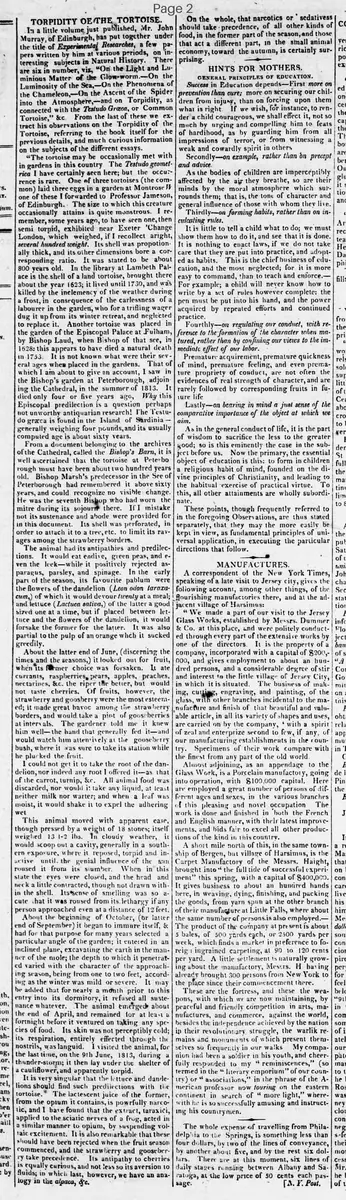
"The tortoise may be occasionally met with in gardens in this country. The Testudo geometrica I have certainly seen here; but the occurrence is rare. One of three tortoises (the common) laid three eggs in a garden at Montrose. One of these I forwarded to Professor Jameson, of Edinburgh. The size to which this creature occasionally attains is quite monstrous. I remember, some years ago, to have seen one, then semi torpid, exhibited near Exeter 'Change London, which weighed, if I recollect aright, several hundred weight. Its shell was proportionably thick, and its other dimensions bore a corresponding ratio. It was stated to be about 800 years old. In the library at Lambeth Palace is the shell of a land tortoise, brought there about the year 1623; it lived until 1730, and was killed by the inclemency of the weather during a frost, in consequence of the carelessness of a labourer in the garden, who for a trifling wager dug it up from its winter retreat, and neglected to replace it. Another tortoise was placed in the garden of the Episcopal Palace at Fulham, by Bishop Laud, when Bishop of that see, in 1628: this appears to have died a natural death in 1753. It is not known what were their several ages when placed in the gardens. That of which I am about to give an account, I saw in the Bishop's garden at Peterborough, adjoining the Cathedral, in the summer of 1813. It died only four or five years ago. Why this Episcopal predilection is a question perhaps not unworthy antiquarian research! The Testudo græca is found in the Island of Sardinia — generally weighing four pounds, and its usually computed age is about sixty years. From a document belonging to the archives of the Cathedral, called the Bishop's Barn, it is well ascertained that the tortoise at Peterborough must have been about two hundred years old." Bishop Marsh's predecessor in the See of Peterborough had remembered it above sixty years, and could recognize no visible change. He was the seventh Bishop who had worn the mitre during its sojourn there. If I mistake not its sustenance and abode were provided for in this document. Its shell was perforated, in order to attach it to a tree, etc. to limit its ravages among the strawberry borders. The animal had its antipathies and predilections. It would eat endive, green peas, and even the leek—while it positively rejected asparagus, parsley, and spinage. In the early part of the season, its favourite pabulum were the flowers of the dandelion (Leonodon taraxacum,) of which it would devour twenty at a meal: and lettuce (Lactuca sativa,) of the latter a good sized one at a time. but if placed between lettuce and the flowers of the dandelion, it would forsake the former for the latter. It was also partial to the pulp of an orange which it sucked greedily. About the latter end of June. (discerning the times and the seasons,) it looked out for fruit, when its former choice was forsaken. It ate currants, raspberries, pears, apples, peaches, nectarines, &c. the riper the better, but would not taste cherries. Of fruits, however, the strawberry and gooseberry were the most esteemed; it made great havoc among the strawberry borders, and would take a pint of gooseberries at intervals. The gardener told me it knew him well—the hand that generally fed it—and would watch him attentively at the gooseberry bush, where it was sure to take its station while he plucked the fruit. I could not get it to take the root of the dandelion, nor indeed any root I offered it—as that of the carrot, turnip, &c. All animal food was discarded, nor would it take any liquid, at least neither milk nor water; and when a leaf was moist, it would shake it to expel the adhering wet. This animal moved with apparent ease, though pressed by a weight of 18 stones; itself weighed 13 1-2 lbs. In cloudy weather, it would scoop out a cavity, generally in a southern exposure, where it reposed, torpid and inactive until. the genial influence of the sun roused it from its slumber. When in this state the eyes were closed, and the head and neck a little contracted, though not drawn within the shell. Its sense of smelling was so acute that it was roused from its lethargy if any person approached even at a distance of 12 feet. About the beginning of October, (or latter end of September) it began to immure itself, & had for that purpose for many years selected a particular angle of the garden; it entered in an inclined plane, excavating the earth in the manner of the mole; the depth to which it penetrated varied with the character of the approaching season, being from one to two feet, according as the winter was mild or severe. It may be added that for nearly a month prior to this entry into its dormitory, it refused all sustenance whatever. The animal emerged about the end of April, and remained torpid at least a fortnight before it ventured on taking any species of food. Its skin was not perceptibly cold; its respiration, entirely effected through the nostrils, was languid. I visited the animal, for the last time, on the 9th June, 1813, during a thunder-storm; it then lay under the shelter of a cauliflower, and apparently torpid. It is very singular that the lettuce and dandelions should find such predilections with the tortoise. The lactescent juice of the former, from the opium it contains, is powerfully narcotic, and I have found that the extract, taraxici, applied to the sciatic nerves of a frog, acted in a similar manner to opium, by suspending voluntary excitement. It is also remarkable that these should have been rejected when the fruit season commenced, and the strawberry and gooseberry take precedence. Its antipathy to cherries is equally curious, and not less so its aversion to fluids; in which last, however, we have an analogy in the alpaca, &c.
On the whole, that narcotics or 'sedatives should take precedence, of all other kinds of food, in the former part of the season, and those that act a different part, in the small animal economy, toward the autumn, is certainly surprising.
In a little volume just published, Mr. John Murray, of Edinburgh, has put together under the title of Experimental Researches, a few papers written by him at various periods, on interesting subjects in Natural History. There are six in number, viz, "On the Light and Luminous Matter of the Glow-worm.—On the Luminosity of the Sea,—On the Phenomena of the Chameleon,—On the Ascent of the Spider into the Atmosphere,—and on Torpidity, as connected with the Testudo Græca, or Common Tortoise," &c. From the last of these we extract his observations on the Torpidity of the Tortoise, referring to the book itself for the previous details, and much curious information on the subjects of the different essays.
"The tortoise may be occasionally met with in gardens in this country. The Testudo geometrica I have certainly seen here; but the occurrence is rare. One of three tortoises (the common) laid three eggs in a garden at Montrose. One of these I forwarded to Professor Jameson, of Edinburgh. The size to which this creature occasionally attains is quite monstrous. I remember, some years ago, to have seen one, then semi torpid, exhibited near Exeter 'Change London, which weighed, if I recollect aright, several hundred weight. Its shell was proportionably thick, and its other dimensions bore a corresponding ratio. It was stated to be about 800 years old. In the library at Lambeth Palace is the shell of a land tortoise, brought there about the year 1623; it lived until 1730, and was killed by the inclemency of the weather during a frost, in consequence of the carelessness of a labourer in the garden, who for a trifling wager dug it up from its winter retreat, and neglected to replace it. Another tortoise was placed in the garden of the Episcopal Palace at Fulham, by Bishop Laud, when Bishop of that see, in 1628: this appears to have died a natural death in 1753. It is not known what were their several ages when placed in the gardens. That of which I am about to give an account, I saw in the Bishop's garden at Peterborough, adjoining the Cathedral, in the summer of 1813. It died only four or five years ago. Why this Episcopal predilection is a question perhaps not unworthy antiquarian research! The Testudo græca is found in the Island of Sardinia — generally weighing four pounds, and its usually computed age is about sixty years. From a document belonging to the archives of the Cathedral, called the Bishop's Barn, it is well ascertained that the tortoise at Peterborough must have been about two hundred years old." Bishop Marsh's predecessor in the See of Peterborough had remembered it above sixty years, and could recognize no visible change. He was the seventh Bishop who had worn the mitre during its sojourn there. If I mistake not its sustenance and abode were provided for in this document. Its shell was perforated, in order to attach it to a tree, etc. to limit its ravages among the strawberry borders. The animal had its antipathies and predilections. It would eat endive, green peas, and even the leek—while it positively rejected asparagus, parsley, and spinage. In the early part of the season, its favourite pabulum were the flowers of the dandelion (Leonodon taraxacum,) of which it would devour twenty at a meal: and lettuce (Lactuca sativa,) of the latter a good sized one at a time. but if placed between lettuce and the flowers of the dandelion, it would forsake the former for the latter. It was also partial to the pulp of an orange which it sucked greedily. About the latter end of June. (discerning the times and the seasons,) it looked out for fruit, when its former choice was forsaken. It ate currants, raspberries, pears, apples, peaches, nectarines, &c. the riper the better, but would not taste cherries. Of fruits, however, the strawberry and gooseberry were the most esteemed; it made great havoc among the strawberry borders, and would take a pint of gooseberries at intervals. The gardener told me it knew him well—the hand that generally fed it—and would watch him attentively at the gooseberry bush, where it was sure to take its station while he plucked the fruit. I could not get it to take the root of the dandelion, nor indeed any root I offered it—as that of the carrot, turnip, &c. All animal food was discarded, nor would it take any liquid, at least neither milk nor water; and when a leaf was moist, it would shake it to expel the adhering wet. This animal moved with apparent ease, though pressed by a weight of 18 stones; itself weighed 13 1-2 lbs. In cloudy weather, it would scoop out a cavity, generally in a southern exposure, where it reposed, torpid and inactive until. the genial influence of the sun roused it from its slumber. When in this state the eyes were closed, and the head and neck a little contracted, though not drawn within the shell. Its sense of smelling was so acute that it was roused from its lethargy if any person approached even at a distance of 12 feet. About the beginning of October, (or latter end of September) it began to immure itself, & had for that purpose for many years selected a particular angle of the garden; it entered in an inclined plane, excavating the earth in the manner of the mole; the depth to which it penetrated varied with the character of the approaching season, being from one to two feet, according as the winter was mild or severe. It may be added that for nearly a month prior to this entry into its dormitory, it refused all sustenance whatever. The animal emerged about the end of April, and remained torpid at least a fortnight before it ventured on taking any species of food. Its skin was not perceptibly cold; its respiration, entirely effected through the nostrils, was languid. I visited the animal, for the last time, on the 9th June, 1813, during a thunder-storm; it then lay under the shelter of a cauliflower, and apparently torpid. It is very singular that the lettuce and dandelions should find such predilections with the tortoise. The lactescent juice of the former, from the opium it contains, is powerfully narcotic, and I have found that the extract, taraxici, applied to the sciatic nerves of a frog, acted in a similar manner to opium, by suspending voluntary excitement. It is also remarkable that these should have been rejected when the fruit season commenced, and the strawberry and gooseberry take precedence. Its antipathy to cherries is equally curious, and not less so its aversion to fluids; in which last, however, we have an analogy in the alpaca, &c.
On the whole, that narcotics or 'sedatives should take precedence, of all other kinds of food, in the former part of the season, and those that act a different part, in the small animal economy, toward the autumn, is certainly surprising.
What sub-type of article is it?
Essay
What themes does it cover?
Nature
What keywords are associated?
Tortoise
Torpidity
Hibernation
Diet
Natural History
Peterborough
Episcopal Gardens
Seasonal Habits
What entities or persons were involved?
Mr. John Murray, Of Edinburgh
Literary Details
Title
Torpidity Of The Tortoise.
Author
Mr. John Murray, Of Edinburgh
Subject
Observations On The Torpidity Of The Common Tortoise
Form / Style
Prose Observations On Natural History
Key Lines
The Tortoise May Be Occasionally Met With In Gardens In This Country.
It Would Eat Endive, Green Peas, And Even The Leek—While It Positively Rejected Asparagus, Parsley, And Spinage.
About The Beginning Of October, (Or Latter End Of September) It Began To Immure Itself, & Had For That Purpose For Many Years Selected A Particular Angle Of The Garden;
It Is Very Singular That The Lettuce And Dandelions Should Find Such Predilections With The Tortoise.