Thank you for visiting SNEWPapers!
Sign up free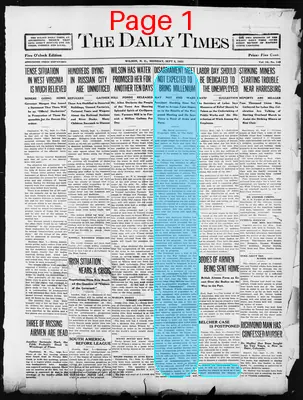
Editorial
September 5, 1921
The Daily Times
Wilson, Wilson County, North Carolina
What is this article about?
President Harding cautions against overoptimism for the upcoming disarmament conference, emphasizing the need to maintain U.S. army and navy, pursue approximate reductions, and address war's root causes realistically, as reported from Washington on Sept. 3, 1921.
Clipping
OCR Quality
98%
Excellent
Full Text
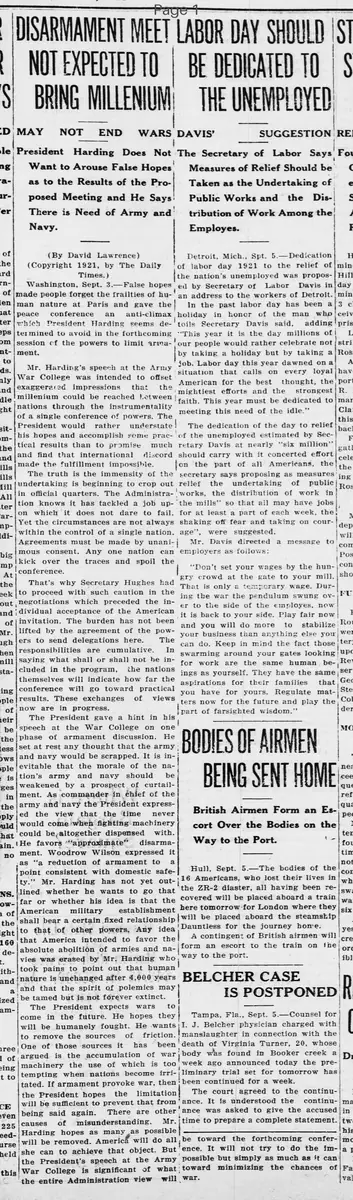
DISARMAMENT MEET NOT EXPECTED TO BRING MILLENIUM
MAY NOT END WARS
President Harding Does Not Want to Arouse False Hopes as to the Results of the Proposed Meeting and He Says There is Need of Army and Navy.
(By David Lawrence)
(Copyright 1921, by The Daily Times.)
Washington, Sept. 3.--False hopes made people forget the frailties of human nature at Paris and gave the peace conference an anti-climax which President Harding seems determined to avoid in the forthcoming session of the powers to limit armament.
Mr. Harding's speech at the Army War College was intended to offset exaggerated impressions that the millennium could be reached between nations through the instrumentality of a single conference of powers. The President would rather understate his hopes and accomplish some practical results than to promise much and find that international discord made the fulfillment impossible.
The truth is the immensity of the undertaking is beginning to crop out in official quarters. The Administration knows it has tackled a job upon which it does not dare to fail.
Yet the circumstances are not always within the control of a single nation. Agreements must be made by unanimous consent. Any one nation can kick over the traces and spoil the conference.
That's why Secretary Hughes had to proceed with such caution in the negotiations which preceded the individual acceptance of the American invitation. The burden has not been lifted by the agreement of the powers to send delegations here.
The responsibilities are cumulative. In saying what shall or shall not be included in the program, the nations themselves will indicate how far the conference will go toward practical results. These exchanges of views now are in progress.
The President gave a hint in his speech at the War College on one phase of armament discussion. He set at rest any thought that the army and navy would be scrapped. It is inevitable that the morale of the nation's army and navy should be weakened by a prospect of curtailment. As commander in chief of the army and navy the President expressed the view that the time never would come when fighting machinery could be altogether dispensed with.
He favors "approximate" disarmament. Woodrow Wilson expressed it as "a reduction of armament to a point consistent with domestic safety." Mr. Harding has not yet outlined whether he wants to go that far or whether his idea is that the American military establishment shall bear a certain fixed relationship to that of other powers. Any idea that America intended to favor the absolute abolition of armies and navies was erased by Mr. Harding who took pains to point out that human nature is unchanged after 4,000 years and that the spirit of polemics may be tamed but is not forever extinct.
The President expects wars to come in the future. He hopes they will be humanely fought. He wants to remove the sources of friction.
One of those sources it has been argued is the accumulation of war machinery the use of which is too tempting when nations become irritated. If armament provoke war, then the President hopes the limitation will be sufficient to prevent that from being said again.
There are other causes of misunderstanding. Mr. Harding hopes as many as possible will be removed. America will do all she can to achieve that object. But the President's speech at the Army War College is significant of what the entire Administration views will be toward the forthcoming conference.
It will not try to do the impossible but simply as much as it can toward minimizing the chances of war.
MAY NOT END WARS
President Harding Does Not Want to Arouse False Hopes as to the Results of the Proposed Meeting and He Says There is Need of Army and Navy.
(By David Lawrence)
(Copyright 1921, by The Daily Times.)
Washington, Sept. 3.--False hopes made people forget the frailties of human nature at Paris and gave the peace conference an anti-climax which President Harding seems determined to avoid in the forthcoming session of the powers to limit armament.
Mr. Harding's speech at the Army War College was intended to offset exaggerated impressions that the millennium could be reached between nations through the instrumentality of a single conference of powers. The President would rather understate his hopes and accomplish some practical results than to promise much and find that international discord made the fulfillment impossible.
The truth is the immensity of the undertaking is beginning to crop out in official quarters. The Administration knows it has tackled a job upon which it does not dare to fail.
Yet the circumstances are not always within the control of a single nation. Agreements must be made by unanimous consent. Any one nation can kick over the traces and spoil the conference.
That's why Secretary Hughes had to proceed with such caution in the negotiations which preceded the individual acceptance of the American invitation. The burden has not been lifted by the agreement of the powers to send delegations here.
The responsibilities are cumulative. In saying what shall or shall not be included in the program, the nations themselves will indicate how far the conference will go toward practical results. These exchanges of views now are in progress.
The President gave a hint in his speech at the War College on one phase of armament discussion. He set at rest any thought that the army and navy would be scrapped. It is inevitable that the morale of the nation's army and navy should be weakened by a prospect of curtailment. As commander in chief of the army and navy the President expressed the view that the time never would come when fighting machinery could be altogether dispensed with.
He favors "approximate" disarmament. Woodrow Wilson expressed it as "a reduction of armament to a point consistent with domestic safety." Mr. Harding has not yet outlined whether he wants to go that far or whether his idea is that the American military establishment shall bear a certain fixed relationship to that of other powers. Any idea that America intended to favor the absolute abolition of armies and navies was erased by Mr. Harding who took pains to point out that human nature is unchanged after 4,000 years and that the spirit of polemics may be tamed but is not forever extinct.
The President expects wars to come in the future. He hopes they will be humanely fought. He wants to remove the sources of friction.
One of those sources it has been argued is the accumulation of war machinery the use of which is too tempting when nations become irritated. If armament provoke war, then the President hopes the limitation will be sufficient to prevent that from being said again.
There are other causes of misunderstanding. Mr. Harding hopes as many as possible will be removed. America will do all she can to achieve that object. But the President's speech at the Army War College is significant of what the entire Administration views will be toward the forthcoming conference.
It will not try to do the impossible but simply as much as it can toward minimizing the chances of war.
What sub-type of article is it?
War Or Peace
Foreign Affairs
Military Affairs
What keywords are associated?
Disarmament Conference
Armament Limitation
President Harding
False Hopes
Army Navy
International Discord
What entities or persons were involved?
President Harding
Secretary Hughes
Woodrow Wilson
Editorial Details
Primary Topic
President Harding's Realistic Expectations For The Disarmament Conference
Stance / Tone
Cautious Realism Avoiding False Hopes
Key Figures
President Harding
Secretary Hughes
Woodrow Wilson
Key Arguments
Avoid Exaggerated Expectations For The Disarmament Conference To Prevent Anti Climax
Maintain Army And Navy As Essential Despite Disarmament Efforts
Pursue Approximate Disarmament Rather Than Absolute Abolition
Human Nature Remains Prone To Conflict After 4,000 Years
Limit Armaments To Reduce Sources Of Friction And Temptation For War
Address Multiple Causes Of International Misunderstanding