Thank you for visiting SNEWPapers!
Sign up free
Fowle's New Hampshire Gazette And General Advertiser
Portsmouth, Rockingham County, New Hampshire
What is this article about?
An editorial reprints an address decrying excessive rum consumption in Connecticut, highlighting its economic cost exceeding national debt interest, health and moral harms, and poor's disproportionate use. It advocates temperance, local alternatives like cider, higher duties via federal power, and compares to English policy.
Merged-components note: Merged sequential components continuing the editorial on the evils of spirituous liquors and need for federal power.
Clipping
OCR Quality
Full Text
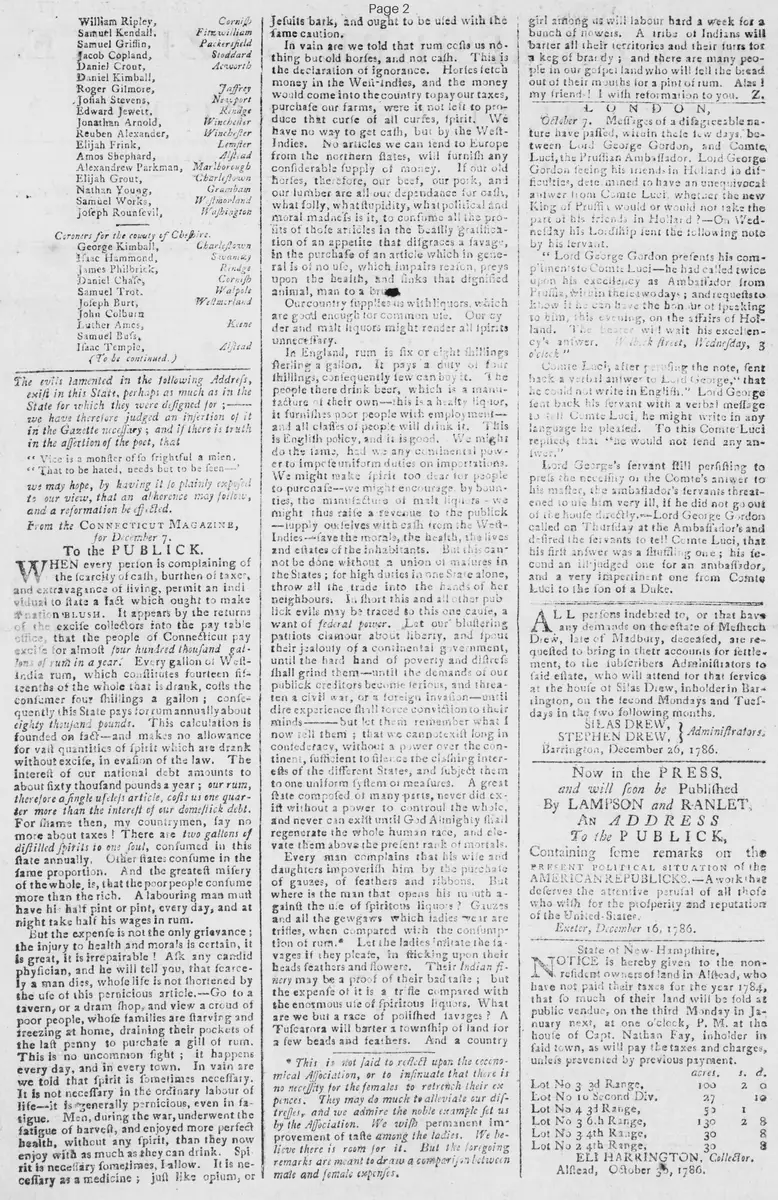
exist in this State, perhaps as much as in the
State for which they were designed ;--we
have therefore judged an insertion of it
in the Gazette necessary : and if there is truth
in the assertion of the poet, that
" Vice is a monster of so frightful a mien.
That to be hated, needs but to be seen--"
we may hope, by having it so plainly exposed
to our view, that an abhorrence may follow,
and a reformation be effected.
From the Connecticut Magazine,
for December 7.
To the PUBLIC.
WHEN every person is complaining of
the scarcity of cash, burden of taxes
and extravagance of living, permit an indi-
vidual to state a fact which ought to make
Nation blush. It appears by the returns
of the excise collectors into the pay table
office, that the people of Connecticut pay
excise for almost four hundred thousand gal-
lons of rum in a year. Every gallon of West-
India rum, which constitutes fourteen fif-
teenths of the whole that is drank, costs the
consumer four shillings a gallon ; conse-
quently this State pays for rum annually about
eighty thousand pounds. This calculation is
founded on fact--and makes no allowance
for vast quantities of spirit which are drank
without excise, in evasion of the law. The
interest of our national debt amounts to
about sixty thousand pounds a year ; our rum,
therefore a single useless article, costs us one quar-
ter more than the interest of our domestick debt.
For shame then, my countrymen, say no
more about taxes ! There are two gallons of
distilled spirits to one soul, consumed in this
state annually. Other states consume in the
same proportion. And the greatest misery
of the whole, is, that the poor people consume
more than the rich. A labouring man must
have his half pint or pint, every day, and at
night take half his wages in rum.
But the expense is not the only grievance;
the injury to health and morals is certain, it
is great, it is irreparable ! Ask any candid
physician, and he will tell you, that scarce-
ly a man dies, whose life is not shortened by
the use of this pernicious article.---Go to a
tavern, or a dram shop, and view a crowd of
poor people, whose families are starving and
freezing at home, draining their pockets of
the last penny to purchase a gill of rum.
This is no uncommon sight ; it happens
every day, and in every town. In vain are
we told that spirit is sometimes necessary.
It is not necessary in the ordinary labour of
life--it is generally pernicious, even in fa-
tigue. Men, during the war, underwent the
fatigue of harvest, and enjoyed more perfect
health, without any spirit, than they now
enjoy with as much as they can drink. Spi-
rit is necessary sometimes, I allow. It is ne-
cessary as a medicine ; just like opium, or
Jesuits bark, and ought to be used with the
same caution.
In vain are we told that rum costs us no-
thing but old horses, and not cash. This is
the declaration of ignorance. Horses fetch
money in the West-indies, and the money
would come into the country to pay our taxes,
purchase our farms, were it not left to pro-
duce that curse of all curses, spirit. We
have no way to get cash, but by the West-
Indies. No articles we can send to Europe
from the northern states, will furnish any
considerable supply of money. If our old
horses, therefore, our beef, our pork, and
our lumber are all our dependence for cash,
what folly, what stupidity, what political and
moral madness is it, to consume all the pro-
fits of those articles in the beastly gratifica-
tion of an appetite that disgraces a savage,
in the purchase of an article which in gene-
ral is of no use, which impairs reason, preys
upon the health, and sinks that dignified
animal, man to a brute.
Our country supplies us with liquors, which
are good enough for common use. Our cy-
der and malt liquors might render all spirits
unnecessary.
In England, rum is six or eight shillings
sterling a gallon. It pays a duty of four
shillings, consequently few can buy it. The
people there drink beer, which is a manu-
ufacture of their own--this is a healthy liquor.
it furnishes poor people with employment,
and all classes of people will drink it. This
is English policy, and it is good. We might
do the same, had we any continental pow-
er to impose uniform duties on importations.
We might make spirit too dear for people
to purchase--we might encourage, by boun-
ties, the manufacture of malt liquors - we
might thus raise a revenue to the publick
--supply ourselves with cash from the West-
Indies--save the morals, the health, the lives
and estates of the inhabitants. But this can-
not be done without a union of measures in
the States : for high duties in one State alone,
throw all the trade into the hands of her
neighbours. In short this and all other pub-
lic evils may be traced to this one cause, a
want of federal power. Let our blustering
patriots clamour about liberty, and spout
their jealousy of a continental government,
until the hard hand of poverty and distress
shall grind them--until the demands of our
publick creditors become serious, and threa-
ten a civil war, or a foreign invasion--until
dire experience shall force conviction to their
minds--nay--but let them remember what I
now tell them : that we cannot exist long in
confederacy, without a power over the con-
tinent, sufficient to silence the clashing inter-
ets of the different States, and subject them
to one uniform system of measures. A great
state composed of many parts, never did ex-
ist without a power to control the whole,
and never can exist until God Almighty shall
regenerate the whole human race, and ele-
vate them above the present rank of mortals.
Every man complains that his wife and
daughters impoverish him by the purchase
of gauzes, of feathers and ribbons. But
where is the man that opens his mouth a-
gainst the use of spirituous liquors ? Gauzes
and all the gewgaws which ladies wear are
trifles, when compared with the consump-
tion of rum. Let the ladies imitate the sa-
vages if they please, in sticking upon their
heads feathers and flowers. Their Indian fi-
nery may be a proof of their bad taste : but
the expense of it is a trifle compared with
the enormous use of spirituous liquors. What
are we but a race of polished savages ? A
Tuscarora will barter a township of land for
a few beads and feathers. And a country
* This is not said to reflect upon the ecoNo-
mical Association, or to insinuate that there is
no necessity for the females to retrench their ex-
pences. They may do much to alleviate our dis-
tresses, and we admire the noble example set us
by the Association. We wish permanent im-
provement of taste among the ladies. We be-
lieve there is room for it. But the foregoing
remarks are meant to draw a comparison between
male and female expenses.
girl among us will labour hard a week for a
bunch of flowers. A tribe of Indians will
barter all their territories and their furs for
a keg of brandy ; and there are many peo-
ple in our gospel land who will sell the bread
out of their mouths for a pint of rum. Alas !
my friend-- I wish reformation to you. Z.
What sub-type of article is it?
What keywords are associated?
What entities or persons were involved?
Editorial Details
Primary Topic
Evils Of Rum Consumption And Call For Federal Power To Regulate
Stance / Tone
Strong Moral Condemnation Of Spirituous Liquors And Advocacy For Temperance And Stronger Continental Government
Key Figures
Key Arguments