Thank you for visiting SNEWPapers!
Sign up free
Editorial
May 3, 1827
Martinsburg Gazette And Public Advertiser
Martinsburg, Berkeley County, West Virginia
What is this article about?
The editorial highlights inconsistencies in the views of DeWitt Clinton and Wm. B. Giles on the federal government's power to fund and construct roads and canals for internal improvements, contrasting their earlier support with later opposition.
Clipping
OCR Quality
95%
Excellent
Full Text
From the American Patriot
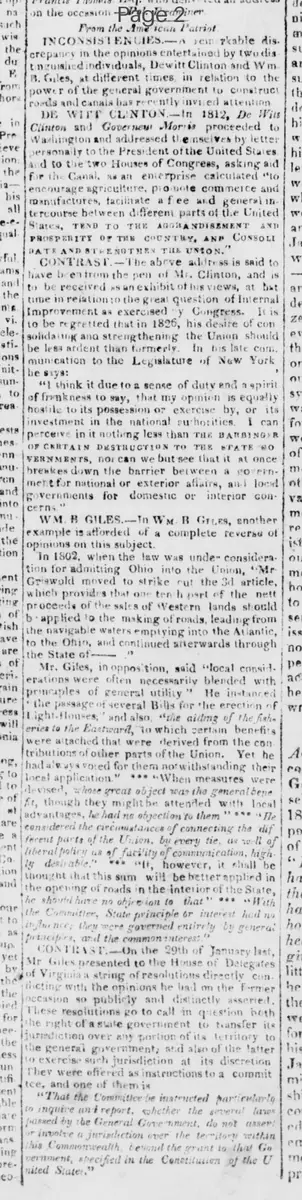
INCONSISTENCIES.—A remarkable discrepancy in the opinions entertained by two distinguished individuals, DeWitt Clinton and Wm. B. Giles, at different times in relation to the power of the general government to construct roads and canals has recently invited attention.
DE WITT CLINTON.—In 1812, De Witt Clinton and Governor DeWitt Morris proceeded to Washington and addressed themselves by letter personally to the President of the United States and to the two Houses of Congress, asking aid for the Canal, as an enterprise calculated "to encourage agriculture, promote commerce and manufactures, facilitate a free and general intercourse between different parts of the United States, TEND TO THE AGGRANDISEMENT AND PROSPERITY OF THE COUNTRY, AND CONSOLIDATE AND STRENGTHEN THE UNION."
CONTRAST.—The above address is said to have been from the pen of Mr. Clinton, and is to be received as an exhibit of his views, at that time in relation to the great question of Internal Improvement as exercised by Congress. It is to be regretted that in 1826, his desire of consolidating and strengthening the Union should be less ardent than formerly. In his late communication to the Legislature of New York he says:
"I think it due to a sense of duty and a spirit of frankness to say, that my opinion is equally hostile to its possession or exercise by, or its investment in the national authorities I can perceive in it nothing less than THE HARBINGER OF CERTAIN DESTRUCTION TO THE STATE GOVERNMENTS, nor can we but see that it at once breaks down the barrier between a government for national or exterior affairs, and local governments for domestic or interior concerns."
WM. B. GILES.—In Wm. B. Giles, another example is afforded of a complete reversal of opinions on this subject.
In 1802, when the law was under consideration for admitting Ohio into the Union, "Mr. Griswold moved to strike out the 3d article, which provides that one tenth part of the nett proceeds of the sales of Western lands should be applied to the making of roads, leading from the navigable waters emptying into the Atlantic, to the Ohio, and continued afterwards through the State of—"
Mr. Giles, in opposition, said "local considerations were often necessarily blended with principles of general utility" He instanced the passage of several Bills for the erection of Light-Houses.'and also, "the aiding of the fisheries to the Eastward, to which certain benefits were attached that were derived from the contributions of other parts of the Union. Yet he had always voted for them notwithstanding their local application". "When measures were proposed, whose great object was the general benefit, though they might be attended with local advantages, he had no objection to them". "He considered the circumstances of connecting the different parts of the Union, by every tie, as full of liberal policy as of facility of communication, highly desirable." "It, however, it shall be thought that this sum will be better applied in the opening of roads in the interior of the State, he should have no objection to that". "With the Committee, State principle or interest had no influence, they were governed entirely by general principles, and the common interest:."
CONTRAST.—On the 29th of January last, Mr. Giles presented to the House of Delegates of Virginia a string of resolutions directly contradicting with the opinions he had on the former occasion so publicly and distinctly asserted.
These resolutions go to call in question both the right of a state government to transfer its jurisdiction over any portion of its territory to the general government: and also of the latter to exercise such jurisdiction at its discretion.
They were offered as instructions to a committee, and one of them is
"That the Committee be instructed particularly to inquire and report, whether the several laws passed by the General Government, do not assert or involve a jurisdiction over the territory within this Commonwealth beyond the grant to that Government, specified in the Constitution of the United States."
INCONSISTENCIES.—A remarkable discrepancy in the opinions entertained by two distinguished individuals, DeWitt Clinton and Wm. B. Giles, at different times in relation to the power of the general government to construct roads and canals has recently invited attention.
DE WITT CLINTON.—In 1812, De Witt Clinton and Governor DeWitt Morris proceeded to Washington and addressed themselves by letter personally to the President of the United States and to the two Houses of Congress, asking aid for the Canal, as an enterprise calculated "to encourage agriculture, promote commerce and manufactures, facilitate a free and general intercourse between different parts of the United States, TEND TO THE AGGRANDISEMENT AND PROSPERITY OF THE COUNTRY, AND CONSOLIDATE AND STRENGTHEN THE UNION."
CONTRAST.—The above address is said to have been from the pen of Mr. Clinton, and is to be received as an exhibit of his views, at that time in relation to the great question of Internal Improvement as exercised by Congress. It is to be regretted that in 1826, his desire of consolidating and strengthening the Union should be less ardent than formerly. In his late communication to the Legislature of New York he says:
"I think it due to a sense of duty and a spirit of frankness to say, that my opinion is equally hostile to its possession or exercise by, or its investment in the national authorities I can perceive in it nothing less than THE HARBINGER OF CERTAIN DESTRUCTION TO THE STATE GOVERNMENTS, nor can we but see that it at once breaks down the barrier between a government for national or exterior affairs, and local governments for domestic or interior concerns."
WM. B. GILES.—In Wm. B. Giles, another example is afforded of a complete reversal of opinions on this subject.
In 1802, when the law was under consideration for admitting Ohio into the Union, "Mr. Griswold moved to strike out the 3d article, which provides that one tenth part of the nett proceeds of the sales of Western lands should be applied to the making of roads, leading from the navigable waters emptying into the Atlantic, to the Ohio, and continued afterwards through the State of—"
Mr. Giles, in opposition, said "local considerations were often necessarily blended with principles of general utility" He instanced the passage of several Bills for the erection of Light-Houses.'and also, "the aiding of the fisheries to the Eastward, to which certain benefits were attached that were derived from the contributions of other parts of the Union. Yet he had always voted for them notwithstanding their local application". "When measures were proposed, whose great object was the general benefit, though they might be attended with local advantages, he had no objection to them". "He considered the circumstances of connecting the different parts of the Union, by every tie, as full of liberal policy as of facility of communication, highly desirable." "It, however, it shall be thought that this sum will be better applied in the opening of roads in the interior of the State, he should have no objection to that". "With the Committee, State principle or interest had no influence, they were governed entirely by general principles, and the common interest:."
CONTRAST.—On the 29th of January last, Mr. Giles presented to the House of Delegates of Virginia a string of resolutions directly contradicting with the opinions he had on the former occasion so publicly and distinctly asserted.
These resolutions go to call in question both the right of a state government to transfer its jurisdiction over any portion of its territory to the general government: and also of the latter to exercise such jurisdiction at its discretion.
They were offered as instructions to a committee, and one of them is
"That the Committee be instructed particularly to inquire and report, whether the several laws passed by the General Government, do not assert or involve a jurisdiction over the territory within this Commonwealth beyond the grant to that Government, specified in the Constitution of the United States."
What sub-type of article is it?
Constitutional
Infrastructure
What keywords are associated?
Internal Improvements
Federal Power
Roads And Canals
Constitutional Jurisdiction
Opinion Inconsistencies
Dewitt Clinton
Wm. B. Giles
What entities or persons were involved?
Dewitt Clinton
Wm. B. Giles
Governor Dewitt Morris
President Of The United States
Congress
Legislature Of New York
House Of Delegates Of Virginia
Mr. Griswold
Editorial Details
Primary Topic
Inconsistencies In Views On Federal Power For Internal Improvements
Stance / Tone
Critical Of Opinion Reversals
Key Figures
Dewitt Clinton
Wm. B. Giles
Governor Dewitt Morris
President Of The United States
Congress
Legislature Of New York
House Of Delegates Of Virginia
Mr. Griswold
Key Arguments
Dewitt Clinton In 1812 Supported Federal Aid For Canals To Promote Agriculture, Commerce, And Union Strength
Dewitt Clinton In 1826 Opposed Federal Internal Improvements As Destructive To State Governments
Wm. B. Giles In 1802 Supported Federal Funding For Roads Connecting Parts Of The Union For General Benefit
Wm. B. Giles In January Presented Resolutions Questioning Federal Jurisdiction Over State Territory