Thank you for visiting SNEWPapers!
Sign up free
Literary
August 3, 1835
Lynchburg Virginian
Lynchburg, Virginia
What is this article about?
A descriptive poem by a 15-year-old student, inspired by an engraving of Fingal's Cave on Staffa island, Scotland. It portrays the cave's natural majesty formed by basaltic pillars, contrasts it with human art, and argues for divine creation against skepticism.
Clipping
OCR Quality
95%
Excellent
Full Text
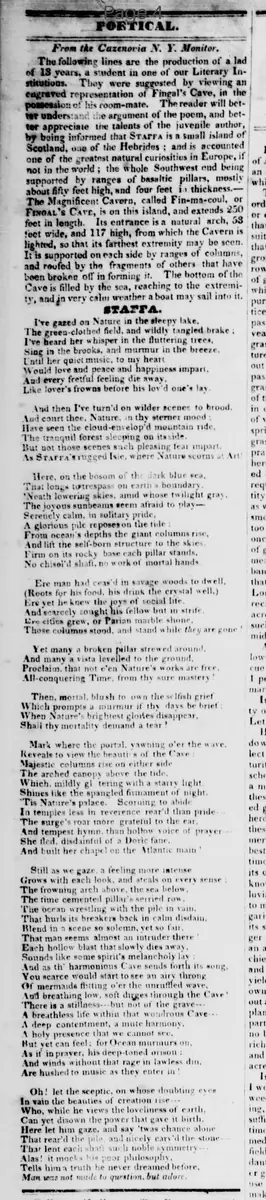
POETICAL.
From the Catskill, N. Y. Monitor.
The following lines are the production of a lad of 15 years, a student in one of our Literary Institutions. They were suggested by viewing an engraved representation of Fingal's Cave, in the possession of his room-mate. The reader will better understand the argument of the poem, and better appreciate the talents of the juvenile author, by being informed that Staffa is a small island of Scotland, one of the Hebrides; and is accounted one of the greatest natural curiosities in Europe, if not in the world; the whole Southwest end being supported by ranges of basaltic pillars, mostly about fifty feet high, and four feet in thickness.
The Magnificent Cavern, called Fin-ma-coul, or Fingal's Cave, is on this island, and extends 250 feet in length. Its entrance is a natural arch, 59 feet wide, and 117 high, from which the Cavern is lighted, so that its farthest extremity may be seen. It is supported on each side by ranges of columns, and roofed by the fragments of others that have been broken off in forming it. The bottom of the Cave is filled by the sea, reaching to the extremity, and in very calm weather a boat may sail into it.
STAFFA.
I've gazed on Nature in the sleepy lake.
The green-clothed field, and wildly tangled brake,
I've heard her whisper in the fluttering trees,
Sing in the brooks, and murmur in the breeze,
Until her quiet music, to my heart
Would love and peace and happiness impart.
And every fretful feeling die away.
Like lover's frowns before his lov'd one's lay
And then I've turn'd on wilder scenes to brood.
And court thee, Nature, in thy sterner mood;
Have seen the cloud-envelop'd mountain ride.
The tranquil forest sleeping on its side.
But not those scenes such pleasing fear impart.
As Staffa's rugged Isle, where Nature scorns at Art
Here, on the bosom of th' dark blue sea,
That longs to trespass on earth's boundary.
Neath lowering skies, and whose twilight gray
The joyous sunbeams seem afraid to play--
Serenely calm, in solitary pride,
A glorious pile reposes on the tide:
From ocean's depths the giant columns rise
And lift the self-born structure to the skies
Firm on its rocky base each pillar stands.
No chisel'd shaft, no work of mortal hands
Ere man had ceas'd in savage woods to dwell
(Roots for his food, his drink the crystal well.)
Ere yet he knew the joys of social life.
And scarcely sought his fellow but in strife
Ere cities grew, or Parian marble shone,
Those columns stood, and stand while they are gone
Yet many a broken pillar strewed around
And many a vista levelled to the ground.
Proclaim, that not e'en Nature's works are free.
All-conquering Time, from thy sure mastery
Then, mortal, blush to own the selfish grief
Which prompts a murmur if thy days be brief
When Nature's brightest glories disappear,
Shall thy mortality demand a tear
Mark where the portal, yawning o'er the wave.
Reveals to view the beauties of the Cave
Majestic columns rise on either side
The arched canopy above the tide,
Which, mildly glittering with a starry light
Shines like the spangled firmament of night.
'Tis Nature's palace, scorning to abide
In temples less in reverence rear'd than pride
The surge's roar more grateful to the ear.
And tempest hymn, than hollow voice of prayer
She fled, disdainful of a Doric fane.
And built her chapel on the Atlantic main
Still as we gaze, a feeling more intense
Grows with each look, and steals on every sense
The frowning arch above, the sea below,
The time cemented pillar's serried row.
The ocean wrestling with the pile in vain,
That hurls its breakers back in calm disdain.
Blend in a scene so solemn, yet so fair.
That man seems almost an intruder there
Each hollow blast that slowly dies away.
Sounds like some spirit's melancholy lay
And as th' harmonious Cave sends forth its song,
You scarce would start to see an airy throng
Of mermaids flitting o'er the unruffled wave
And breathing low, soft dirges through the Cave
There is a stillness--but not of the grave--
A breathless life within that wondrous Cave
A deep contentment, a mute harmony.
A holy presence that we cannot see,
But yet can feel: for Ocean murmurs on.
As if in prayer, his deep-toned orison :
And winds without that rage in lawless din,
Are hushed to music as they enter in
Oh! let the sceptic, on whose doubting ever
In vain the beauties of creation rise..
Who, while he views the loveliness of earth
Can yet disown the power that gave it birth.
Here let him gaze, and say 'twas chance alone
That rear'd the pile, and nicely carv'd the stone
That lent each shaft such noble symmetry
Alas! it mocks his poor philosophy.
Tells him a truth he never dreamed before.
Man was not made to question, but adore.
From the Catskill, N. Y. Monitor.
The following lines are the production of a lad of 15 years, a student in one of our Literary Institutions. They were suggested by viewing an engraved representation of Fingal's Cave, in the possession of his room-mate. The reader will better understand the argument of the poem, and better appreciate the talents of the juvenile author, by being informed that Staffa is a small island of Scotland, one of the Hebrides; and is accounted one of the greatest natural curiosities in Europe, if not in the world; the whole Southwest end being supported by ranges of basaltic pillars, mostly about fifty feet high, and four feet in thickness.
The Magnificent Cavern, called Fin-ma-coul, or Fingal's Cave, is on this island, and extends 250 feet in length. Its entrance is a natural arch, 59 feet wide, and 117 high, from which the Cavern is lighted, so that its farthest extremity may be seen. It is supported on each side by ranges of columns, and roofed by the fragments of others that have been broken off in forming it. The bottom of the Cave is filled by the sea, reaching to the extremity, and in very calm weather a boat may sail into it.
STAFFA.
I've gazed on Nature in the sleepy lake.
The green-clothed field, and wildly tangled brake,
I've heard her whisper in the fluttering trees,
Sing in the brooks, and murmur in the breeze,
Until her quiet music, to my heart
Would love and peace and happiness impart.
And every fretful feeling die away.
Like lover's frowns before his lov'd one's lay
And then I've turn'd on wilder scenes to brood.
And court thee, Nature, in thy sterner mood;
Have seen the cloud-envelop'd mountain ride.
The tranquil forest sleeping on its side.
But not those scenes such pleasing fear impart.
As Staffa's rugged Isle, where Nature scorns at Art
Here, on the bosom of th' dark blue sea,
That longs to trespass on earth's boundary.
Neath lowering skies, and whose twilight gray
The joyous sunbeams seem afraid to play--
Serenely calm, in solitary pride,
A glorious pile reposes on the tide:
From ocean's depths the giant columns rise
And lift the self-born structure to the skies
Firm on its rocky base each pillar stands.
No chisel'd shaft, no work of mortal hands
Ere man had ceas'd in savage woods to dwell
(Roots for his food, his drink the crystal well.)
Ere yet he knew the joys of social life.
And scarcely sought his fellow but in strife
Ere cities grew, or Parian marble shone,
Those columns stood, and stand while they are gone
Yet many a broken pillar strewed around
And many a vista levelled to the ground.
Proclaim, that not e'en Nature's works are free.
All-conquering Time, from thy sure mastery
Then, mortal, blush to own the selfish grief
Which prompts a murmur if thy days be brief
When Nature's brightest glories disappear,
Shall thy mortality demand a tear
Mark where the portal, yawning o'er the wave.
Reveals to view the beauties of the Cave
Majestic columns rise on either side
The arched canopy above the tide,
Which, mildly glittering with a starry light
Shines like the spangled firmament of night.
'Tis Nature's palace, scorning to abide
In temples less in reverence rear'd than pride
The surge's roar more grateful to the ear.
And tempest hymn, than hollow voice of prayer
She fled, disdainful of a Doric fane.
And built her chapel on the Atlantic main
Still as we gaze, a feeling more intense
Grows with each look, and steals on every sense
The frowning arch above, the sea below,
The time cemented pillar's serried row.
The ocean wrestling with the pile in vain,
That hurls its breakers back in calm disdain.
Blend in a scene so solemn, yet so fair.
That man seems almost an intruder there
Each hollow blast that slowly dies away.
Sounds like some spirit's melancholy lay
And as th' harmonious Cave sends forth its song,
You scarce would start to see an airy throng
Of mermaids flitting o'er the unruffled wave
And breathing low, soft dirges through the Cave
There is a stillness--but not of the grave--
A breathless life within that wondrous Cave
A deep contentment, a mute harmony.
A holy presence that we cannot see,
But yet can feel: for Ocean murmurs on.
As if in prayer, his deep-toned orison :
And winds without that rage in lawless din,
Are hushed to music as they enter in
Oh! let the sceptic, on whose doubting ever
In vain the beauties of creation rise..
Who, while he views the loveliness of earth
Can yet disown the power that gave it birth.
Here let him gaze, and say 'twas chance alone
That rear'd the pile, and nicely carv'd the stone
That lent each shaft such noble symmetry
Alas! it mocks his poor philosophy.
Tells him a truth he never dreamed before.
Man was not made to question, but adore.
What sub-type of article is it?
Poem
What themes does it cover?
Nature
Religious
Moral Virtue
What keywords are associated?
Staffa
Fingals Cave
Basaltic Columns
Nature Grandeur
Divine Creation
Juvenile Poetry
Literary Details
Title
Staffa
Subject
Suggested By Viewing An Engraved Representation Of Fingal's Cave
Key Lines
I've Gazed On Nature In The Sleepy Lake.
But Not Those Scenes Such Pleasing Fear Impart.
As Staffa's Rugged Isle, Where Nature Scorns At Art
Oh! Let The Sceptic, On Whose Doubting Ever
In Vain The Beauties Of Creation Rise..