Thank you for visiting SNEWPapers!
Sign up free
Herald Of The United States
Warren, Bristol County, Rhode Island
What is this article about?
Report of U.S. House of Representatives proceedings from December 30, 1805, to January 3, 1806, covering bills on surveys, claims, lighthouses, roads; presidential messages on debts and fortifications; resolutions on navy yards and marshals; debates on Articles of War and militia organization; petitions from hat manufacturers and others.
Clipping
OCR Quality
Full Text
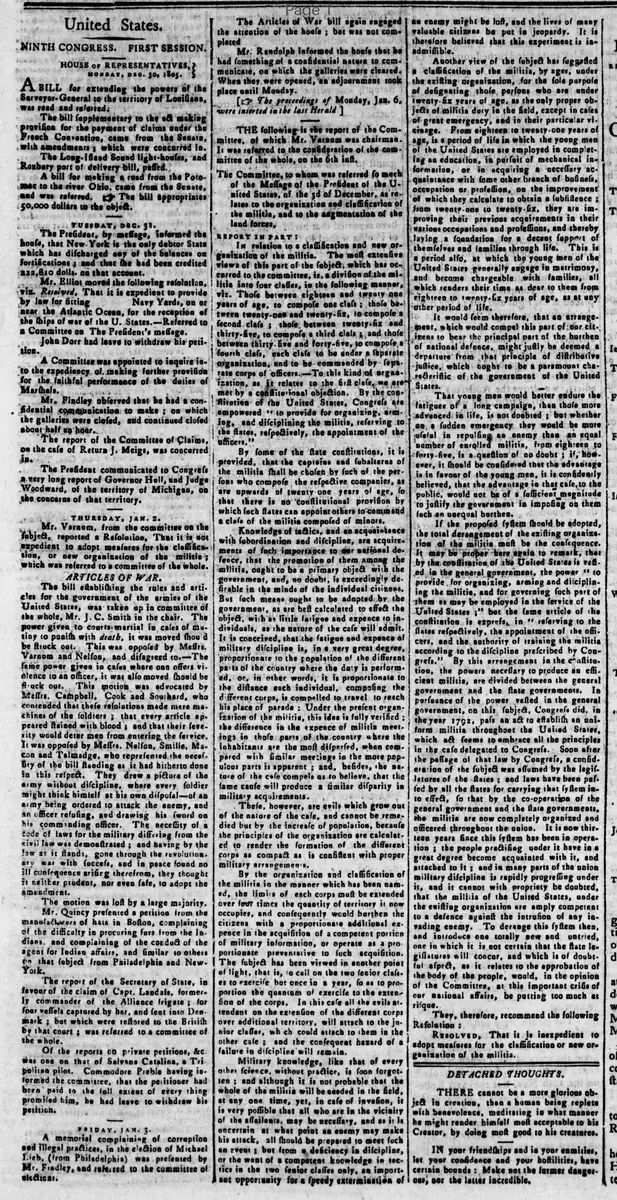
NINTH CONGRESS.
FIRST SESSION
HOUSE OF REPRESENTATIVES,
Monday, Dec. 30, 1805.
A BILL for extending the power of the Surveyor-General to the territory of Louisiana, was read and referred.
The bill supplementary to the act making provision for the payment of claims under the French Convention, came from the Senate, with amendments, which were concurred in.
The Long-Island Sound light-houses, and Roxbury port of delivery bill, passed.
A bill for making a road from the Potomac to the river Ohio, came from the Senate, and was referred. The bill appropriates $50,000 dollars to the object.
TUESDAY, DEC. 31.
The President, by message, informed the house, that New York is the only debtor State which has discharged any of the balances on fortifications, and that he had been credited $222,810 dolls. on that account.
Mr. Elliot moved the following resolution, viz. Resolved, That it is expedient to provide by law for fitting Navy Yards, on or near the Atlantic Ocean, for the reception of the ships of war of the U. States.--Referred to Committee on the President's message.
John Dorr had leave to withdraw his petition.
A Committee was appointed to inquire into the expediency of making further provision for the faithful performance of the duties of Marshals, &c.
Mr. Findley observed that he had a confidential communication to make; on which the galleries were closed, and continued closed about half an hour.
The report of the Committee of Claims, on the case of Return J. Meigs, was concurred in.
The President communicated to Congress a very long report of Governor Hull, and Judge Woodward, of the territory of Michigan, on the concerns of that territory.
THURSDAY, JAN. 2.
Mr. Varnum, from the committee on the subject, reported Resolution, That it is not expedient to adopt measures for the classification, or new organization of the militia; which was referred to a committee of the whole.
ARTICLES OF WAR.
The bill establishing the rules and articles for the government of the armies of the United States, was taken up in committee of the whole, Mr. J. C. Smith in the chair. The power given to courts-martial in cases of mutiny to punish with death, it was moved should be struck out. This was opposed by Messrs. Varnum and Nelson, and disagreed to.--The same power given in cases where one offers violence to an officer, it was also moved should be struck out. This motion was advocated by Messrs. Campbell, Cook and Southard, who contended that these resolutions made mere machines of the soldiers; that every article appeared stained with blood; and that their severity would deter men from entering the service. It was opposed by Messrs. Nelson, Smilie, Mason and Talmadge, who represented the necessity of the bill standing as it had hitherto done in this respect. They drew a picture of the army without discipline, where every soldier might think himself at his own disposal-of an army being ordered to attack the enemy, and an officer refusing, and drawing his sword on his commanding officer. The necessity of a code of laws for the military differing from the civil law was demonstrated; and having by the law as it stands, gone through the revolutionary war with success, and in peace found no ill consequence arising therefrom, they thought it neither prudent, nor even safe, to adopt the amendment. The motion was lost by a large majority.
Mr. Quincy presented a petition from the manufacturers of hats in Boston, complaining of the difficulty in procuring furs from the Indians, and complaining of the conduct of the agent for Indian affairs, and similar to others on that object from Philadelphia and New-York.
The report of the Secretary of State, in favour of the claim of Capt. Landais, formerly commander of the Alliance frigate; for our vessels captured by her, and sent into Denmark: but which were restored to the British by that court: was referred to a committee of the whole.
Of the reports on private petitions, &c. was one on that of Salvane Catalina, a Tripolitan pilot. Commodore Preble having informed the committee, that the petitioner had been paid to the full extent of every thing promised him, he had leave to withdraw his petition.
FRIDAY, JAN. 3.
A memorial complaining of corruption and illegal practices, in the election of Michael Lieb. (from Philadelphia) was presented by Mr. Findley, and referred to the committee of elections.
The Articles of War bill again engaged the attention of the house; but was not completed.
Mr. Randolph informed the house that he had something of a confidential nature to communicate, on which the galleries were cleared. When they were opened, an adjournment took place until Monday.
[The proceedings of Monday, Jan. 6, were inserted in the last Herald.]
The following is the report of the Committee, of which Mr. Varnum was chairman. It was referred to the consideration of the committee of the whole, on the 8th inst.
The Committee, to whom was referred so much of the Message of the President of the United States, of the 3d of December, as relates to the organization and classification of the militia, and to the augmentation of the land forces,
REPORT IN PART
In relation to the classification and new organization of the militia. The most extensive views of this part of the subject, which has occurred to the committee, is, a division of the militia into four classes, in the following manner, viz. Those between eighteen and twenty one years of age, to compose one class: those between twenty-one and twenty-six, to compose a second class: those between twenty six and thirty-five, to compose a third class; and those between thirty-five and forty-five, to compose a fourth class, each class to be under a separate organization, and to be commanded by separate corps of officers. To this kind of organization, as it relates to the first class, we are met by a constitutional objection. By the constitution of the United States, Congress are empowered "to provide for organizing, arming, and disciplining the militia, reserving to the states, respectively, the appointment of the officers."
By some of the state constitutions, it is provided, that the captains and subalterns of the militia shall be chosen by such of the persons who compose the respective companies, as are upwards of twenty-one years of age, so that there is no constitutional provision by which such states can appoint others to command a class of the militia composed of minors.
Knowledge of tactics, and an acquaintance with subordination and discipline, are acquirements of such importance to our national defence, that the promotion of them among the militia, ought to be a primary object with the government, and, no doubt, is exceedingly desirable in the minds of the individual citizens. But such means ought to be adopted by the government, as are best calculated to effect the object, with as little fatigue and expense to individuals, as the nature of the case will admit.
It is conceived, that the fatigue and expense of military discipline is, in a very great degree, proportionate to the population of the different parts of the country where the duty is performed, or, in other words, it is proportionate to the distance each individual, composing the different corps, is compelled to travel to reach his place of parade: Under the present organization of the militia, this idea is fully verified: the difference in the expense of militia meetings in those parts of the country where the inhabitants are the most dispersed, when compared with similar meetings in the more populous parts is apparent; and, besides, the nature of the case compels us to believe, that the same cause will produce a similar disparity in military acquirements.
These, however, are evils which grow out of the nature of the case, and cannot be remedied but by the increase of population, because the principles of the organization are calculated to render the formation of the different corps as compact as is consistent with proper military arrangements.
By the organization and classification of the militia in the manner which has been named, the limits of each corps must be extended over four times the quantity of territory it now occupies, and consequently would burden the citizens with a proportionate additional expense in the acquisition of a competent portion of military information, or operate as a proportionate preventative to such acquisition.
The subject has been viewed in another point of light, that is, to call on the two senior classes to exercise but once in a year, so as to proportion the quantum of exercise to the extension of the corps. In this case all the evils attendant on the extension of the different corps over additional territory, will attach to the junior classes, which could attach to them in the other case; and the consequent hazard of a failure in discipline will remain.
Military knowledge, like that of every other science, without practice, is soon forgotten; and although it is not probable that the whole of the militia will be needed in the field, at any one time, yet, in case of invasion, it is very possible that all who are in the vicinity of the assailants, may be necessary, and as it is uncertain at what point an enemy may make his attack, all should be prepared to meet such an event; but from a deficiency in discipline, or the want of a competent knowledge in tactics in the two senior classes only, an important opportunity for a speedy extermination of an enemy might be lost, and the lives of many valuable citizens be put in jeopardy.
It is therefore believed that this experiment is inadmissible.
Another view of the subject has suggested classification of the militia, by ages, under the existing organization, for the sole purpose of designating those persons who are under twenty-six years of age, as the only proper objects of militia duty in the field, except in cases of great emergency, and in their particular vicinity. From eighteen to twenty-one years of age, is a period of life in which the young men of the United States are employed in completing an education, in pursuit of mechanical information, or in acquiring a necessary acquaintance with some other branch of business, occupation or profession, on the improvement of which they calculate to obtain a subsistence; from twenty-one to twenty-six, they are improving their previous acquirements in their various occupations and professions, and thereby laying a foundation for a decent support of themselves and families through life. This is a period also, at which the young men of the United States generally engage in matrimony, and become chargeable, with families, all which renders their time as dear to them from eighteen to twenty-six years of age, as at any other period of life.
It would seem therefore, that an arrangement, which would compel this part of our citizens to bear the principal part of the burden of national defence, might justly be deemed a departure from that principle of distributive justice, which ought to be a paramount characteristic of the government of the United States.
That young men would better endure the fatigues of a long campaign, than those more advanced in life, is not doubted; but whether on a sudden emergency they would be more useful in repelling an enemy than an equal number of enrolled militia, from eighteen to forty-five, is a question of no doubt; if, however, it should be considered that the advantage is in favour of the young men, it is confidently believed, that the advantage in that case, to the public, would not be of sufficient magnitude to justify the government in imposing on them such an unequal burden.
If the proposed system should be adopted, the total derangement of the existing organization of the militia must be the consequence.
It may be proper here again to remark, that by the constitution of the United States is vested in the general government, the power "to provide for organizing, arming and disciplining the militia, and for governing such part of them as may be employed in the service of the United States:" but the same article of the constitution is express, in "reserving to the states respectively, the appointment of the officers, and the authority of training the militia according to the discipline prescribed by Congress."
By this arrangement in the constitution, the powers necessary to produce an efficient militia, are divided between the general government and the state governments. In pursuance of the power vested in the general government, on this object, Congress did, in the year 1792, pass an act to establish an uniform militia throughout the United States, which act seems to embrace all the principles in the case delegated to Congress.--Soon after the passage of that law by Congress, a consideration of the subject was assumed by the legislatures of the states; and laws have been passed by all the states for carrying that system into effect, so that by the co-operation of the general government and the state governments, the militia are now completely organized and officered throughout the union.
It is now thirteen years since this System has been in operation; the people practicing under it have in a great degree become acquainted with it, and attached to it: and in many parts of the union military discipline is rapidly progressing under it, and it cannot with propriety be doubted, that the militia of the United States, under the existing organization are amply competent to a defence against the intrusion of any invading enemy. To derange this System then, and introduce one totally new and untried, one in which it is not certain that the state legislatures will concur, and which is of doubtful aspect, as it relates to the approbation of the body of the people, would, in the opinion of the Committee, at this important crisis of our national affairs, be putting too much at risque.
They, therefore, recommend the following Resolution:
Resolved, That it is inexpedient to adopt measures for the classification or new organization of the militia.
What sub-type of article is it?
What keywords are associated?
What entities or persons were involved?
Where did it happen?
Domestic News Details
Primary Location
United States
Event Date
December 30, 1805 January 3, 1806
Key Persons
Outcome
bills passed or referred including lighthouse and port bill, road appropriation of $50,000; resolutions on navy yards and marshals; debates retained death penalties in articles of war; committee report recommended against militia reorganization; various petitions handled.
Event Details
The House considered bills extending surveyor powers to Louisiana, supplementary claims under French Convention (amendments concurred), Long-Island Sound lighthouses and Roxbury port (passed), and a $50,000 road from Potomac to Ohio (referred). Presidential message noted New York's fortification payments. Resolution for navy yards referred. Petition withdrawals and committee appointments occurred. Confidential communications closed galleries. Report on Return J. Meigs concurred. Michigan territory report received. Militia reorganization deemed inexpedient. Articles of War bill debated, retaining court-martial death powers for mutiny and violence against officers. Petitions from hat manufacturers on Indian furs, Capt. Landais claim, and Salvane Catalina (withdrawn). Election memorial on Michael Lieb referred. Confidential communication by Mr. Randolph led to adjournment. Detailed committee report opposed militia classification due to constitutional, practical, and equity issues, recommending no changes.