Thank you for visiting SNEWPapers!
Sign up free
Herald Of The United States
Warren, Bristol County, Rhode Island
What is this article about?
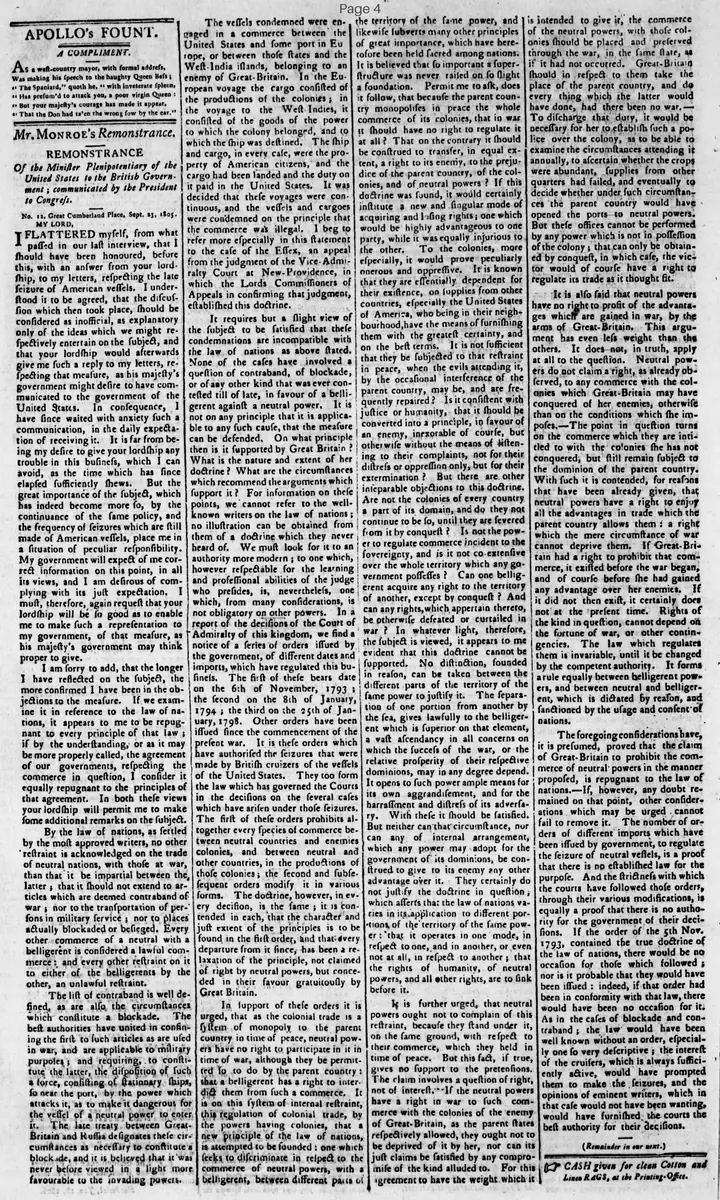
On September 23, 1805, U.S. Minister James Monroe remonstrates to the British Foreign Secretary against the seizure of American vessels under British Orders-in-Council, arguing they violate neutral rights and the law of nations by restricting trade with enemy colonies.
Clipping
OCR Quality
Full Text
REMONSTRANCE
Of the Minister Plenipotentiary of the United States to the British Government; communicated by the President to Congress.
No. 12, Great Cumberland Place, Sept. 23, 1805.
MY LORD,
I FLATTERED myself, from what passed in our last interview, that I should have been honoured, before this, with an answer from your lordship, to my letters, respecting the late seizure of American vessels. I understood it to be agreed, that the discussion which then took place, should be considered as unofficial, as explanatory only of the ideas which we might respectively entertain on the subject, and that your lordship would afterwards give me such a reply to my letters, respecting that measure, as his majesty's government might desire to have communicated to the government of the United States. In consequence, I have since waited with anxiety such a communication, in the daily expectation of receiving it. It is far from being my desire to give your lordship any trouble in this business, which I can avoid, as the time which has since elapsed sufficiently shews. But the great importance of the subject, which has indeed become more so, by the continuance of the same policy, and the frequency of seizures which are still made of American vessels, place me in a situation of peculiar responsibility. My government will expect of me correct information on this point, in all its views, and I am desirous of complying with its just expectation. I must, therefore, again request that your lordship will be so good as to enable me to make such a representation to my government, of that measure, as his majesty's government may think proper to give.
I am sorry to add, that the longer I have reflected on the subject, the more confirmed I have been in the objections to the measure. If we examine it in reference to the law of nations, it appears to me to be repugnant to every principle of that law; if by the understanding, or as it may be more properly called, the agreement of our governments, respecting the commerce in question, I consider it equally repugnant to the principles of that agreement. In both these views your lordship will permit me to make some additional remarks on the subject.
By the law of nations, as settled by the most approved writers, no other restraint is acknowledged on the trade of neutral nations, with those at war, than that it be impartial between the latter; that it should not extend to articles which are deemed contraband of war; nor to the transportation of persons in military service: nor to places actually blockaded or besieged. Every other commerce of a neutral with a belligerent is considered a lawful commerce: and every other restraint on it to either of the belligerents by the other, an unlawful restraint.
The list of contraband is well defined, as are also the circumstances which constitute a blockade. The best authorities have united in confining the first to such articles as are used in war; and are applicable to military purposes; and requiring, to constitute the latter, the disposition of such a force, consisting of stationary ships, so near the port, by the power which attacks it, as to make it dangerous for the vessel of a neutral power to enter it. The late treaty, between Great-Britain and Russia designates these circumstances as necessary to constitute a blockade, and it is believed that it was never before viewed in a light more favourable to the invading powers.
The vessels condemned were engaged in a commerce between the United States and some port in Europe, or between those states and the West-India islands, belonging to an enemy of Great-Britain. In the European voyage the cargo consisted of the productions of the colonies: in the voyage to the West Indies, it consisted of the goods of the power to which the colony belonged, and (so which the ship was destined. The ship and cargo, in every case, were the property of American citizens, and the cargo had been landed and the duty on it paid in the United States. It was decided that these voyages were continuous, and the vessels and cargoes were condemned on the principle that the commerce was illegal. I beg to refer more especially in this statement to the case of the Essex, an appeal from the judgement of the Vice-Admiralty Court at New-Providence, in which the Lords Commissioners of Appeals in confirming that judgement, established this doctrine.
It requires but a slight view of the subject to be satisfied that these condemnations are incompatible with the law of nations as above stated. None of the cases have involved a question of contraband, of blockade, or of any other kind that was ever contested till of late, in favour of a belligerent against a neutral power. It is not on any principle that it is applicable to any such case, that the measure can be defended. On what principle then is it supported by Great Britain? What is the nature and extent of her doctrine? What are the circumstances which recommend the arguments which support it? For information on these points, we cannot refer to the well-known writers on the law of nations; no illustration can be obtained from them of a doctrine which they never heard of. We must look for it to an authority more modern; to one which, however respectable for the learning and professional abilities of the judge who presides, is, nevertheless, one which, from many considerations, is not obligatory on other powers. In a report of the decisions of the Court of Admiralty of this kingdom, we find a notice of a series of orders issued by the government, of different dates and imports, which have regulated this business. The first of these bears date on the 6th of November, 1793.; the second on the 8th of January, 1794; the third on the 25th of January, 1798. Other orders have been issued since the commencement of the present war. It is these orders which have authorized the seizures that were made by British cruizers of the vessels of the United States. They too form the law which has governed the Courts in the decisions on the several cases which have arisen under those Seizures.
The first of these orders prohibits altogether every species of commerce between neutral countries and enemies colonies, and between neutral and other countries, in the productions of those colonies: the second and subsequent orders modify it in various forms. The doctrine, however, in every decision, is the same: it is contended in each, that the character and just extent of the principle is to be found in the first order, and that every departure from it since, has been a relaxation of the principle, not claimed of right by neutral powers, but conceded in their favour gratuitously by Great Britain.
In support of these orders it is urged, that as the colonial trade is a system of monopoly to the parent country in time of peace, neutral powers have no right to participate in it in time of war, although they be permitted so to do by the parent country: that a belligerent has a right to interdict them from such a commerce. It is on this system of internal restraint, this regulation of colonial trade, by the powers having colonies, that a new principle of the law of nations, is attempted to be founded: one which seeks to discriminate in respect to the commerce of neutral powers, with a belligerent, between different parts of the territory of the same power, and likewise subverts many other principles of great importance, which have heretofore been held sacred among nations.
It is believed that so important a superstructure was never raised on so slight a foundation. Permit me to ask, does it follow, that because the parent country monopolizes in peace the whole commerce of its colonies, that in war it should have no right to regulate it at all? That on the contrary it should be construed to transfer, in equal extent, a right to its enemy, to the prejudice of the parent country, of the colonies, and of neutral powers? If this doctrine was sound, it would certainly institute a new and singular mode of acquiring and losing rights; one which would be highly advantageous to one party, while it was equally injurious to the other. To the colonies, more especially, it would prove peculiarly onerous and oppressive. It is known that they are essentially dependent for their existence, on supplies from other countries, especially the United States of America, who being in their neighbourhood, have the means of furnishing them with the greatest certainty, and on the best terms. It is not sufficient that they be subjected to that restraint in peace, when the evils attending it, by the occasional interference of the parent country, may be, and are frequently repaired? Is it consistent with justice or humanity, that it should be converted into a principle, in favour of an enemy, inexorable of course, but otherwise without the means of listening to their complaints, not for their distress or oppression only, but for their extermination? But there are other inseparable objections to this doctrine.
Are not the colonies of every country a part of its domain, and do they not continue to be so, until they are severed from it by conquest? Is not the power to regulate commerce incident to the sovereignty, and is it not co-extensive over the whole territory which any government possesses? Can one belligerent acquire any right to the territory of another, except by conquest? And can any rights, which appertain thereto, be otherwise defeated or curtailed in war? In whatever light, therefore, the subject is viewed, it appears to me evident that this doctrine cannot be supported. No distinction, founded in reason, can be taken between the different parts of the territory of the same power to justify it. The separation of one portion from another by the sea, gives lawfully to the belligerent which is superior on that element, a vast ascendancy in all concerns on which the success of the war, or the relative prosperity of their respective dominions, may in any degree depend. It opens to such power ample means for its own aggrandizement, and for the harassment and distress of its adversary. With these it should be satisfied. But neither that circumstance, nor can any of internal arrangement which any power may adopt for the government of its dominions, be construed to give to its enemy any other advantage over it. They certainly do not justify the doctrine in question which asserts that the law of nations varies in its application to different portions of the territory of the same power: that it operates in one mode, in respect to one, and in another, or even not at all, in respect to another; that the rights of humanity, of neutral powers, and all other rights, are to sink before it.
It is further urged, that neutral powers ought not to complain of this restraint, because they stand under it, on the same ground, with respect to their commerce, which they held in time of peace. But this fact, if true, gives no support to the pretensions. The claim involves a question of right, not of interest. If the neutral powers have a right in war to such commerce with the colonies of the enemy of Great-Britain, as the parent states respectively allowed, they ought not to be deprived of it by her, nor can its just claims be satisfied by any compromise of the kind alluded to. For this agreement to have the weight, which it is intended to give it, the commerce of the neutral powers, with those colonies should be placed and preserved through the war, in the same state, as if it had not occurred. Great-Britain should in respect to them take the place of the parent country, and do every thing which the latter would have done, had there been no war. To discharge that duty, it would be necessary for her to establish such a police over the colony, as to be able to examine the circumstances attending it annually, to ascertain whether the crops were abundant, supplies from other quarters had failed, and eventually to decide whether under such circumstances the parent country would have opened the ports to neutral powers. But these offices cannot be performed by any power which is not in possession of the colony: that can only be obtained by conquest, in which case, the victor would of course have a right to regulate its trade as it thought fit.
It is also said that neutral powers have no right to profit of the advantages which are gained in war, by the arms of Great-Britain. This argument has even less weight than the others. It does not, in truth, apply at all to the question. Neutral powers do not claim a right, as already observed, to any commerce with the colonies which Great-Britain may have conquered of her enemies, otherwise than on the conditions which she imposes. The point in question turns on the commerce which they are entitled to with the colonies she has not conquered; but still remain subject to the dominion of the parent country. With such it is contended, for reasons that have been already given, that neutral powers have a right to enjoy all the advantages in trade which the parent country allows them: a right which the mere circumstance of war cannot deprive them. If Great-Britain had a right to prohibit that commerce, it existed before the war began, and of course before she had gained any advantage over her enemies. If it did not then exist, it certainly does not at the present time. Rights of the kind in question, cannot depend on the fortune of war, or other contingencies. The law which regulates them is invariable, until it be changed by the competent authority. It forms a rule equally between belligerent powers, and between neutral and belligerent, which is dictated by reason, and sanctioned by the usage and consent of nations.
The foregoing considerations have, it is presumed, proved that the claim of Great-Britain to prohibit the commerce of neutral powers in the manner proposed, is repugnant to the law of nations. If, however, any doubt remained on that point, other considerations which may be urged cannot fail to remove it. The number of orders of different imports which have been issued by government, to regulate the seizure of neutral vessels, is a proof that there is no established law for the purpose. And the strictness with which the courts have followed those orders, through their various modifications, is equally a proof that there is no authority for the government of their decisions. If the order of the 6th Nov. 1793, contained the true doctrine of the law of nations, there would be no occasion for those which followed; nor is it probable that they would have been issued: indeed, if that order had been in conformity with that law, there would have been no occasion for it. As in the cases of blockade and contraband: the law would have been well known without an order, especially one so very descriptive; the interest of the cruizers, which is always sufficiently active, would have prompted them to make the seizures, and the opinions of eminent writers, which in that case would not have been wanting, would have furnished the courts the best authority for their decisions.
(Remainder in our next.)
What sub-type of article is it?
What keywords are associated?
What entities or persons were involved?
Where did it happen?
Foreign News Details
Primary Location
Great Britain
Event Date
Sept. 23, 1805
Key Persons
Event Details
James Monroe, U.S. Minister Plenipotentiary, writes a remonstrance to the British Foreign Secretary protesting the seizure of American vessels engaged in trade with enemy colonies and ports, arguing that British Orders-in-Council (from 1793 onward) violate the law of nations by restricting neutral trade beyond contraband, blockade, or military transport, and infringe on U.S. rights as a neutral power. He references the Essex case and demands a formal response for communication to the U.S. government.