Thank you for visiting SNEWPapers!
Sign up free
Literary
September 30, 1818
Alexandria Gazette & Daily Advertiser
Alexandria, Virginia
What is this article about?
An 1818 article in Alexandria praises the tenderness and vivacity of Irish music's emotional impact, recounting an anecdote about the song 'Erin Go Bragh' stirring rebellion, and quoting Gerald of Wales (Cambrensis) eulogizing Irish musical skill despite his anti-Irish sentiments.
Clipping
OCR Quality
95%
Excellent
Full Text
ALEXANDRIA
WEDNESDAY, SEPTEMBER 30, 1818.
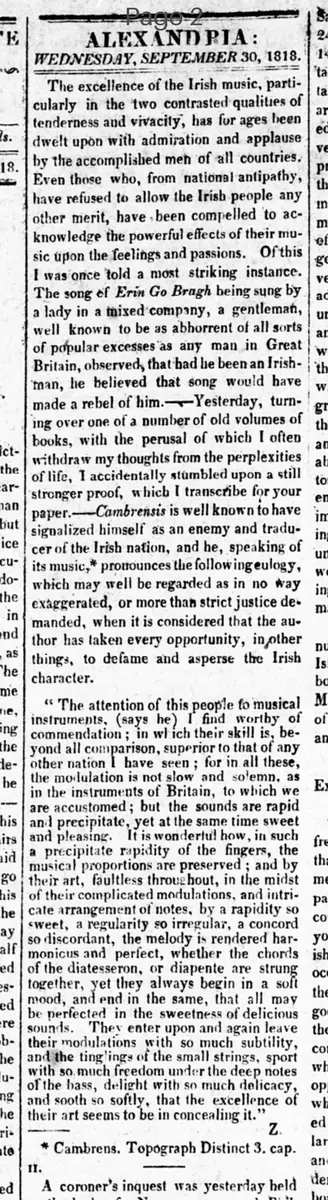
The excellence of the Irish music, particularly in the two contrasted qualities of tenderness and vivacity, has for ages been dwelt upon with admiration and applause by the accomplished men of all countries. Even those who, from national antipathy, have refused to allow the Irish people any other merit, have been compelled to acknowledge the powerful effects of their music upon the feelings and passions. Of this I was once told a most striking instance. The song of Erin Go Bragh being sung by a lady in a mixed company, a gentleman, well known to be as abhorrent of all sorts of popular excesses as any man in Great Britain, observed, that had he been an Irishman, he believed that song would have made a rebel of him.—Yesterday, turning over one of a number of old volumes of books, with the perusal of which I often withdraw my thoughts from the perplexities of life, I accidentally stumbled upon a still stronger proof, which I transcribe for your paper.—Cambrensis is well known to have signalized himself as an enemy and traducer of the Irish nation, and he, speaking of its music,* pronounces the following eulogy, which may well be regarded as in no way exaggerated, or more than strict justice demanded, when it is considered that the author has taken every opportunity, in other things, to defame and asperse the Irish character.
"The attention of this people to musical instruments, (says he) I find worthy of commendation; in which their skill is, beyond all comparison, superior to that of any other nation I have seen; for in all these, the modulation is not slow and solemn, as in the instruments of Britain, to which we are accustomed; but the sounds are rapid and precipitate, yet at the same time sweet and pleasing. It is wonderful how, in such a precipitate rapidity of the fingers, the musical proportions are preserved; and by their art, faultless throughout, in the midst of their complicated modulations, and intricate arrangement of notes, by a rapidity so sweet, a regularity so irregular, a concord so discordant, the melody is rendered harmonious and perfect, whether the chords of the diatesseron, or diapente are strung together, yet they always begin in a soft mood, and end in the same, that all may be perfected in the sweetness of delicious sounds. They enter upon and again leave their modulations with so much subtility, and the tinglings of the small strings, sport with so much freedom under the deep notes of the bass, delight with so much delicacy, and sooth so softly, that the excellence of their art seems to be in concealing it."
Z.
* Cambrens. Topograph. Distinct. 3. cap. II.
WEDNESDAY, SEPTEMBER 30, 1818.
The excellence of the Irish music, particularly in the two contrasted qualities of tenderness and vivacity, has for ages been dwelt upon with admiration and applause by the accomplished men of all countries. Even those who, from national antipathy, have refused to allow the Irish people any other merit, have been compelled to acknowledge the powerful effects of their music upon the feelings and passions. Of this I was once told a most striking instance. The song of Erin Go Bragh being sung by a lady in a mixed company, a gentleman, well known to be as abhorrent of all sorts of popular excesses as any man in Great Britain, observed, that had he been an Irishman, he believed that song would have made a rebel of him.—Yesterday, turning over one of a number of old volumes of books, with the perusal of which I often withdraw my thoughts from the perplexities of life, I accidentally stumbled upon a still stronger proof, which I transcribe for your paper.—Cambrensis is well known to have signalized himself as an enemy and traducer of the Irish nation, and he, speaking of its music,* pronounces the following eulogy, which may well be regarded as in no way exaggerated, or more than strict justice demanded, when it is considered that the author has taken every opportunity, in other things, to defame and asperse the Irish character.
"The attention of this people to musical instruments, (says he) I find worthy of commendation; in which their skill is, beyond all comparison, superior to that of any other nation I have seen; for in all these, the modulation is not slow and solemn, as in the instruments of Britain, to which we are accustomed; but the sounds are rapid and precipitate, yet at the same time sweet and pleasing. It is wonderful how, in such a precipitate rapidity of the fingers, the musical proportions are preserved; and by their art, faultless throughout, in the midst of their complicated modulations, and intricate arrangement of notes, by a rapidity so sweet, a regularity so irregular, a concord so discordant, the melody is rendered harmonious and perfect, whether the chords of the diatesseron, or diapente are strung together, yet they always begin in a soft mood, and end in the same, that all may be perfected in the sweetness of delicious sounds. They enter upon and again leave their modulations with so much subtility, and the tinglings of the small strings, sport with so much freedom under the deep notes of the bass, delight with so much delicacy, and sooth so softly, that the excellence of their art seems to be in concealing it."
Z.
* Cambrens. Topograph. Distinct. 3. cap. II.
What sub-type of article is it?
Essay
What themes does it cover?
Patriotism
Social Manners
What keywords are associated?
Irish Music
Cambrensis
Erin Go Bragh
National Antipathy
Musical Eulogy
Irish Character
What entities or persons were involved?
Z.
Literary Details
Author
Z.
Subject
Excellence Of Irish Music
Form / Style
Prose Reflection With Historical Quotation
Key Lines
The Song Of Erin Go Bragh Being Sung By A Lady In A Mixed Company, A Gentleman, Well Known To Be As Abhorrent Of All Sorts Of Popular Excesses As Any Man In Great Britain, Observed, That Had He Been An Irishman, He Believed That Song Would Have Made A Rebel Of Him.
"The Attention Of This People To Musical Instruments, (Says He) I Find Worthy Of Commendation; In Which Their Skill Is, Beyond All Comparison, Superior To That Of Any Other Nation I Have Seen;