Thank you for visiting SNEWPapers!
Sign up free
Story
August 7, 1891
The Kinsley Graphic
Kinsley, Edwards County, Kansas
What is this article about?
Wealthy New York parents face immense costs to prepare daughters for marriage, from luxurious boarding schools and accomplishments to social debuts and jewels, while steering them toward rich suitors.
Clipping
OCR Quality
95%
Excellent
Full Text
What a Daughter Costs.
Thousand Necessary to Launch Her Upon the Seas of Matrimony.
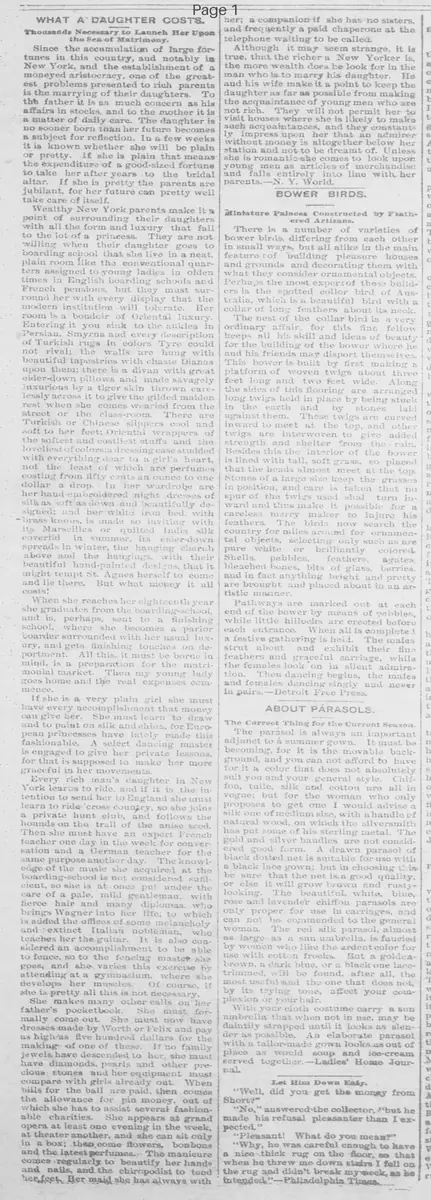
Since the accumulation of large fortunes in this country, and notably in New York, and the establishment of a moneyed aristocracy, one of the greatest problems presented to rich parents is the marrying off their daughters. To the father it is as much a concern as his affairs in stocks, and to the mother it is a matter of daily care. The daughter is no sooner born than her future becomes a subject for reflection. In a few weeks it is known whether she will be plain or pretty. If she is plain that means the expenditure of a good-sized fortune to take her after years to the bridal altar. If she is pretty the parents are jubilant, for her future can pretty well take care of itself.
Wealthy New York parents make it a point of surrounding their daughters with all the form and luxury that fall to the lot of a princess. They are not willing when their daughter goes to boarding school that she live in a neat, plain room like the conventional quarters assigned to young ladies in olden times in English boarding schools and French pensions, but they must surround her with every display that the modern institution will tolerate. Her room is a boudoir of Oriental luxury. Entering it you sink to the ankles in Persian, Smyrna and every description of Turkish rugs in colors Tyre could not rival; the walls are hung with beautiful tapestries with chaste Dianas upon them; there is a divan with great eider-down pillows and made savagely luxurious by a tiger skin thrown carelessly across it to give the gilded maiden rest when she comes wearied from the street or the class-room. There are Turkish or Chinese slippers cool and soft to her feet; Oriental wrappers of the softest and costliest stuffs and the loveliest of colors; a dressing case studded with everything dear to a girl's heart, not the least of which are perfumes costing from fifty cents an ounce to one dollar a drop. In her wardrobe are her hand-embroidered night dresses of silk as soft as down and bountifully designed; and her white iron bed, with brass knobs, is made so inviting with its Marseilles or quilted India-silk coverlet in summer, its eider-down spreads in winter, the hanging cherub above and the hangings, with their beautiful hand-painted designs, that it might tempt St. Agnes herself to come and lie there. But what money it all costs!
When she reaches her eighteenth year she graduates from the boarding-school, and is, perhaps, sent to a finishing school, where she becomes a parlor boarder surrounded with her usual luxury, and gets finishing touches on deportment. All this, it must be borne in mind, is a preparation for the matrimonial market. Then my young lady goes home and the real expenses commence.
If she is a very plain girl she must have every accomplishment that money can give her. She must learn to draw and to paint on silk and china, for European princesses have lately made this fashionable. A select dancing master is engaged to give her private lessons, for that is supposed to make her more graceful in her movements. Every rich man's daughter in New York learns to ride, and if it is the intention to send her to England she must learn to ride 'cross country, so she joins a private hunt club, and follows the hounds on the trail of the anise seed. Then she must have an expert French teacher one day in the week for conversation and a German teacher for the same purpose another day. The knowledge of the music she acquired at the boarding-school is not considered sufficient, so she is at once put under the care of a pale, mild gentleman, with fierce hair and many diplomas, who brings Wagner into her life, to which is added the offices of some melancholy and extinct Italian nobleman, who teaches her the guitar. It is also considered an accomplishment to be able to fence, so to the fencing master she goes, and she varies this exercise by attending at a gymnasium, where she develops her muscles. Of course, if she is pretty all this is not necessary.
She makes many other calls on her father's pocketbook. She must formally come out. She must now have dresses made by Worth or Felix and pay as high as five hundred dollars for the making of one of these. If no family jewels have descended to her, she must have diamonds, pearls and other precious stones and her equipment must compare with girls already out. When bills for the ball are paid, then comes the allowance for pin money, out of which she has to assist several fashionable charities. She appears at grand opera at least one evening in the week, at theater another, and she can sit only in a box; then come flowers, bonbons and the latest perfumes. The manicurist comes regularly to beautify her hands and nails and the chiropodist to tend her feet. Her maid she has always with her; a companion if she has no sisters, and frequently a paid chaperone at the telephone waiting to be called.
Although it may seem strange, it is true, that the richer a New Yorker is, the more wealth does he look for in the man who is to marry his daughter. He and his wife make it a point to keep the daughter as far as possible from making the acquaintance of young men who are not rich. They will not permit her to visit houses where she is likely to make such acquaintances, and they constantly impress upon her that an admirer without money is altogether below her station and not to be dreamt of. Unless she is romantic—she comes to look upon young men as articles of merchandise and falls entirely into line with her parents.—N. Y. World.
Thousand Necessary to Launch Her Upon the Seas of Matrimony.
Since the accumulation of large fortunes in this country, and notably in New York, and the establishment of a moneyed aristocracy, one of the greatest problems presented to rich parents is the marrying off their daughters. To the father it is as much a concern as his affairs in stocks, and to the mother it is a matter of daily care. The daughter is no sooner born than her future becomes a subject for reflection. In a few weeks it is known whether she will be plain or pretty. If she is plain that means the expenditure of a good-sized fortune to take her after years to the bridal altar. If she is pretty the parents are jubilant, for her future can pretty well take care of itself.
Wealthy New York parents make it a point of surrounding their daughters with all the form and luxury that fall to the lot of a princess. They are not willing when their daughter goes to boarding school that she live in a neat, plain room like the conventional quarters assigned to young ladies in olden times in English boarding schools and French pensions, but they must surround her with every display that the modern institution will tolerate. Her room is a boudoir of Oriental luxury. Entering it you sink to the ankles in Persian, Smyrna and every description of Turkish rugs in colors Tyre could not rival; the walls are hung with beautiful tapestries with chaste Dianas upon them; there is a divan with great eider-down pillows and made savagely luxurious by a tiger skin thrown carelessly across it to give the gilded maiden rest when she comes wearied from the street or the class-room. There are Turkish or Chinese slippers cool and soft to her feet; Oriental wrappers of the softest and costliest stuffs and the loveliest of colors; a dressing case studded with everything dear to a girl's heart, not the least of which are perfumes costing from fifty cents an ounce to one dollar a drop. In her wardrobe are her hand-embroidered night dresses of silk as soft as down and bountifully designed; and her white iron bed, with brass knobs, is made so inviting with its Marseilles or quilted India-silk coverlet in summer, its eider-down spreads in winter, the hanging cherub above and the hangings, with their beautiful hand-painted designs, that it might tempt St. Agnes herself to come and lie there. But what money it all costs!
When she reaches her eighteenth year she graduates from the boarding-school, and is, perhaps, sent to a finishing school, where she becomes a parlor boarder surrounded with her usual luxury, and gets finishing touches on deportment. All this, it must be borne in mind, is a preparation for the matrimonial market. Then my young lady goes home and the real expenses commence.
If she is a very plain girl she must have every accomplishment that money can give her. She must learn to draw and to paint on silk and china, for European princesses have lately made this fashionable. A select dancing master is engaged to give her private lessons, for that is supposed to make her more graceful in her movements. Every rich man's daughter in New York learns to ride, and if it is the intention to send her to England she must learn to ride 'cross country, so she joins a private hunt club, and follows the hounds on the trail of the anise seed. Then she must have an expert French teacher one day in the week for conversation and a German teacher for the same purpose another day. The knowledge of the music she acquired at the boarding-school is not considered sufficient, so she is at once put under the care of a pale, mild gentleman, with fierce hair and many diplomas, who brings Wagner into her life, to which is added the offices of some melancholy and extinct Italian nobleman, who teaches her the guitar. It is also considered an accomplishment to be able to fence, so to the fencing master she goes, and she varies this exercise by attending at a gymnasium, where she develops her muscles. Of course, if she is pretty all this is not necessary.
She makes many other calls on her father's pocketbook. She must formally come out. She must now have dresses made by Worth or Felix and pay as high as five hundred dollars for the making of one of these. If no family jewels have descended to her, she must have diamonds, pearls and other precious stones and her equipment must compare with girls already out. When bills for the ball are paid, then comes the allowance for pin money, out of which she has to assist several fashionable charities. She appears at grand opera at least one evening in the week, at theater another, and she can sit only in a box; then come flowers, bonbons and the latest perfumes. The manicurist comes regularly to beautify her hands and nails and the chiropodist to tend her feet. Her maid she has always with her; a companion if she has no sisters, and frequently a paid chaperone at the telephone waiting to be called.
Although it may seem strange, it is true, that the richer a New Yorker is, the more wealth does he look for in the man who is to marry his daughter. He and his wife make it a point to keep the daughter as far as possible from making the acquaintance of young men who are not rich. They will not permit her to visit houses where she is likely to make such acquaintances, and they constantly impress upon her that an admirer without money is altogether below her station and not to be dreamt of. Unless she is romantic—she comes to look upon young men as articles of merchandise and falls entirely into line with her parents.—N. Y. World.
What sub-type of article is it?
Curiosity
What themes does it cover?
Social Manners
Family
What keywords are associated?
Daughter Costs
Wealthy Parents
Matrimonial Market
Social Debut
Accomplishments
New York Aristocracy
Where did it happen?
New York
Story Details
Location
New York
Story Details
Wealthy parents in New York expend vast sums to lavish their daughters with luxury from birth, through education and accomplishments, to social debut, all to secure a rich marriage, treating suitors as merchandise.