Thank you for visiting SNEWPapers!
Sign up free
Gazette Of The United States
New York, New York County, New York
What is this article about?
This satirical essay continuation critiques the French National Assembly's religious impartiality and anti-slave trade efforts, using biblical curses on Ham's descendants and pseudo-scientific racial theories to justify perpetual negro slavery as divine will.
Merged-components note: This is a direct textual continuation of the 'Philosophical Reflections on the Late Revolution in France' essay from page 1 (reading order 2) to page 2 (reading order 3), indicated by the matching content flow and 'To be continued.' The original label for the second part was 'editorial', but it fits as part of the overall literary essay.
Clippings
1 of 2
OCR Quality
Full Text
ON THE LATE
REVOLUTION IN FRANCE, &C.
CONTINUATION.
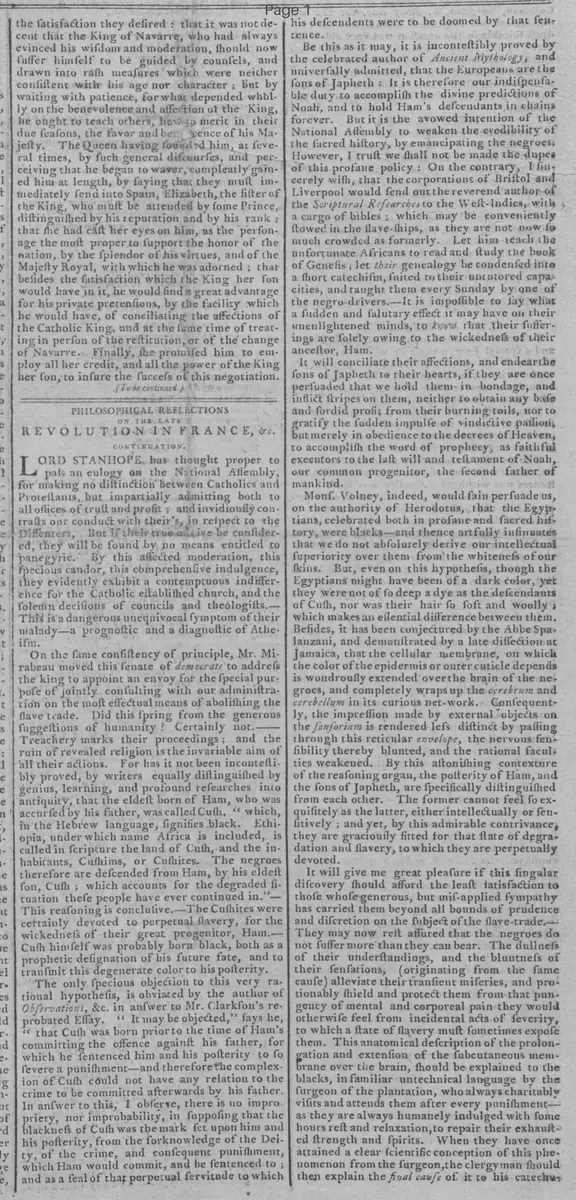
LORD STANHOPE, has thought proper to pass an eulogy on the National Assembly, for making no distinction between Catholics and Protestants, but impartially admitting both to all offices of trust and profit; and invidiously contrasts our conduct with theirs, in respect to the Dissenters. But if their true motives be considered, they will be found by no means entitled to panegyric. By this affected moderation, this specious candor, this comprehensive indulgence, they evidently exhibit a contemptuous indifference for the Catholic established church, and the solemn decisions of councils and theologians. This is a dangerous unequivocal symptom of their malady—a prognostic and a diagnostic of Atheism.
On the same consistency of principle, Mr. Mirabeau moved this senate of democrats to address the king to appoint an envoy for the special purpose of jointly consulting with our administration on the most effectual means of abolishing the slave trade. Did this spring from the generous suggestions of humanity? Certainly not. Treachery marks their proceedings; and the ruin of revealed religion is the invariable aim of all their actions. For has it not been incontestibly proved, by writers equally distinguished by genius, learning, and profound researches into antiquity, that the eldest born of Ham, who was accursed by his father, was called Cush, "which, in the Hebrew language, signifies black. Ethiopia, under which name Africa is included, is called in scripture the land of Cuth, -and the inhabitants, Cushims, or Cuthites. The negroes therefore are descended from Ham, by his eldest son, Cush; which accounts for the degraded situation these people have ever continued in." This reasoning is conclusive. The Cushites were certainly devoted to perpetual slavery, for the wickedness of their great progenitor, Ham. Cush himself was probably born black, both as a prophetic designation of his future fate, and to transmit this degenerate color to his posterity.
The only specious objection to this very rational hypothesis, is obviated by the author of Observations, &c. in answer to Mr. Clarkson's reprobated Essay. "It may be objected," says he, "that Cush was born prior to the time of Ham's committing the offence against his father, for which he sentenced him and his posterity to so severe a punishment—and therefore the complexion of Cush could not have any relation to the crime to be committed afterwards by his father. In answer to this, I observe, there is no impropriety, nor improbability, in supposing that the blackness of Cush was the mark set upon him and his posterity, from the foreknowledge of the Deity, of the crime, and consequent punishment, which Ham would commit, and be sentenced to; and as a seal of that perpetual servitude to which his descendants were to be doomed by that sentence."
Be this as it may, it is incontestibly proved by the celebrated author of Ancient Mythology, universally admitted, that the Europeans are the sons of Japheth: It is therefore our indispensable duty to accomplish the divine predictions of Noah, and to hold Ham's descendants in chains forever. But it is the avowed intention of the National Assembly to weaken the credibility of the sacred history, by emancipating the negroes. However, I trust we shall not be made the dupes of this profane policy: On the contrary, I sincerely wish, that the corporations of Bristol and Liverpool would send out the reverend author of the Scriptural Researches to the West-Indies, with a cargo of bibles; which may be conveniently towed in the slave-ships, as they are not now so much crowded as formerly. Let him teach the unfortunate Africans to read and study the book of Genesis; let their genealogy be condensed into a short catechism, suited to their untutored capacities, and taught them every Sunday by one of the negro-drivers. --It is impossible to say what a sudden and salutary effect it may have on their unenlightened minds, to know that their sufferings are solely owing to the wickedness of their ancestor, Ham.
It will conciliate their affections, and endear the sons of Japheth to their hearts, if they are once persuaded that we hold them in bondage, and inflict stripes on them, neither to obtain any base and sordid profit from their burning toils, nor to gratify the sudden impulse of vindictive passion but merely in obedience to the decrees of Heaven, to accomplish the word of prophecy, as faithful executors to the last will and testament of Noah, our common progenitor, the second father of mankind.
Monf. Volney, indeed, would fain persuade us, on the authority of Herodotus, that the Egyptians, celebrated both in profane and sacred history, were blacks—and thence artfully insinuates that we do not absolutely derive our intellectual superiority over them from the whiteness of our skins. But, even on this hypothesis, though the Egyptians might have been of a dark color, yet they were not of so deep a dye as the descendants of Cuth, nor was their hair so soft and woolly: which makes an essential difference between them. Besides, it has been conjectured by the Abbe Spalanzani, and demonstrated by a late dissection at Jamaica, that the cellular membrane, on which the color of the epidermis or outer cuticle depends is wondrously extended over the brain of the negroes, and completely wraps up the cerebrum and cerebellum in its curious net-work. Consequently, the impression made by external objects on the sensorium is rendered less distinct by passing through this reticular envelope, the nervous sensibility thereby blunted, and the rational faculties weakened. By this astonishing contexture of the reasoning organ, the posterity of Ham, and the sons of Japheth, are specifically distinguished from each other. The former cannot feel so exquisitely as the latter, either intellectually or sensitively; and yet, by this admirable contrivance, they are graciously fitted for that state of degradation and slavery, to which they are perpetually devoted.
It will give me great pleasure if this singular discovery should afford the least satisfaction to those whose generous, but mis-applied sympathy has carried them beyond all bounds of prudence and discretion on the subject of the slave-trade. They may now rest assured that the negroes do not suffer more than they can bear. The dullness of their understandings, and the bluntness of their sensations, (originating from the same cause) alleviate their transient miseries, and proportionably shield and protect them from that pungency of mental and corporeal pain they would otherwise feel from incidental acts of severity, to which a state of slavery must sometimes expose them. This anatomical description of the prolongation and extension of the subcutaneous membrane over the brain, should be explained to the blacks, in familiar untechnical language by the surgeon of the plantation, who always charitably visits and attends them after every punishment— as they are always humanely indulged with some hours rest and relaxation, to repair their exhausted strength and spirits. When they have once attained a clear scientific conception of this phenomenon from the surgeon, the clergyman should then explain the final cause of it to his catechumens.
men, that they may derive religious consolation from this marked providential inferiority of their species, and look up to their masters, mistresses, and the vigilant negro-drivers, with more awe and reverence.
To be continued.
What sub-type of article is it?
What themes does it cover?
What keywords are associated?
Literary Details
Title
Philosophical Reflections On The Late Revolution In France, &C. (Continuation)
Subject
Critique Of French Revolution Policies On Religion And Slave Trade
Key Lines