Thank you for visiting SNEWPapers!
Sign up free
Editorial
April 23, 1823
The Hillsborough Recorder
Hillsboro, Orange County, North Carolina
What is this article about?
The Village Preacher editorial urges forgiveness inspired by Jesus' prayer 'Father forgive them,' applies it to personal relationships, warns against revenge, and praises Joseph Addison's pious sentiments from the Spectator, noting his serene Christian death in 1719.
Merged-components note: Continuation of the 'Village Preacher' article on forgiveness and piety; merged due to sequential reading order and direct textual continuation.
Clipping
OCR Quality
98%
Excellent
Full Text
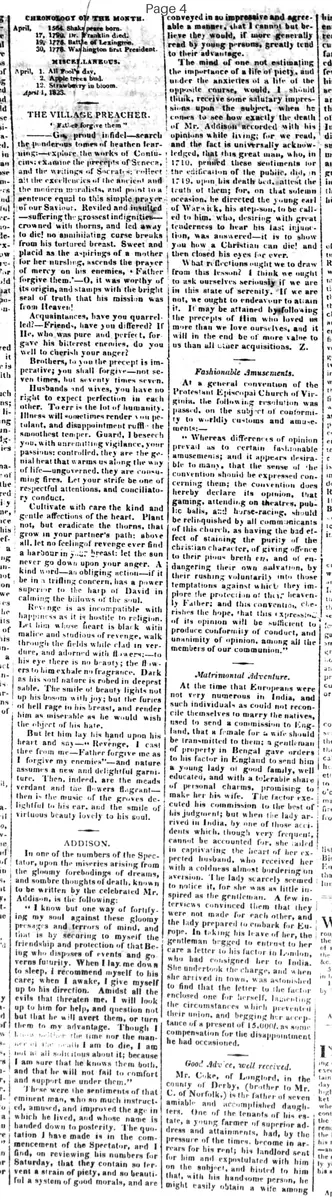
THE VILLAGE PREACHER
Father forgive them
—Gay proud infidel—search the ponderous tomes of heathen learning:—explore the works of Confucius: examine the precepts of Seneca, and the writings of Socrates: collect all the excellencies of the ancient and the modern moralists, and point to a sentence equal to this simple prayer of our Saviour. Reviled and insulted—suffering the grossest indignities—crowned with thorns, and led away to die! no annihilating curse breaks from his tortured breast. Sweet and placid as the aspirations of a mother for her nursling, ascends the prayer of mercy on his enemies, "Father forgive them."—O, it was worthy of its origin, and stamps with the bright seal of truth that his mission was from Heaven!
Acquaintances, have you quarrelled? Friends, have you differed? If He, who was pure and perfect, forgave his bitterest enemies, do you well to cherish your anger? Brothers, to you the precept is imperative; you shall forgive—not seven times, but seventy times seven. Husbands and wives, you have no right to expect perfection in each other. To err is the lot of humanity. Illness will sometimes render you petulant, and disappointment ruffle the smoothest temper. Guard, I beseech you, with unremitting vigilance, your passions: controlled, they are the genial heat that warms us along the way of life—ungoverned, they are consuming fires. Let your strife be one of respectful attentions, and conciliatory conduct.
Cultivate with care the kind and gentle affections of the heart. Plant not, but eradicate the thorns, that grow in your partner's path: above all, let no feeling of revenge ever find a harbour in your breast: let the sun never go down upon your anger. A kind word—an obliging action—if it be in a trifling concern, has a power superior to the harp of David in calming the billows of the soul.
Revenge is as incompatible with happiness as it is hostile to religion. Let him whose heart is black with malice and studious of revenge, walk through the fields while clad in verdure, and adorned with flowers;—to his eye there is no beauty; the flowers to him exhale no fragrance. Dark as his soul nature is robed in deepest sable. The smile of beauty lights not up his bosom with joy; but the furies of hell rage in his breast, and render him as miserable as he would wish the object of his hate.
But let him lay his hand upon his heart and say—"Revenge, I cast thee from me—Father forgive me as I forgive my enemies"—and nature assumes a new and delightful garniture. Then, indeed, are the meads verdant and the flowers fragrant—then in the music of the groves delightful to his ear, and the smile of virtuous beauty lovely to his soul.
ADDISON.
In one of the numbers of the Spectator, upon the miseries arising from the gloomy Forebodings of dreams, and sombre thoughts of death, known to be written by the celebrated Mr. Addison, is the following:
"I know but one way of fortifying my soul against these gloomy presages and terrors of mind, and that is by securing to myself the friendship and protection of that Being who disposes of events and governs futurity. When I lay me down to sleep, I recommend myself to his care; when I awake, I give myself up to his direction. Amidst all the evils that threaten me, I will look up to him for help, and question not but that he will avert them, or turn them to my advantage. Though I know neither the time nor the manner of my death, I am not at all solicitous about it; because I am sure that he knows them both, and that he will not fail to comfort and support me under them."
Those were the sentiments of that eminent man, who so much instructed, amused, and improved the age in which he lived, and whose name is handed down to posterity. The quotation I have made is in the commencement of the Spectator, and I find, on reviewing his numbers for Saturday, that they contain so fervent a strain of piety, and so beautiful a system of good morals, and are conveyed in so impressive and agreeable a manner, that I cannot but believe they would, if more generally read by young persons, greatly tend to their advantage.
The mind of one not estimating the importance of a life of piety, and under the anxieties of a life of the opposite course, would, I should think, receive some salutary impressions upon the subject, when he comes to see how exactly the death of Mr. Addison accorded with his opinions while living; for we read, and the fact is universally acknowledged, that this great man, who, in 1710, penned these sentiments for the edification of the public, did, in 1719, upon his death bed, attest the truth of them; for, on that solemn occasion, he directed the young earl of Warwick, his step-son, to be called to him, who, desiring with great tenderness to hear his last injunction, was answered—it is to show you how a Christian can die! and then closed his eyes for ever.
What reflections ought we to draw from this lesson? I think we ought to ask ourselves seriously if we are in this state of serenity. If we are not, we ought to endeavour to attain it. It may be attained by following the precepts of Him who loved us more than we love ourselves, and it will in the end be of more value to us than all other acquisitions. Z.
Father forgive them
—Gay proud infidel—search the ponderous tomes of heathen learning:—explore the works of Confucius: examine the precepts of Seneca, and the writings of Socrates: collect all the excellencies of the ancient and the modern moralists, and point to a sentence equal to this simple prayer of our Saviour. Reviled and insulted—suffering the grossest indignities—crowned with thorns, and led away to die! no annihilating curse breaks from his tortured breast. Sweet and placid as the aspirations of a mother for her nursling, ascends the prayer of mercy on his enemies, "Father forgive them."—O, it was worthy of its origin, and stamps with the bright seal of truth that his mission was from Heaven!
Acquaintances, have you quarrelled? Friends, have you differed? If He, who was pure and perfect, forgave his bitterest enemies, do you well to cherish your anger? Brothers, to you the precept is imperative; you shall forgive—not seven times, but seventy times seven. Husbands and wives, you have no right to expect perfection in each other. To err is the lot of humanity. Illness will sometimes render you petulant, and disappointment ruffle the smoothest temper. Guard, I beseech you, with unremitting vigilance, your passions: controlled, they are the genial heat that warms us along the way of life—ungoverned, they are consuming fires. Let your strife be one of respectful attentions, and conciliatory conduct.
Cultivate with care the kind and gentle affections of the heart. Plant not, but eradicate the thorns, that grow in your partner's path: above all, let no feeling of revenge ever find a harbour in your breast: let the sun never go down upon your anger. A kind word—an obliging action—if it be in a trifling concern, has a power superior to the harp of David in calming the billows of the soul.
Revenge is as incompatible with happiness as it is hostile to religion. Let him whose heart is black with malice and studious of revenge, walk through the fields while clad in verdure, and adorned with flowers;—to his eye there is no beauty; the flowers to him exhale no fragrance. Dark as his soul nature is robed in deepest sable. The smile of beauty lights not up his bosom with joy; but the furies of hell rage in his breast, and render him as miserable as he would wish the object of his hate.
But let him lay his hand upon his heart and say—"Revenge, I cast thee from me—Father forgive me as I forgive my enemies"—and nature assumes a new and delightful garniture. Then, indeed, are the meads verdant and the flowers fragrant—then in the music of the groves delightful to his ear, and the smile of virtuous beauty lovely to his soul.
ADDISON.
In one of the numbers of the Spectator, upon the miseries arising from the gloomy Forebodings of dreams, and sombre thoughts of death, known to be written by the celebrated Mr. Addison, is the following:
"I know but one way of fortifying my soul against these gloomy presages and terrors of mind, and that is by securing to myself the friendship and protection of that Being who disposes of events and governs futurity. When I lay me down to sleep, I recommend myself to his care; when I awake, I give myself up to his direction. Amidst all the evils that threaten me, I will look up to him for help, and question not but that he will avert them, or turn them to my advantage. Though I know neither the time nor the manner of my death, I am not at all solicitous about it; because I am sure that he knows them both, and that he will not fail to comfort and support me under them."
Those were the sentiments of that eminent man, who so much instructed, amused, and improved the age in which he lived, and whose name is handed down to posterity. The quotation I have made is in the commencement of the Spectator, and I find, on reviewing his numbers for Saturday, that they contain so fervent a strain of piety, and so beautiful a system of good morals, and are conveyed in so impressive and agreeable a manner, that I cannot but believe they would, if more generally read by young persons, greatly tend to their advantage.
The mind of one not estimating the importance of a life of piety, and under the anxieties of a life of the opposite course, would, I should think, receive some salutary impressions upon the subject, when he comes to see how exactly the death of Mr. Addison accorded with his opinions while living; for we read, and the fact is universally acknowledged, that this great man, who, in 1710, penned these sentiments for the edification of the public, did, in 1719, upon his death bed, attest the truth of them; for, on that solemn occasion, he directed the young earl of Warwick, his step-son, to be called to him, who, desiring with great tenderness to hear his last injunction, was answered—it is to show you how a Christian can die! and then closed his eyes for ever.
What reflections ought we to draw from this lesson? I think we ought to ask ourselves seriously if we are in this state of serenity. If we are not, we ought to endeavour to attain it. It may be attained by following the precepts of Him who loved us more than we love ourselves, and it will in the end be of more value to us than all other acquisitions. Z.
What sub-type of article is it?
Moral Or Religious
What keywords are associated?
Forgiveness
Piety
Revenge
Addison
Spectator
Christian Death
What entities or persons were involved?
Saviour
Confucius
Seneca
Socrates
Addison
Earl Of Warwick
Editorial Details
Primary Topic
Forgiveness, Piety, And Serene Christian Death Exemplified By Jesus And Addison
Stance / Tone
Exhortative Promotion Of Forgiveness And Religious Piety
Key Figures
Saviour
Confucius
Seneca
Socrates
Addison
Earl Of Warwick
Key Arguments
Jesus' Prayer 'Father Forgive Them' Surpasses All Moralists' Teachings
Christians Must Forgive Repeatedly As Jesus Forgave Enemies
Control Passions To Avoid Revenge, Which Destroys Happiness
Addison's Spectator Promotes Piety Against Fears Of Death
Addison Died Serenely In 1719, Exemplifying His Beliefs From 1710