Thank you for visiting SNEWPapers!
Sign up free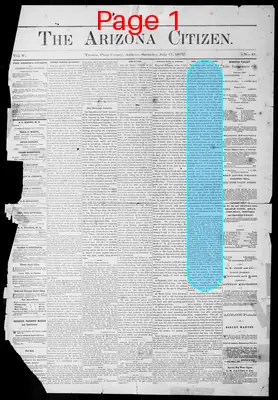
Story
July 17, 1875
Arizona Citizen
Tucson, Florence, Pima County, Pinal County, Arizona
What is this article about?
Article discusses the Colorado Desert's challenges to Arizona, misconceptions linking it to the territory, and an ongoing U.S. Engineer Corps expedition led by Lt. Wheeler, with Lt. Bergland in command, investigating irrigation feasibility by diverting the Colorado River. Includes details on instructions and team.
Clipping

OCR Quality
98%
Excellent
Full Text
THE COLORADO DESERT.
This sandy and burning area of country lying west of the Colorado river and between us and the settled portion of California, has been a source of great damage to Arizona. The press of California too often connected it in some way with our Territory, and travelers and emigrants from the west having to cross it en route hither, generally credited the hardships of passing over it to the greatly inferior ones experienced in Arizona. Of late years, that desert has had much attention by men in public life who have never seen it, but think something ought to be done to improve it, and who believe something in that line can be done. We rather think the idea of opening up a channel to the Gulf of California, expecting thereby to overflow it with ocean water, has been abandoned. Just now a party under command of Lt. Geo. M. Wheeler of the U. S. Engineer Corps. is ordered by him to make a thorough investigation of the practicability of irrigating it by turning the Colorado river on it. Lieutenant Bergland is in immediate command of the party and his instructions are to make a most thorough investigation of all points worth knowing in connection with the desert and river.
So in the course of a few months, we shall have very definite and reliable information with reference to that desert and its possible irrigation by turning the river. If it be demonstrated that the river can be turned upon the desert, the next question must be, whether such diversion will be permitted? And we think this is one about which there can be little if any doubt, for it is hardly probable that a great navigable stream may be destroyed upon any account short of a superhuman one. However, this scientific examination can hardly fail to develope some useful information.
The desert is now spanned by telegraph and soon will be again with the addition of a railway, thereby making any other condition of secondary importance to Arizona.
The closing paragraph of Lieut. Wheeler's instructions to Lieut. Bergland, reads:
Your attention should be specially directed to areas of marked depression along the route and their geographical extent, with approaches thereto, as far as practicable. The flow of the river and the character of its sediments will be determined at Camp Mojave and at the mouth of the Rio Virgen. Incidentally you will determine the points at which artificial reservoirs can be most easily constructed, taking advantage of the contour of the sub-drainage basins; the more or less impermeable character of the soil underlying them; the value for agricultural purposes of arid tracts encountered, if water can be had, and the probable amount that can be reclaimed; the analysis of alkaline, saline and other deposits; the probable climatic changes to ensue: character of the present vegetation; probable changes in the average total flow of the river in different seasons etc., etc.
Lieutenant Bergland remains in the field till October 15. Returning then to Los Angeles, he will reduce his notes and submit his report to headquarters at Washington. In the field he will be aided by Gilbert Thompson, topographer, and Dr. Oscar Loew, chemist and mineralogist, beside a numerous corps of other assistants.
This sandy and burning area of country lying west of the Colorado river and between us and the settled portion of California, has been a source of great damage to Arizona. The press of California too often connected it in some way with our Territory, and travelers and emigrants from the west having to cross it en route hither, generally credited the hardships of passing over it to the greatly inferior ones experienced in Arizona. Of late years, that desert has had much attention by men in public life who have never seen it, but think something ought to be done to improve it, and who believe something in that line can be done. We rather think the idea of opening up a channel to the Gulf of California, expecting thereby to overflow it with ocean water, has been abandoned. Just now a party under command of Lt. Geo. M. Wheeler of the U. S. Engineer Corps. is ordered by him to make a thorough investigation of the practicability of irrigating it by turning the Colorado river on it. Lieutenant Bergland is in immediate command of the party and his instructions are to make a most thorough investigation of all points worth knowing in connection with the desert and river.
So in the course of a few months, we shall have very definite and reliable information with reference to that desert and its possible irrigation by turning the river. If it be demonstrated that the river can be turned upon the desert, the next question must be, whether such diversion will be permitted? And we think this is one about which there can be little if any doubt, for it is hardly probable that a great navigable stream may be destroyed upon any account short of a superhuman one. However, this scientific examination can hardly fail to develope some useful information.
The desert is now spanned by telegraph and soon will be again with the addition of a railway, thereby making any other condition of secondary importance to Arizona.
The closing paragraph of Lieut. Wheeler's instructions to Lieut. Bergland, reads:
Your attention should be specially directed to areas of marked depression along the route and their geographical extent, with approaches thereto, as far as practicable. The flow of the river and the character of its sediments will be determined at Camp Mojave and at the mouth of the Rio Virgen. Incidentally you will determine the points at which artificial reservoirs can be most easily constructed, taking advantage of the contour of the sub-drainage basins; the more or less impermeable character of the soil underlying them; the value for agricultural purposes of arid tracts encountered, if water can be had, and the probable amount that can be reclaimed; the analysis of alkaline, saline and other deposits; the probable climatic changes to ensue: character of the present vegetation; probable changes in the average total flow of the river in different seasons etc., etc.
Lieutenant Bergland remains in the field till October 15. Returning then to Los Angeles, he will reduce his notes and submit his report to headquarters at Washington. In the field he will be aided by Gilbert Thompson, topographer, and Dr. Oscar Loew, chemist and mineralogist, beside a numerous corps of other assistants.
What sub-type of article is it?
Historical Event
Curiosity
What themes does it cover?
Exploration
Nature
What keywords are associated?
Colorado Desert
Irrigation
Colorado River
Wheeler Expedition
Bergland Survey
Arizona Territory
U.S. Engineer Corps
What entities or persons were involved?
Lt. Geo. M. Wheeler
Lieutenant Bergland
Gilbert Thompson
Dr. Oscar Loew
Where did it happen?
Colorado Desert, West Of The Colorado River, Between Arizona And California
Story Details
Key Persons
Lt. Geo. M. Wheeler
Lieutenant Bergland
Gilbert Thompson
Dr. Oscar Loew
Location
Colorado Desert, West Of The Colorado River, Between Arizona And California
Event Date
Ongoing Until October 15
Story Details
Scientific expedition investigates irrigating the Colorado Desert by diverting the Colorado River, assessing feasibility, river flow, soil, vegetation, and potential agricultural reclamation.