Thank you for visiting SNEWPapers!
Sign up free
Story
August 27, 1864
Springfield Weekly Republican
Springfield, Hampden County, Massachusetts
What is this article about?
Description of Confederate prisoners at Elmira, NY, during the Civil War: their unkempt appearances, bathing routines, receipt of letters and lavish clothing gifts from New York sympathizers, and avoidance of Union uniforms.
Clipping
OCR Quality
98%
Excellent
Full Text
The Rebel Prisoners At Elmira, N. Y.-
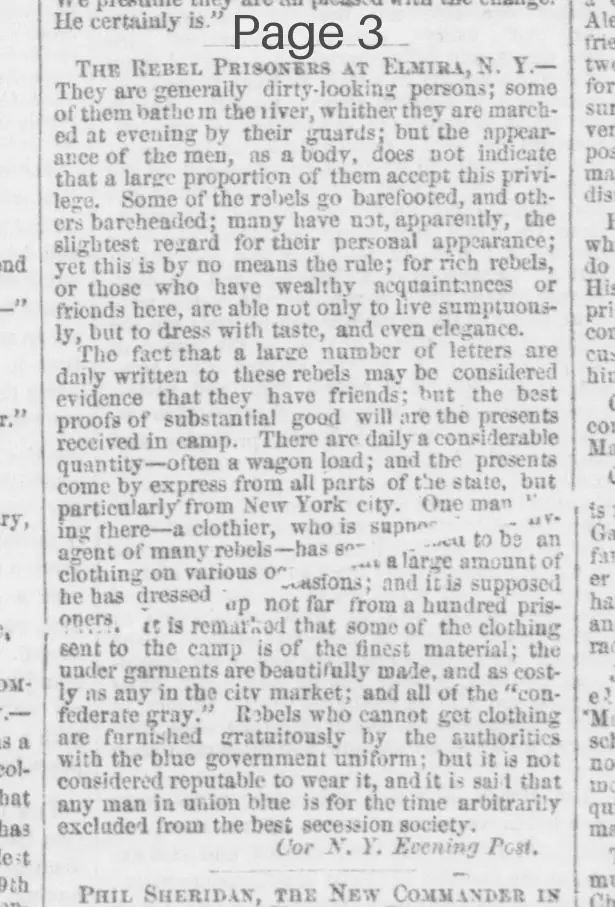
They are generally dirty-looking persons; some of them bathe in the river, whither they are marched at evening by their guards; but the appearance of the men, as a body, does not indicate that a large proportion of them accept this privilege. Some of the rebels go barefooted, and others bareheaded; many have not, apparently, the slightest regard for their personal appearance; yet this is by no means the rule; for rich rebels, or those who have wealthy acquaintances or friends here, are able not only to live sumptuously, but to dress with taste, and even elegance. The fact that a large number of letters are daily written to these rebels may be considered evidence that they have friends: but the best proofs of substantial good will are the presents received in camp. There are daily a considerable quantity-often a wagon load; and the presents come by express from all parts of the state, but particularly from New York city. One man living there-a clothier, who is supposed to be an agent of many rebels-has sent a large amount of clothing on various occasions; and it is supposed he has dressed up not far from a hundred prisoners. It is remarked that some of the clothing sent to the camp is of the finest material; the under garments are beautifully made, and as costly as any in the city market; and all of the "confederate gray." Rebels who cannot get clothing are furnished gratuitously by the authorities with the blue government uniform; but it is not considered reputable to wear it, and it is said that any man in union blue is for the time arbitrarily excluded from the best secession society.
Cor N. Y. Evening Post.
They are generally dirty-looking persons; some of them bathe in the river, whither they are marched at evening by their guards; but the appearance of the men, as a body, does not indicate that a large proportion of them accept this privilege. Some of the rebels go barefooted, and others bareheaded; many have not, apparently, the slightest regard for their personal appearance; yet this is by no means the rule; for rich rebels, or those who have wealthy acquaintances or friends here, are able not only to live sumptuously, but to dress with taste, and even elegance. The fact that a large number of letters are daily written to these rebels may be considered evidence that they have friends: but the best proofs of substantial good will are the presents received in camp. There are daily a considerable quantity-often a wagon load; and the presents come by express from all parts of the state, but particularly from New York city. One man living there-a clothier, who is supposed to be an agent of many rebels-has sent a large amount of clothing on various occasions; and it is supposed he has dressed up not far from a hundred prisoners. It is remarked that some of the clothing sent to the camp is of the finest material; the under garments are beautifully made, and as costly as any in the city market; and all of the "confederate gray." Rebels who cannot get clothing are furnished gratuitously by the authorities with the blue government uniform; but it is not considered reputable to wear it, and it is said that any man in union blue is for the time arbitrarily excluded from the best secession society.
Cor N. Y. Evening Post.
What sub-type of article is it?
Historical Event
Curiosity
What themes does it cover?
Misfortune
Social Manners
What keywords are associated?
Confederate Prisoners
Elmira Prison
Prisoner Clothing
New York Gifts
Civil War Prisoners
Where did it happen?
Elmira, N. Y.
Story Details
Location
Elmira, N. Y.
Story Details
Observational account of Confederate prisoners' appearances, hygiene, social support through letters and gifts of fine clothing from New York sympathizers, and their rejection of Union uniforms.