Thank you for visiting SNEWPapers!
Sign up free
Editorial
September 2, 1785
Fowle's New Hampshire Gazette And General Advertiser
Portsmouth, Rockingham County, New Hampshire
What is this article about?
Bryan Edwards argues for resuming free trade between British West Indies and the US, refuting Lord Sheffield's objections, affirming Ireland's fair share, emphasizing reliable American supplies over unreliable Canadian ones, and warning of humanitarian crises for slaves and economic ruin for planters due to prohibitions.
Clipping
OCR Quality
75%
Good
Full Text
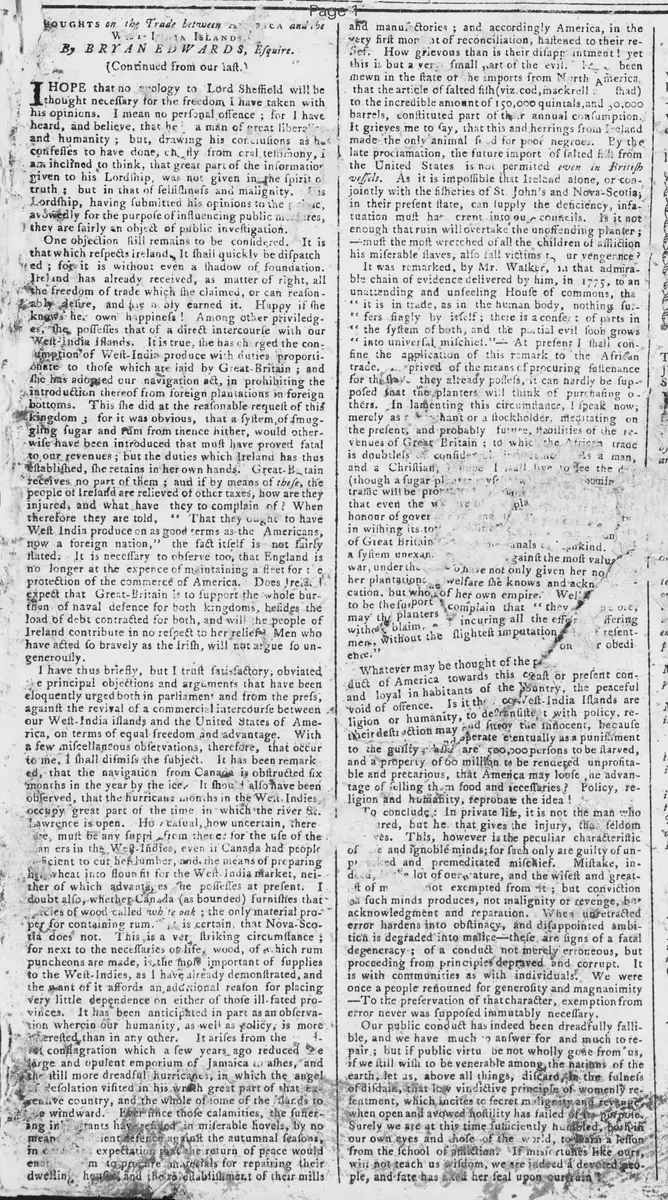
Observations on the Trade between America and the British Islands.
By BRYAN EDWARDS, Esquire.
(Continued from our last.)
I hope that no apology to Lord Sheffield will be thought necessary for the freedom I have taken with his opinions. I mean no personal offence; for I have heard, and believe, that he is a man of great liberality and humanity; but, drawing his conclusions as he confesses to have done, chiefly from oral testimony, I am inclined to think, that great part of the information given to his Lordship, was not given in the spirit of truth, but in that of selfishness and malignity. His Lordship, having submitted his opinions to the public, avowedly for the purpose of influencing public measures, they are fairly an object of public investigation.
One objection still remains to be considered. It is that which respects Ireland. It shall quickly be dispatched; for it is without even a shadow of foundation. Ireland has already received, as matter of right, all the freedom of trade which she claimed, or can reasonably desire, and nobly earned it. Happy if she knows her own happiness! Among other privileges, she possesses that of a direct intercourse with our West-India Islands. It is true, she has charged the consumption of West-India produce with duties proportionate to those which are laid by Great-Britain; and she has adopted our navigation act, in prohibiting the introduction thereof from foreign plantations in foreign bottoms. This she did at the reasonable request of this kingdom; for it was obvious, that a system of smuggling sugar and rum from thence hither, would otherwise have been introduced that must have proved fatal to our revenues; but the duties which Ireland has thus established, she retains in her own hands. Great-Britain receives no part of them: and if by means of these, the people of Ireland are relieved of other taxes, how are they injured, and what have they to complain of? When therefore they are told,
That they ought to have West-India produce on as good terms as the Americans, now a foreign nation, the fact itself is not fairly stated: It is necessary to observe too, that England is no longer at the expense of maintaining a fleet for the protection of the commerce of America. Does Ireland expect that Great-Britain is to support the whole burden of naval defence for both kingdoms, besides the load of debt contracted for both, and will the people of Ireland contribute in no respect to her relief? Men who have acted so bravely as the Irish, will not argue so ungenerously.
I have thus briefly, but I trust satisfactorily, obviated the principal objections and arguments that have been eloquently urged both in parliament and from the press, against the revival of a commercial intercourse between our West-India islands and the United States of America, on terms of equal freedom and advantage. With a few miscellaneous observations, therefore, that occur to me, I shall dismiss the subject. It has been remarked, that the navigation from Canada is obstructed six months in the year by the ice. It should also have been observed, that the hurricane months in the West-Indies occupy great part of the time in which the river St. Lawrence is open. How casual, how uncertain, therefore, there must be any supply from thence for the use of the planters in the West-Indies, even if Canada had people sufficient to cut her lumber, and the means of preparing her wheat into flour fit for the West-India market, neither of which advantages she possesses at present. I doubt also, whether Canada (as bounded) furnishes that species of wood called white oak; the only material proper for containing rum. It is certain, that Nova-Scotia does not. This is a very striking circumstance; for next to the necessaries of life, wood, of which rum puncheons are made, is the most important of supplies to the West-Indies, as I have already demonstrated, and the want of it affords an additional reason for placing very little dependence on either of those ill-fated provinces. It has been anticipated in part as an observation wherein our humanity, as well as policy, is more interested than in any other. It arises from the late conflagration which a few years ago reduced the large and opulent emporium of Jamaica to ashes, and the still more dreadful hurricanes, in which the angel of desolation visited in his wrath great part of that extensive country, and the whole of some of the islands to the windward. Ever since those calamities, the suffering islanders have resided in miserable hovels, by no means sufficient defence against the autumnal seasons. In consequence of expectation that the return of peace would enable them to procure materials for repairing their dwellings, the re-establishment of their mills and manufactories: and accordingly America, in the very first moment of reconciliation, hastened to their relief. How grievous then is their disappointment! yet this is but a very small part of the evil. It has been shown in the state of the imports from North America, that the article of salted fish (viz. cod, mackerel, shad) to the incredible amount of 150,000 quintals, and 30,000 barrels, constituted part of their annual consumption. It grieves me to say, that this and herrings from Ireland made the only animal food for poor negroes. By the late proclamation, the future import of salted fish from the United States is not permitted even in British vessels. As it is impossible that Ireland alone, or conjointly with the fisheries of St. John's and Nova-Scotia; in their present state, can supply the deficiency, infatuation must have crept into our councils. Is it not enough that ruin will overtake the unoffending planter; must the most wretched of all the children of affliction his miserable slaves, also fall victims to our vengeance? It was remarked, by Mr. Walker, in that admirable chain of evidence delivered by him, in 1775, to an unheeding and unfeeling House of Commons, that "it is in trade, as in the human body, nothing suffers singly by itself; there is a concert of parts in the system of both, and the partial evil soon grows into universal mischief."- At present I shall confine the application of this remark to the African trade. Deprived of the means of procuring sustenance for the slaves they already possess, it can hardly be supposed that the planters will think of purchasing others. In lamenting this circumstance, I speak now; merely as a merchant or a stockholder, meditating on the present, and probably future, liabilities of the revenues of Great Britain; to which the African trade is doubtless considerably tributary. As a man, and a Christian, I hope I shall be excused the day (though a sugar planter) for wishing its traffic will be prohibited; that even the welfare of the slaves may be consulted, in wishing its total abolition; a system unexampled against the most valuable part of her possessions, acquired under the most enormous expense during a long and bloody war, under the auspices of a monarch, who has not only given her no cause of offence, but whose paternal care has ever been exerted for her prosperity. She knows and acknowledges this with gratitude. but who, of her own empire. Well to be the support may the planters complain that "they are oppressed, because they do not receive, without the slightest imputation of disloyalty, or incurring all the effects of resentment, suffering the" on r obedi and loyal inhabitants of the country, the peaceful conduct of America towards this craft or present con- Whatever may be thought of the p void of offence. Is it the object-West-India Islands are their destruction may but destroy the innocent, because ligion or humanity, to de@ranfifte t with policy, re- nd.pperate eventually as a punishment to the guilty r alls are 500,pooperons to be starved, and a property of 60 million to be rendered unprofitable and precarious, that America may loose he advantage of selling th m food and necessaries? Policy, re- ligion and humanity, reprobate the idea! .
To conclude: In private life, it is not the man who suffers, but he that gives the injury, that seldom forgives. This, however is the peculiar characteristic of base and ignoble minds; for such only are guilty of un- provoked and premeditated mischief. Mistake, in- deed, is the lot of our nature, and the wisest and greatest of m iot exempted from it : but conviction on such minds produces, not malignity or revenge, but acknowledgment and reparation. . When unretracted error hardens into obstinacy, and disappointed ambi- tion is degraded into malice-there are signs of a fatal degeneracy ; of a conduct not merely erroneous, but proceeding from principles depraved and corrupt. It is with communities as with individuals. We were once a people renowned for generosity and magnanimity ---To the preservation of that character, exemption from error never was supposed immutably necessary. Our public conduct has indeed been dreadfully falli- ble, and we have much to answer for and much to re- pair.; but if public virtue be not wholly gone from us, if we still wish to be venerable among the nations of the earth, let us, above all things, discard in the fulness of disdain, that low vindictive principle of womanly re- sentment, which incites to secret malignity and revenge when open and avowed hostility has failed of its purpose.. Surely we are at this time sufficiently humbled, both in our own eyes and those of the world, to learn a lesson from the school of affliction. If misfortunes like ours, will not teach us wisdom, we are indeed a devoted peo- ple, and fate has fixed her seal upon our ruin.
By BRYAN EDWARDS, Esquire.
(Continued from our last.)
I hope that no apology to Lord Sheffield will be thought necessary for the freedom I have taken with his opinions. I mean no personal offence; for I have heard, and believe, that he is a man of great liberality and humanity; but, drawing his conclusions as he confesses to have done, chiefly from oral testimony, I am inclined to think, that great part of the information given to his Lordship, was not given in the spirit of truth, but in that of selfishness and malignity. His Lordship, having submitted his opinions to the public, avowedly for the purpose of influencing public measures, they are fairly an object of public investigation.
One objection still remains to be considered. It is that which respects Ireland. It shall quickly be dispatched; for it is without even a shadow of foundation. Ireland has already received, as matter of right, all the freedom of trade which she claimed, or can reasonably desire, and nobly earned it. Happy if she knows her own happiness! Among other privileges, she possesses that of a direct intercourse with our West-India Islands. It is true, she has charged the consumption of West-India produce with duties proportionate to those which are laid by Great-Britain; and she has adopted our navigation act, in prohibiting the introduction thereof from foreign plantations in foreign bottoms. This she did at the reasonable request of this kingdom; for it was obvious, that a system of smuggling sugar and rum from thence hither, would otherwise have been introduced that must have proved fatal to our revenues; but the duties which Ireland has thus established, she retains in her own hands. Great-Britain receives no part of them: and if by means of these, the people of Ireland are relieved of other taxes, how are they injured, and what have they to complain of? When therefore they are told,
That they ought to have West-India produce on as good terms as the Americans, now a foreign nation, the fact itself is not fairly stated: It is necessary to observe too, that England is no longer at the expense of maintaining a fleet for the protection of the commerce of America. Does Ireland expect that Great-Britain is to support the whole burden of naval defence for both kingdoms, besides the load of debt contracted for both, and will the people of Ireland contribute in no respect to her relief? Men who have acted so bravely as the Irish, will not argue so ungenerously.
I have thus briefly, but I trust satisfactorily, obviated the principal objections and arguments that have been eloquently urged both in parliament and from the press, against the revival of a commercial intercourse between our West-India islands and the United States of America, on terms of equal freedom and advantage. With a few miscellaneous observations, therefore, that occur to me, I shall dismiss the subject. It has been remarked, that the navigation from Canada is obstructed six months in the year by the ice. It should also have been observed, that the hurricane months in the West-Indies occupy great part of the time in which the river St. Lawrence is open. How casual, how uncertain, therefore, there must be any supply from thence for the use of the planters in the West-Indies, even if Canada had people sufficient to cut her lumber, and the means of preparing her wheat into flour fit for the West-India market, neither of which advantages she possesses at present. I doubt also, whether Canada (as bounded) furnishes that species of wood called white oak; the only material proper for containing rum. It is certain, that Nova-Scotia does not. This is a very striking circumstance; for next to the necessaries of life, wood, of which rum puncheons are made, is the most important of supplies to the West-Indies, as I have already demonstrated, and the want of it affords an additional reason for placing very little dependence on either of those ill-fated provinces. It has been anticipated in part as an observation wherein our humanity, as well as policy, is more interested than in any other. It arises from the late conflagration which a few years ago reduced the large and opulent emporium of Jamaica to ashes, and the still more dreadful hurricanes, in which the angel of desolation visited in his wrath great part of that extensive country, and the whole of some of the islands to the windward. Ever since those calamities, the suffering islanders have resided in miserable hovels, by no means sufficient defence against the autumnal seasons. In consequence of expectation that the return of peace would enable them to procure materials for repairing their dwellings, the re-establishment of their mills and manufactories: and accordingly America, in the very first moment of reconciliation, hastened to their relief. How grievous then is their disappointment! yet this is but a very small part of the evil. It has been shown in the state of the imports from North America, that the article of salted fish (viz. cod, mackerel, shad) to the incredible amount of 150,000 quintals, and 30,000 barrels, constituted part of their annual consumption. It grieves me to say, that this and herrings from Ireland made the only animal food for poor negroes. By the late proclamation, the future import of salted fish from the United States is not permitted even in British vessels. As it is impossible that Ireland alone, or conjointly with the fisheries of St. John's and Nova-Scotia; in their present state, can supply the deficiency, infatuation must have crept into our councils. Is it not enough that ruin will overtake the unoffending planter; must the most wretched of all the children of affliction his miserable slaves, also fall victims to our vengeance? It was remarked, by Mr. Walker, in that admirable chain of evidence delivered by him, in 1775, to an unheeding and unfeeling House of Commons, that "it is in trade, as in the human body, nothing suffers singly by itself; there is a concert of parts in the system of both, and the partial evil soon grows into universal mischief."- At present I shall confine the application of this remark to the African trade. Deprived of the means of procuring sustenance for the slaves they already possess, it can hardly be supposed that the planters will think of purchasing others. In lamenting this circumstance, I speak now; merely as a merchant or a stockholder, meditating on the present, and probably future, liabilities of the revenues of Great Britain; to which the African trade is doubtless considerably tributary. As a man, and a Christian, I hope I shall be excused the day (though a sugar planter) for wishing its traffic will be prohibited; that even the welfare of the slaves may be consulted, in wishing its total abolition; a system unexampled against the most valuable part of her possessions, acquired under the most enormous expense during a long and bloody war, under the auspices of a monarch, who has not only given her no cause of offence, but whose paternal care has ever been exerted for her prosperity. She knows and acknowledges this with gratitude. but who, of her own empire. Well to be the support may the planters complain that "they are oppressed, because they do not receive, without the slightest imputation of disloyalty, or incurring all the effects of resentment, suffering the" on r obedi and loyal inhabitants of the country, the peaceful conduct of America towards this craft or present con- Whatever may be thought of the p void of offence. Is it the object-West-India Islands are their destruction may but destroy the innocent, because ligion or humanity, to de@ranfifte t with policy, re- nd.pperate eventually as a punishment to the guilty r alls are 500,pooperons to be starved, and a property of 60 million to be rendered unprofitable and precarious, that America may loose he advantage of selling th m food and necessaries? Policy, re- ligion and humanity, reprobate the idea! .
To conclude: In private life, it is not the man who suffers, but he that gives the injury, that seldom forgives. This, however is the peculiar characteristic of base and ignoble minds; for such only are guilty of un- provoked and premeditated mischief. Mistake, in- deed, is the lot of our nature, and the wisest and greatest of m iot exempted from it : but conviction on such minds produces, not malignity or revenge, but acknowledgment and reparation. . When unretracted error hardens into obstinacy, and disappointed ambi- tion is degraded into malice-there are signs of a fatal degeneracy ; of a conduct not merely erroneous, but proceeding from principles depraved and corrupt. It is with communities as with individuals. We were once a people renowned for generosity and magnanimity ---To the preservation of that character, exemption from error never was supposed immutably necessary. Our public conduct has indeed been dreadfully falli- ble, and we have much to answer for and much to re- pair.; but if public virtue be not wholly gone from us, if we still wish to be venerable among the nations of the earth, let us, above all things, discard in the fulness of disdain, that low vindictive principle of womanly re- sentment, which incites to secret malignity and revenge when open and avowed hostility has failed of its purpose.. Surely we are at this time sufficiently humbled, both in our own eyes and those of the world, to learn a lesson from the school of affliction. If misfortunes like ours, will not teach us wisdom, we are indeed a devoted peo- ple, and fate has fixed her seal upon our ruin.
What sub-type of article is it?
Trade Or Commerce
Economic Policy
Foreign Affairs
What keywords are associated?
West India Trade
American Commerce
British Policy
Ireland Privileges
Slave Sustenance
Naval Defence
Canadian Supplies
Jamaica Disasters
African Trade
Commercial Intercourse
What entities or persons were involved?
Lord Sheffield
Bryan Edwards
Ireland
Great Britain
West India Islands
United States Of America
Canada
Nova Scotia
Jamaica
Editorial Details
Primary Topic
Advocacy For Renewed Commercial Intercourse Between British West Indies And United States
Stance / Tone
Strongly Supportive Of Trade Revival, Critical Of Restrictive Policies
Key Figures
Lord Sheffield
Bryan Edwards
Ireland
Great Britain
West India Islands
United States Of America
Canada
Nova Scotia
Jamaica
Key Arguments
Lord Sheffield's Opinions Based On Biased, Selfish Testimony
Ireland Already Enjoys Fair Trade Privileges With West Indies, Including Direct Intercourse And Retained Duties
Americans As Foreign Nation Receive Better Terms Unfairly, But Britain No Longer Protects Their Commerce
Canadian Supplies Unreliable Due To Ice, Hurricanes, And Lack Of Resources Like White Oak For Rum Puncheons
Post Disaster Reconstruction In Jamaica Relies On American Materials
Prohibition Of Salted Fish Imports Endangers Slaves' Food Supply, Impacting African Trade And Planters
Restrictions Harm Loyal West Indian Planters Without Cause, Contradicting Policy, Religion, And Humanity
Britain Should Avoid Vindictive Policies And Repair Errors For Magnanimity