Thank you for visiting SNEWPapers!
Sign up free
Editorial
December 20, 1851
New England Religious Herald
Hartford, Hartford County, Connecticut
What is this article about?
The editorial addresses a query on reconciling human actions affecting lifespan (via health laws and habits) with divine predestination of life's length. It argues using Scripture and reason that both are compatible: God works through natural causes and human agency to fulfill His purposes, as seen in biblical examples like Paul's shipwreck and Cyrus's conquest.
Clipping
OCR Quality
98%
Excellent
Full Text
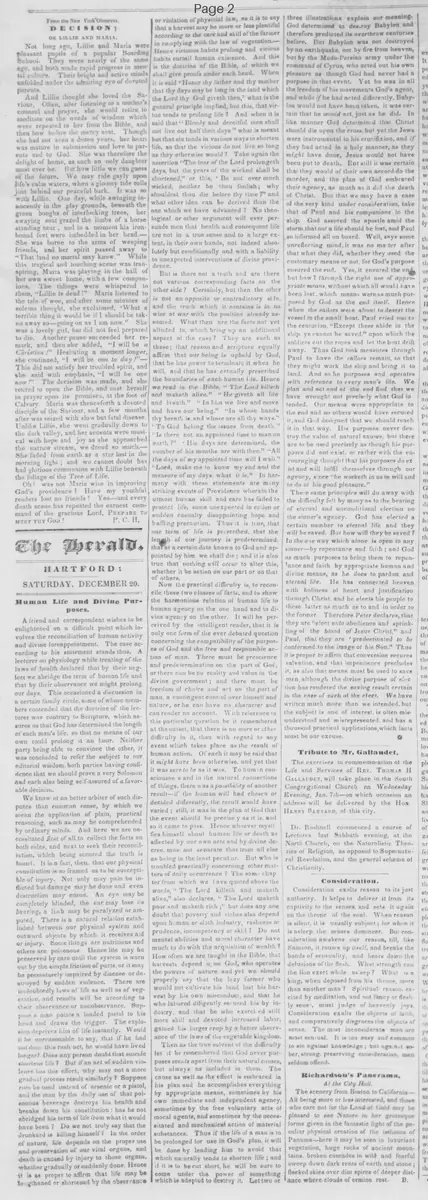
Human Life and Divine Purposes.
A friend and correspondent wishes to be enlightened on a difficult point which involves the reconciliation of human activity and divine foreappointment. The case according to his statement stands thus. A lecturer on physiology while treating of the laws of health declared that by their neglect we abridge the term of human life and that by their observance we might prolong our days. This occasioned a discussion in a certain family circle, some of whose members contended that the doctrine of the lecturer was contrary to Scripture, which assures us that God has determined the length of each man's life, so that no means of our own could prolong it an hour. Neither party being able to convince the other, it was concluded to refer the subject to our editorial wisdom, both parties having confidence that we should prove a very Solomon and each also being self-assured of a favorable decision.
We know of no better arbiter of such disputes than common sense, by which we mean the application of plain, practical reasoning, such as may be comprehended by ordinary minds. And here we are necessitated first of all to collect the facts on both sides, and next to seek their reconciliation, which being secured the truth is found. It is a fact, then, that our physical constitution is so framed as to be susceptible of injury. Not only may pain be inflicted but damage may be done and even destruction may ensue. An eye may be completely blinded, the ear may lose its hearing, a limb may be paralyzed or amputated. There is a natural relation established between our physical system and outward objects by which it receives aid or injury. Some things are nutritious and others are poisonous. Hence life may be preserved by care until the system is worn out by the simple friction of parts, or it may be prematurely impaired by disease or destroyed by sudden violence. There are undoubtedly laws of life as well as of vegetation, and results will be according to their observance or nonobservance. Suppose a man points a loaded pistol to his head and draws the trigger. The explosion deprives him of life instantly. Would it be unreasonable to say, that if he had not done this rash act, he would have lived longer? Does any person doubt that suicide shortens life? But if an act of sudden violence has this effect, why may not a more gradual process result similarly? Suppose rum be used instead of arsenic or a pistol, and the man by the daily use of that poisonous beverage destroys his health and breaks down his constitution: has he not abridged his term of life from what it would have been? Do we not truly say that the drunkard is killing himself? In the order of nature, life depends on the proper use and preservation of our vital organs, and death is caused by injury to those organs, whether gradually or suddenly done. Hence it is as proper to affirm that life may be lengthened or shortened by the observance or violation of physical law, as it is to say that a harvest may be more or less plentiful according to the care and skill of the farmer in complying with the law of vegetation.
Hence virtuous habits prolong and vicious habits curtail human existence. And this is the doctrine of the Bible, of which we shall give proofs under each head. When it is said "Honor thy father and thy mother that thy days may be long in the land which the Lord thy God giveth thee," what is the general principle implied, but this, that virtue tends to prolong life? And when it is said that "Bloody and deceitful men shall not live out half their days" what is meant but that sin tends in various ways to shorten life, so that the vicious do not live so long as they otherwise would? Take again the assertion "The fear of the Lord prolongeth days, but the years of the wicked shall be shortened," or this, "Be not over much wicked, neither be thou foolish; why shouldest thou die before thy time?" and what other idea can be derived than the one which we have advanced? No theological or other argument will ever persuade men that health and consequent life are not in a true sense and to a large extent, in their own hands, not indeed absolutely but conditionally and with a liability to unexpected interventions of divine providence.
But is there not a truth and are there not various corresponding facts on the other side? Certainly, but then the other is not an opposite or contradictory side and the truth which it contains is in no wise at war with the position already assumed. What then are the facts not yet alluded to, which bring up an additional aspect of the case? They are such as these; that reason and scripture equally affirm that our being is upheld by God, that he has power to terminate it when he will, and that he has actually prescribed the boundaries of each human life. Hence we read in the Bible, "The Lord killeth and maketh alive." "He giveth all life and breath." "In him we live and move and have our being." "In whose hands thy breath is and whose are all thy ways." "To God belong the issues from death." "Is there not an appointed time to man on earth?" "His days are determined, the number of his months are with thee." "All the days of my appointed time will I wait." "Lord, make me to know my end and the measure of my days, what it is." In harmony with these statements are many striking events of Providence wherein the utmost human skill and care has failed to protect life, some unexpected infection or sudden casualty disappointing hope and baffling precaution. Thus it is true, that our term of life is prescribed, that the length of our journey is predetermined, that at a certain date known to God and appointed by him we shall die; and it is also true that nothing will occur to alter this, whether it be action on our part or on that of others.
Now the practical difficulty is, to reconcile these two classes of facts, and to show the harmonious relation of human life to human agency on the one hand and to divine agency on the other. It will be perceived by the intelligent reader, that it is only one form of the ever debated question concerning the compatibility of the purposes of God and the free and responsible action of man. There must be prescience and predetermination on the part of God, or there can be no reality and value in the divine government; and there must be freedom of choice and act on the part of man, a contingent control over himself and nature, or he can have no character and can render no account. With reference to this particular question be it remembered at the outset, that there is no more or other difficulty in it, than with regard to any event which takes place as the result of human action. Of each it may be said that it might have been otherwise, and yet that it was sure to be as it was. To human consciousness and in the natural connections of things, there was a possibility of another result—if the human will had chosen or decided differently, the result would have varied; still, it was in the plan of God that the event should be precisely as it is, and so it came to pass. Hence whoever mystifies himself about human life or death as affected by our own acts and by divine decree, must not separate that from all else as being in the least peculiar. But who is troubled practically concerning other matters of daily occurrence? The same chapter from which we have quoted above the words, "The Lord killeth and maketh alive," also declares, "The Lord maketh poor and maketh rich;" but does any one doubt that poverty and riches also depend upon human or sloth industry, rashness or prudence, incompetency or skill? Do not mental abilities and moral character have much to do with the acquisition of wealth? How often we are taught in the Bible, that harvests depend upon God, who operates the powers of nature and yet we should properly say that the lazy farmer who would not cultivate his land lost his harvest by his own misconduct, and that he who labored diligently secured his by industry, and that he who exercised still more skill and devoted increased labor gained his larger crop by a better observance of the laws of the vegetable kingdom.
Then as the true solvent of the difficulty let it be remembered that God never purposes events apart from their natural causes, but always as included in them. The cause as well as the effect is embraced in his plan and he accomplishes everything by appropriate means, sometimes by his own immediate and independent agency sometimes by the free voluntary acts of moral agents, and sometimes by the necessitated and mechanical action of material substances. Thus if the life of a man is to be prolonged for use in God's plan, it will be done by leading him to avoid that which naturally tends to shorten life; and if it is to be cut short, he will be sure to come under the power of something which is adapted to destroy it. Let two or three illustrations explain our meaning.
God determined to destroy Babylon and therefore predicted its overthrow centuries before. But Babylon was not destroyed by an earthquake, nor by fire from heaven, but by the Medo-Persian army under the command of Cyrus, who acted out his own pleasure as though God had never had a purpose in that event. Yet he was in all the freedom of his movements God's agent, and while if he had acted differently, Babylon would not have been taken, it was certain that he would not, just as he did. In like manner God determined that Christ should die upon the cross, but yet the Jews were instrumental in his crucifixion, and if they had acted in a holy manner, as they might have done, Jesus would not have been put to death. But still it was certain that they would of their own accord do the murder, and the plan of God embraced their agency, as much as it did the death of Christ. But that we may have a case of the very kind under consideration, take that of Paul and his companions in the ship. God assured the apostle amid the storm that not a life should be lost, and Paul so informed all on board. Well, says some unreflecting mind, it was no matter after that what they did, whether they used the customary means or not, for God's purpose ensured the end. Yes, it ensured the end but how? through the right use of appropriate means without which all would have been lost, which means were as much purposed by God as the end itself. Hence when the sailors were about to desert the vessel in the small boat, Paul cried out to the centurion, "Except these abide in the ship, ye cannot be saved," upon which the soldiers cut the ropes and let the boat drift away. Thus God took measures through Paul to have the sailors remain, so that they might work the ship and bring it to land. And so he purposes and operates with reference to every man's life. We plan and act and at the end find that we have wrought out precisely what God intended. Our means were appropriate to the end and no others would have secured it, and God designed that we should reach it in that way. His purposes never destroy the value of natural causes, but these are to be used precisely as though his purposes did not exist, or rather with the encouraging thought that his purposes do exist and will fulfil themselves through our agency, since "he worketh in us to will and to do of his good pleasure."
These same principles will do away with the difficulty felt by many as to the bearing of eternal and unconditional election on the sinner's agency. God has elected a certain number to eternal life and they will be saved. But how will they be saved? In the one way which alone is open to any sinner—by repentance and faith; and God as much purposes to bring them to repentance and faith by appropriate human and divine means, as he does to pardon and eternal life. He has connected heaven with holiness of heart and justification through Christ, and he elects his people to these latter as much as to and in order to the former. Therefore Peter declares, that they are "elect unto obedience and sprinkling of the blood of Jesus Christ," and Paul, that they are "predestinated to be conformed to the image of his Son." Thus it is proper to affirm that conversion secures salvation, and that impenitence precludes it, as also that means must be used to save men although the divine purpose of election has rendered the saving result certain in the case of each of the elect. We have written much more than we intended, but the subject is one of interest, is often misunderstood and misrepresented, and has a thousand practical applications, which facts must be our excuse.
A friend and correspondent wishes to be enlightened on a difficult point which involves the reconciliation of human activity and divine foreappointment. The case according to his statement stands thus. A lecturer on physiology while treating of the laws of health declared that by their neglect we abridge the term of human life and that by their observance we might prolong our days. This occasioned a discussion in a certain family circle, some of whose members contended that the doctrine of the lecturer was contrary to Scripture, which assures us that God has determined the length of each man's life, so that no means of our own could prolong it an hour. Neither party being able to convince the other, it was concluded to refer the subject to our editorial wisdom, both parties having confidence that we should prove a very Solomon and each also being self-assured of a favorable decision.
We know of no better arbiter of such disputes than common sense, by which we mean the application of plain, practical reasoning, such as may be comprehended by ordinary minds. And here we are necessitated first of all to collect the facts on both sides, and next to seek their reconciliation, which being secured the truth is found. It is a fact, then, that our physical constitution is so framed as to be susceptible of injury. Not only may pain be inflicted but damage may be done and even destruction may ensue. An eye may be completely blinded, the ear may lose its hearing, a limb may be paralyzed or amputated. There is a natural relation established between our physical system and outward objects by which it receives aid or injury. Some things are nutritious and others are poisonous. Hence life may be preserved by care until the system is worn out by the simple friction of parts, or it may be prematurely impaired by disease or destroyed by sudden violence. There are undoubtedly laws of life as well as of vegetation, and results will be according to their observance or nonobservance. Suppose a man points a loaded pistol to his head and draws the trigger. The explosion deprives him of life instantly. Would it be unreasonable to say, that if he had not done this rash act, he would have lived longer? Does any person doubt that suicide shortens life? But if an act of sudden violence has this effect, why may not a more gradual process result similarly? Suppose rum be used instead of arsenic or a pistol, and the man by the daily use of that poisonous beverage destroys his health and breaks down his constitution: has he not abridged his term of life from what it would have been? Do we not truly say that the drunkard is killing himself? In the order of nature, life depends on the proper use and preservation of our vital organs, and death is caused by injury to those organs, whether gradually or suddenly done. Hence it is as proper to affirm that life may be lengthened or shortened by the observance or violation of physical law, as it is to say that a harvest may be more or less plentiful according to the care and skill of the farmer in complying with the law of vegetation.
Hence virtuous habits prolong and vicious habits curtail human existence. And this is the doctrine of the Bible, of which we shall give proofs under each head. When it is said "Honor thy father and thy mother that thy days may be long in the land which the Lord thy God giveth thee," what is the general principle implied, but this, that virtue tends to prolong life? And when it is said that "Bloody and deceitful men shall not live out half their days" what is meant but that sin tends in various ways to shorten life, so that the vicious do not live so long as they otherwise would? Take again the assertion "The fear of the Lord prolongeth days, but the years of the wicked shall be shortened," or this, "Be not over much wicked, neither be thou foolish; why shouldest thou die before thy time?" and what other idea can be derived than the one which we have advanced? No theological or other argument will ever persuade men that health and consequent life are not in a true sense and to a large extent, in their own hands, not indeed absolutely but conditionally and with a liability to unexpected interventions of divine providence.
But is there not a truth and are there not various corresponding facts on the other side? Certainly, but then the other is not an opposite or contradictory side and the truth which it contains is in no wise at war with the position already assumed. What then are the facts not yet alluded to, which bring up an additional aspect of the case? They are such as these; that reason and scripture equally affirm that our being is upheld by God, that he has power to terminate it when he will, and that he has actually prescribed the boundaries of each human life. Hence we read in the Bible, "The Lord killeth and maketh alive." "He giveth all life and breath." "In him we live and move and have our being." "In whose hands thy breath is and whose are all thy ways." "To God belong the issues from death." "Is there not an appointed time to man on earth?" "His days are determined, the number of his months are with thee." "All the days of my appointed time will I wait." "Lord, make me to know my end and the measure of my days, what it is." In harmony with these statements are many striking events of Providence wherein the utmost human skill and care has failed to protect life, some unexpected infection or sudden casualty disappointing hope and baffling precaution. Thus it is true, that our term of life is prescribed, that the length of our journey is predetermined, that at a certain date known to God and appointed by him we shall die; and it is also true that nothing will occur to alter this, whether it be action on our part or on that of others.
Now the practical difficulty is, to reconcile these two classes of facts, and to show the harmonious relation of human life to human agency on the one hand and to divine agency on the other. It will be perceived by the intelligent reader, that it is only one form of the ever debated question concerning the compatibility of the purposes of God and the free and responsible action of man. There must be prescience and predetermination on the part of God, or there can be no reality and value in the divine government; and there must be freedom of choice and act on the part of man, a contingent control over himself and nature, or he can have no character and can render no account. With reference to this particular question be it remembered at the outset, that there is no more or other difficulty in it, than with regard to any event which takes place as the result of human action. Of each it may be said that it might have been otherwise, and yet that it was sure to be as it was. To human consciousness and in the natural connections of things, there was a possibility of another result—if the human will had chosen or decided differently, the result would have varied; still, it was in the plan of God that the event should be precisely as it is, and so it came to pass. Hence whoever mystifies himself about human life or death as affected by our own acts and by divine decree, must not separate that from all else as being in the least peculiar. But who is troubled practically concerning other matters of daily occurrence? The same chapter from which we have quoted above the words, "The Lord killeth and maketh alive," also declares, "The Lord maketh poor and maketh rich;" but does any one doubt that poverty and riches also depend upon human or sloth industry, rashness or prudence, incompetency or skill? Do not mental abilities and moral character have much to do with the acquisition of wealth? How often we are taught in the Bible, that harvests depend upon God, who operates the powers of nature and yet we should properly say that the lazy farmer who would not cultivate his land lost his harvest by his own misconduct, and that he who labored diligently secured his by industry, and that he who exercised still more skill and devoted increased labor gained his larger crop by a better observance of the laws of the vegetable kingdom.
Then as the true solvent of the difficulty let it be remembered that God never purposes events apart from their natural causes, but always as included in them. The cause as well as the effect is embraced in his plan and he accomplishes everything by appropriate means, sometimes by his own immediate and independent agency sometimes by the free voluntary acts of moral agents, and sometimes by the necessitated and mechanical action of material substances. Thus if the life of a man is to be prolonged for use in God's plan, it will be done by leading him to avoid that which naturally tends to shorten life; and if it is to be cut short, he will be sure to come under the power of something which is adapted to destroy it. Let two or three illustrations explain our meaning.
God determined to destroy Babylon and therefore predicted its overthrow centuries before. But Babylon was not destroyed by an earthquake, nor by fire from heaven, but by the Medo-Persian army under the command of Cyrus, who acted out his own pleasure as though God had never had a purpose in that event. Yet he was in all the freedom of his movements God's agent, and while if he had acted differently, Babylon would not have been taken, it was certain that he would not, just as he did. In like manner God determined that Christ should die upon the cross, but yet the Jews were instrumental in his crucifixion, and if they had acted in a holy manner, as they might have done, Jesus would not have been put to death. But still it was certain that they would of their own accord do the murder, and the plan of God embraced their agency, as much as it did the death of Christ. But that we may have a case of the very kind under consideration, take that of Paul and his companions in the ship. God assured the apostle amid the storm that not a life should be lost, and Paul so informed all on board. Well, says some unreflecting mind, it was no matter after that what they did, whether they used the customary means or not, for God's purpose ensured the end. Yes, it ensured the end but how? through the right use of appropriate means without which all would have been lost, which means were as much purposed by God as the end itself. Hence when the sailors were about to desert the vessel in the small boat, Paul cried out to the centurion, "Except these abide in the ship, ye cannot be saved," upon which the soldiers cut the ropes and let the boat drift away. Thus God took measures through Paul to have the sailors remain, so that they might work the ship and bring it to land. And so he purposes and operates with reference to every man's life. We plan and act and at the end find that we have wrought out precisely what God intended. Our means were appropriate to the end and no others would have secured it, and God designed that we should reach it in that way. His purposes never destroy the value of natural causes, but these are to be used precisely as though his purposes did not exist, or rather with the encouraging thought that his purposes do exist and will fulfil themselves through our agency, since "he worketh in us to will and to do of his good pleasure."
These same principles will do away with the difficulty felt by many as to the bearing of eternal and unconditional election on the sinner's agency. God has elected a certain number to eternal life and they will be saved. But how will they be saved? In the one way which alone is open to any sinner—by repentance and faith; and God as much purposes to bring them to repentance and faith by appropriate human and divine means, as he does to pardon and eternal life. He has connected heaven with holiness of heart and justification through Christ, and he elects his people to these latter as much as to and in order to the former. Therefore Peter declares, that they are "elect unto obedience and sprinkling of the blood of Jesus Christ," and Paul, that they are "predestinated to be conformed to the image of his Son." Thus it is proper to affirm that conversion secures salvation, and that impenitence precludes it, as also that means must be used to save men although the divine purpose of election has rendered the saving result certain in the case of each of the elect. We have written much more than we intended, but the subject is one of interest, is often misunderstood and misrepresented, and has a thousand practical applications, which facts must be our excuse.
What sub-type of article is it?
Moral Or Religious
What keywords are associated?
Divine Predestination
Human Agency
Length Of Life
Biblical Doctrine
Health Laws
Providence
Free Will
What entities or persons were involved?
God
Bible
Apostle Paul
Cyrus
Christ
Jews
Editorial Details
Primary Topic
Reconciliation Of Human Agency In Lifespan With Divine Predestination
Stance / Tone
Explanatory Reconciliation Affirming Both Human Responsibility And Divine Sovereignty
Key Figures
God
Bible
Apostle Paul
Cyrus
Christ
Jews
Key Arguments
Human Habits And Observance Of Health Laws Can Prolong Or Shorten Life Conditionally.
Scripture Supports That Virtue Prolongs Life And Vice Shortens It.
God Determines Lifespan But Works Through Natural Causes And Human Actions.
Divine Purposes Include Human Agency, As In Biblical Examples Like Paul's Shipwreck.
Predestination And Free Will Are Compatible; God Uses Means To Achieve Ends.
Election To Salvation Involves Human Repentance And Faith As Purposed Means.