Thank you for visiting SNEWPapers!
Sign up free
Constitutional Whig
Richmond, Virginia
What is this article about?
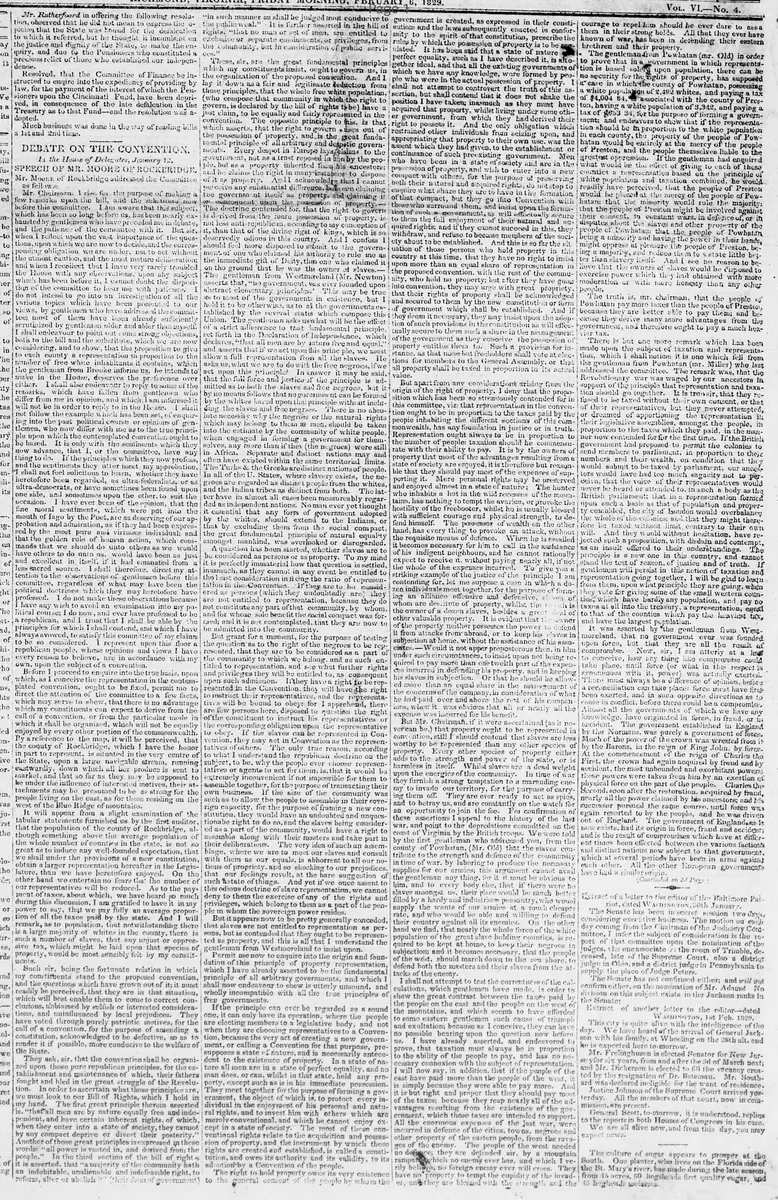
In the Virginia House of Delegates on January 12, Mr. Moore of Rockbridge delivers a speech advocating for representation in the proposed constitutional convention based on free white population, opposing property-based representation, and defending republican principles from the Bill of Rights against eastern delegates' arguments.
Merged-components note: Merging fragmented components containing the speech by Mr. Moore of Rockbridge on the Convention debate, which spans across pages 1 and 2 in reading order; original label of one component was 'story', changed to 'domestic_news' as it fits legislative proceedings.
Clippings
1 of 2
OCR Quality
Full Text
In the House of Delegates, January 12.
SPEECH OF MR. MOORE OF ROCKBRIDGE,
Mr. Moore of Rockbridge addressed the Committee as follows:
Mr. Chairman: I rise for the purpose of making a few remarks upon the bill, and the substitute now before this committee. I am aware that this subject, which has been so long before us, has been nearly exhausted by gentlemen who have preceded me in debate, and the patience of the committee with it. But sir, when I reflect upon the vast importance of the questions, upon which we are now to decide, and the corresponding obligation we are under, not to act without the utmost caution, and the most mature deliberation; and when I recollect that I have very rarely troubled the House with any observations, upon any subject which has been before it, I cannot doubt the disposition of the committee to hear me with patience. I do not intend to go into an investigation of all the various topics which have been presented to our views, by gentlemen who have addressed the committee; most of them have been already sufficiently scrutinized by gentlemen older and abler than myself: I shall endeavour to point out some strong objections, both to the bill and the substitute, which we are now considering, and to show, that the proposition to give to each county a representation in proportion to the number of free white inhabitants it contains, which the gentleman from Brooke informs us, he intends to make in the House, deserves the preference over either. I shall also endeavour to reply to some of the remarks, which have fallen from gentlemen who differ from me in opinion, and which, I am informed it will not be in order to reply to in the House. I shall not follow the example which has been set, of enquiring into the past political course or opinions of gentlemen, who now differ with me as to the true principle upon which the contemplated convention ought to be based. It is only with the sentiments which they now advance, that I, or the committee, have any thing to do. If the principles which they now profess, and the sentiments they utter meet my approbation, I shall not feel solicitous to learn, whether they have heretofore been regarded, as ultra-federalists, or as ultra-democrats, or have sometimes been found upon one side, and sometimes upon the other, to suit the occasion. I have ever been of the opinion, that the fine moral sentiments, which were put into the mouth of Iago by the Poet, are as deserving of our approbation and admiration, as if they had been expressed by the most pure and virtuous individual; and that the golden rule of human action, which commands that we should do unto others as we would have others to do unto us, would have been as just and excellent in itself, if it had emanated from a less sacred source. I shall therefore, direct my attention to the observations of gentlemen before this committee, regardless of what may have been the political doctrines which they may heretofore have professed. I do not make these observations because I have any wish to avoid an examination into my political course; I do now, and ever have professed to be a republican, and I trust that I shall be able by the principles for which I shall contend, and which I have always avowed, to satisfy this committee of my claims to be so considered. I represent upon this floor a republican people, whose opinions and views I have every reason to believe, are in accordance with my own, upon the subject of a convention.
Before I proceed to enquire into the true basis, upon which, as I conceive the representation in the contemplated convention, ought to be fixed, permit me to direct the attention of the committee to a few facts, which may serve to shew, that there is no advantage which my constituents can expect to derive from the call of a convention, or from the particular mode in which it shall be organized, which will not be equally enjoyed by every other portion of the commonwealth.
By a reference to the map, it will be perceived, that the county of Rockbridge, which I have the honor in part to represent. is situated in the very centre of the State, upon a large navigable stream, running eastwardly, down which all her produce is sent to market, and that so far as they may be supposed to be under the influence of interested motives, their attachments may be presumed to be as strong for the people living on the east, as for those residing on the west of the Blue Ridge of mountains.
It will appear from a slight examination of the tabular statements furnished us by the first auditor, that the population of the county of Rockbridge, although something above the average population of the whole number of counties in the state, is not so great as to induce any well-founded expectation, that we shall under the provisions of a new constitution, obtain a larger representation hereafter in the Legislature, than we have heretofore enjoyed. On the other hand we entertain no fears that the number of our representatives will be reduced. As to the payment of taxes, about which, we have heard so much during this discussion, I am gratified to have it in my power to say, that we pay fully an average proportion of all the taxes paid by the state. And I will remark, as to population, that notwithstanding there is a large majority of whites in the county, there is such a number of slaves, that any unjust or oppressive tax, which might be laid upon that species of property, would be most sensibly felt by my constituents.
Such sir, being the fortunate relation in which my constituents stand to the proposed convention, and the questions which have grown out of it; it must readily be perceived, that they are in that situation, which will best enable them to come to correct conclusions, unbiassed by selfish or interested considerations, and uninfluenced by local prejudices. They have voted through purely patriotic motives, for the call of a convention, for the purpose of amending a constitution, acknowledged to be defective, so as to render it if possible, more conducive to the welfare of the State.
They ask, sir, that the convention shall be organized upon those pure republican principles. for the establishment and maintenance of which, their fathers fought and bled in the great struggle of the Revolution. In order to ascertain what those principles are, we must look to our Bill of Rights, which I hold in my hand. The first great principle therein asserted is."that all men are by nature equally free and independent, and have certain inherent rights, of which, when they enter into a state of society, they cannot by any compact deprive or divest their posterity."
Another of those great principles is expressed in these words: "all power is vested in, and derived from the people." In the third section of the bill of rights it is asserted, that "a majority of the community hath an indubitable, unalienable and indefeasible right, to reform, alter or abolish their form of government
"in such manner as shall be judged most conducive to the public weal." It is further asserted in the bill of rights, "that no man or set of men, are entitled to exclusive or separate emoluments, or privileges, from the community, but in consideration of public services.
These, sir, are the great fundamental principles which my constituents insist, ought to govern us, in the organization of the proposed convention. And I lay it down as a fair and legitimate deduction from those principles. that the whole free white population, (who compose that community in which the right to govern, is declared by the bill of rights to be) have a just claim, to be equally and fairly represented in the convention.
The opposite principle to this, is that which asserts, that the right to govern arises out of the possession of property, and is the great fundamental principle of all arbitrary and despotic governments. Every despot in Europe lays claim to the government, not as a trust reposed in him by the people. but as a property inherited from his ancestors: and by claims the right in many instances to dispose of it as property. And I acknowledge that I cannot perceive any substantial difference. between claiming the government itself as property. and claiming it to consequent upon the possession of property.--
The doctrine contended for. that the right to govern is derived from the mere possession of property, is not less anti-republican, according to my conception of it, than that of the divine right of kings, which is so deservedly odious in this country. And I confess I should feel more disposed to submit to the government of one who claimed his authority to rule me as the immediate gift of Deity, than one who claimed it on the ground that he was the owner of slaves.-
The gentleman from Westmoreland (Mr. Newton) asserts that, "no government, was ever founded upon abstract elementary principles.' This may be true as to most of the governments in existence, but I hold it to be otherwise, as to all the governments established by the several states which compose this Union. The gentleman asks us what will be the effect of a strict adherence to that fundamental principle, set forth in the Declaration of Independence, which declares, "that all men are by nature free and equal." and asserts that if we act upon this principle, we must allow a full representation from all the slaves. He asks us, what we are to do with the free negroes, if we act upon this principle? In answer it may be said, that the full force and justice of the principle is admitted as to both the slaves and free negroes, but it by no means follows that no government can be formed by the whites based upon that principle without including the slaves and free negroes. There is no absolute necessity why the negroes or the natural rights which may belong to them as men, should be taken into the estimate by the community of white people, when engaged in forming a government for themselves, any more than if they (the negroes) were still in Africa. Separate and distinct nations may and often have existed within the same territorial limits. The Turks & the Greeks are distinct nations of people. In all of the U. States, where slavery exists, the negroes are regarded as distinct people from the whites, and the Indian tribes as distinct from both. The latter have in almost all cases been measurably regarded as independent nations. No man ever yet thought it essential that any form of government adopted by the whites, should extend to the Indians, or that by excluding them from the social compact, the great fundamental principle of natural equality amongst mankind, was overlooked or disregarded.
A question has been started, whether slaves are to be considered as persons or as property. To my mind it is perfectly immaterial how that question is settled, inasmuch, as they cannot in any event be entitled to the least consideration in fixing the ratio of representation in the Convention. If they are to be considered as persons (which they undoubtedly are; they are not entitled to representation, because they do not constitute any part of that community, by whom, and for whose sole benefit the social compact was formed; and it is not contemplated, that they are now to be admitted into the community.
But grant for a moment, for the purpose of testing the question as to the right of the negroes to be represented, that they are to be considered as a part of the community to which we belong. and as such entitled to representation, and see what further rights and privileges they will be entitled to, as consequent upon such admission. If they have a right to be represented in the Convention, they will have the right to instruct their representatives, and the representatives will be bound to obey: for I apprehend, there are few persons here, disposed to question the right of the constituent to instruct his representatives or the corresponding obligation upon the representative to obey. If the slaves can be represented in Convention, they may act in Convention as the representatives of others." The only true reason, according to what I understand the republican doctrine on the subject, to be, why the people ever choose representatives or agents to act for them, is, that it would be extremely inconvenient if not impossible for them to assemble together, for the purpose of transacting their own business. If the size of the community was such as to allow the people to assemble in their sovereign capacity, for the purpose of framing a new constitution, they would have an undoubted and unquestionable right to do so, and the slaves being considered as a part of the community, would have a right to assemble along with their masters and take part in their deliberations. The very idea of such an assemblage, where we are to meet our slaves and consult with them as our equals, is abhorrent to all our notions of propriety, and so shocking to our prejudices, that our feelings revolt, at the bare suggestion of such a state of things. And yet if we once assent to this odious doctrine of slave representation, we cannot deny to them the exercise of any of the rights and privileges, which belong to them as a part of the people in whom the sovereign power resides.
But it appears now to be pretty generally conceded, that slaves are not entitled to representation as persons, but it is contended that they ought to be represented as property, and this is all that I understand the gentleman from Westmoreland to insist upon.
Permit me now to enquire into the origin and foundation of this principle of property representation, which I have already asserted to be the fundamental principle of all arbitrary governments, and which I shall now endeavour to shew is utterly unsound, and wholly incompatible with all the true principles of free governments.
If the principle can ever be regarded as a sound one, it can only have its operation, where the people are electing members to a legislative body, and not when they are choosing representatives to a Convention, because the very act of creating a new government, or calling a Convention for that purpose, presupposes a state of nature, and is necessarily antecedent to the existence of property. In a state of nature all men are in a state of perfect equality, and no man does, or can, whilst in that state, hold any property, except such as is in his immediate possession. They meet together for the purpose of forming a government, the object of which is, to protect every individual in the enjoyment of his personal and natural rights, and to invest him with others which are merely conventional, and which he cannot enjoy except in a state of society. The most of these conventional rights relate to the acquisition and possession of property, and the instrument by which these rights are created and established, is called a constitution, and owes its authority and its validity, to its adoption by a Convention of the people.
The right to hold property owes its very existence to the general consent of the people by whom the government is created, as expressed in their constitution: and the laws subsequently enacted in conformity to the spirit of that constitution, prescribe the rules by which the possession of property is to be regulated. It has been said that a state of nature perfect equality. such as I have described it, is altogether ideal, and that all the existing governments of which we have any knowledge, were formed by people who were in the actual possession of property. I shall not attempt to controvert the truth of this assertion, but shall contend that it does not shake the position I have taken; inasmuch as they must have acquired that property, whilst living under some other government, from which they had derived their right to possess it. And the only obligation which restrained other individuals from seizing upon, and appropriating that property to their own use, was the assent which they had given, to the establishment or continuance of such preexisting government. Men who have been in a state of society and are in the possession of property, and wish to enter into a new compact with others, for the purpose of preserving both their natural and acquired rights, do not stop to enquire what share they are to have in the formation of that compact, but they go into Convention with those who surround them, and insist upon the formation of such a government, as will effectually secure to them the full enjoyment of their natural and acquired rights; and if they cannot succeed in this, they withdraw, and refuse to become members of the society about to be established. And this is so far the situation of those persons who hold property in this country at this time, that they have no right to insist upon more than an equal share of representation in the proposed convention. with the rest of the community, who hold no property; but after they have gone into convention, they may urge with great propriety, that their rights of property shall be acknowledged and secured to them by the new constitution or form of government which shall be established. And if they deem it necessary, they may insist upon the adoption of such provisions in the constitution as will effectually secure to them such a share in the management of the government as they conceive the possession of property entitles them to. Such a provision for instance, as that none but freeholders shall vote at elections for members to the General Assembly, or that all property shall be taxed in proportion to its actual value.
But apart from any considerations arising from the origin of the right of property, I deny that the proposition which has been so strenuously contended for in this committee, viz: that representation in the convention ought to be in proportion to the taxes paid by the people inhabiting the different sections of this commonwealth, has any foundation in justice or in truth.
Representation ought always to be in proportion to the number of people: taxation should be commensurate with their ability to pay. It is by the owners of property that most of the advantages resulting from a state of society are enjoyed, it is therefore but reasonable that they should pay most of the expenses of supporting it. Mere personal rights may be preserved and enjoyed almost in a state of nature; The hunter who inhabits a hut in the wild recesses of the mountains, has nothing to tempt the avarice, or provoke the hostility of the freebooter, whilst he is usually blessed with sufficient courage and physical strength, to defend himself. The possessor of wealth on the other hand, has every thing to provoke an attack, without the requisite means of defence. When he is assailed it becomes necessary for him to call in the assistance of his indigent neighbours, and he cannot rationally expect to receive it, without paying nearly all, if not the whole of the expenses incurred. To give you a striking example of the justice of the principle I am contending for, let me suppose a case in which a dozen individuals meet together, for the purpose of forming an alliance offensive and defensive, of whom are destitute of property, whilst the 12th is the owner of a dozen slaves, besides a great deal of other valuable property. It is evident that the owner of the property neither possesses the power to defend it from attacks from abroad, or to keep his slaves in subjection at home, without the assistance of his associates. Would it not appear preposterous then, in him under such circumstances, to insist upon not being required to pay more than one twelfth part of the expenses incurred in defending his property. and in keeping his slaves in subjection. Or that he should be allowed more than an equal share in the management of the concerns of the company, in consideration of what he had paid over and above the rest of his companions, when it was obvious that all or nearly all the expense was incurred for his benefit.
But Mr. Chairman, if it were ascertained (as it never can be,) that property ought to be represented in convention, still I should contend that slaves are less worthy to be represented than any other species of property. Every other species of property either adds to the strength and power of the state, or is harmless in itself. Whilst slaves are a dead weight upon the energies of the community. In time of war they furnish a strong temptation to a marauding enemy to invade our territory, for the purpose of carrying them off. They are ever ready to act as spies, and to betray us, and are constantly on the watch for an opportunity to join the foe. For confirmation of these assertions I appeal to the history of the last war, and point to the depredations committed on the coast of Virginia by the British troops. We were told by the first gentleman who addressed you, from the county of Powhatan, (Mr. Old) that the slaves contribute to the strength and defence of the community in time of war. by laboring to produce the necessary supplies for our armies; this argument cannot avail the gentleman any thing, for it must be obvious to him, and to every body else, that if there were no slaves amongst us, their place would be much better filled by a hardy and industrious peasantry, who would supply the wants of our armies at a much cheaper rate, and who would be able and willing to defend their country against all its enemies. On the other hand we find, that nearly the whole force of the white population of the great slave holding counties, is required to be kept at home, to keep their negroes in subjection; and it becomes necessary, that the people of the west, should march down to the sea shore, to defend both the masters and their slaves from the attacks of the enemy.
I shall not attempt to test the correctness of the calculations, which gentlemen have made, in order to shew the great contrast between the taxes paid by the people on the east and the people on the west of the mountains, and which seems to have afforded to some eastern gentlemen such cause of triumph and exultation; because as I conceive, they can have no possible bearing upon the question now before us. I have already asserted, and endeavored to prove, that taxation must always be in proportion to the ability of the people to pay, and has no necessary connexion with the subject of representation.
I will now say. in addition, that if the people of the east have paid more than the people of the west, it is simply because they were able to pay more. And it is but right and proper that they should pay most of the taxes; because they reap nearly all of the advantages resulting from the existence of the government, which those taxes are intended to support.
All the enormous expenses of the last war, were incurred in defence of the cities, towns, negroes and other property of the eastern people, from the ravages of the enemy. The people of the west needed no defence; they are defended sir, by a mountain rampart which no enemy ever has, and which I verily believe, no foreign enemy ever will cross. They have no property to tempt the cupidity of the invader, and they are blessed with the strength. and the
courage to repel him should he ever dare to assail them in their strong holds. All that they ever have known of war, has been in defending their eastern brethren and their property.
The gentleman from Powhatan (Mr. Old) in order to prove that in a government in which representation is based solely upon population, there can be no security for the rights of property, has supposed a case in which the county of Powhatan, possessing a white population of 2,492 whites, and paying a tax of $4,004 84, . associated with the county of Preston, having a white population of 3,342, and paying a tax of $653 34, for the purpose of forming a government; and endeavors to show that if the representation should be in proportion to the white population in each county, the property of the people of Powhatan would be entirely at the mercy of the people of Preston, and the people themselves liable to the greatest oppression. If the gentleman had enquired what would be the effect of giving to each of these counties a representation based on the principle of white population and taxation combined, he would readily have perceived, that the people of Preston would be placed at the mercy of the people of Powhatan: that the minority would rule the majority: that the people of Preston might be involved against their consent, in constant wars, in defence of, or in disputes about the slaves and other property of the people of Powhatan: that the people of Powhatan being a minority and having the power in their hands. might oppress at pleasure the people of Preston, being a majority, and reduce them to a state little better than slavery itself: And I see no reason to believe that the owners of slaves would be disposed to exercise power which they had obtained with more moderation or with more honesty than any other people.
The truth is, Mr. Chairman, that the people of Powhatan pay more taxes than the people of Preston, because they are better able to pay them; and because they derive many more advantages from the government, and therefore ought to pay a much heavier tax.
There is but one more remark which has been made upon the subject of taxation and representation, which I shall notice: it is one which fell from the gentleman from Powhatan (Mr. Miller) who last addressed the committee. The remark was, that the Revolutionary war was waged by our ancestors in support of the principle that representation and taxation should go together. It is true, that they refused to be taxed without their own consent, or that of their representatives, but they never attempted, or dreamed of apportioning the representation in their legislative assemblies, amongst the people, in proportion to the taxes which they paid, in the manner now contended for for the first time. If the British government had proposed to permit the colonies to send members to parliament, in proportion to their numbers and their wealth, on condition that they would submit to be taxed by parliament, our ancestors would have had too much sagacity not to perceive, that the voice of their representatives would never be heard or attended to, in such a body as the British parliament; that in a representation formed upon such a basis as that of population and property combined, the city of London would overbalance the whole of the colonies; and that they might therefore be taxed without limit contrary to their own will. And they would without hesitation, have rejected such a proposition, with disdain and contempt, as an insult offered to their understandings. The principle is a new one in this country, and cannot stand the test of reason, of justice and of truth. If gentlemen will persist in this notion of taxation and representation going together, I will be glad to learn from them, upon what principle they are going, when they vote for giving some of the small western counties, which have hardly any population, and pay no taxes at all into the treasury, a representation, equal to that of the counties which pay the heaviest tax, and have the largest population.
It was asserted by the gentleman from Westmoreland, that no government ever was founded upon force, but that they are all the result of compromise. Now, sir, I am utterly at a loss to conceive, how any thing like compromise could take place, until force (or what in this respect is synonymous with it, power) was actually exerted. There must always be a difference of opinion, before a reconciliation can take place: force must have first been exerted, and in such opposite directions as to come in conflict, before there could be a compromise. Almost all the governments of which we have any knowledge, have originated in force, in fraud, or in accident." The government established in England by the Normans, was purely a government of force. Much of the power of the crown was wrested from it by the Barons, in the reign of King John, by force. At the commencement of the reign of Charles the First. the crown had again acquired by fraud and by accident, the most unbounded and exorbitant powers; these powers were taken from him by an exertion of. physical force on the part of the people. Charles the Second, soon after the restoration, acquired by fraud, nearly all the power claimed by his ancestors; and his successor pursued the same course, until force was again resorted to by the people, and he was driven out of England. The government of England as it now exists, had its origin in force, fraud and accident; and is the result of compromises which have at different times been effected between the various factions and distinct nations now subject to that government, which at several periods have been in arms against each other. All the other European governments have had a similar origin.
DEBATE ON THE CONVENTION.
In the House of Delegates, January 12.
SPEECH OF MR. MOORE OF ROCKBRIDGE.
(CONCLUDED.)
Our own government was founded upon the great fundamental principles declared in our bill of rights, and was established by force, and by the general consent of our ancestors. Compromise had nothing to do with its establishment, because no difference had arisen between the people who created it, and there was nothing about which a compromise could take place. They had all acted together in asserting and maintaining their natural rights, and they intended to establish a government purely upon principle. The defects in our constitution are to be ascribed entirely to accident, and the situation of the country at the time of its adoption. These defects were seen and acknowledged by our ancestors, and they intended to correct them, so soon as a convenient time should arrive; for proof of this assertion, I refer to the Notes on Virginia written by Mr. Jefferson, before the close of the revolution. If fraud had anything to do in creating the existing territorial divisions of the state, it must have been before the revolution, for I am very sure, it could not have had any influence upon the government at that day, or at any time since. I am disposed to believe, that the small counties in the East, were laid off, to suit the convenience of the people at the time, and with a view to what was then the size and situation of the colony, without looking forward to the existence of a great commonwealth, such as Virginia is at the present day. If the small counties shall now attempt to take advantage of the large ones by retaining in their hands, power which they have attained purely by accident; then sir, for the first time, will one portion of this community be found attempting to practice a gross and detestable fraud, upon another: a fraud sir, which I trust the large counties will never submit to, unless compelled to do it by actual force.
We have been asked, Mr. Chairman, by the gentleman from Westmoreland, how it is ascertained that there is a majority of the people in favor of calling a convention? I answer, by the vote which they have given upon the subject. But the gentleman tells us, that there were a great number of voters, who did not go to the polls, who are to be presumed to be against the call of a convention. Sir, I tell the gentleman he has no right to presume any such thing, and that I know, that he knows, and every other member in the House knows, that all those who did not vote, were not opposed to a convention. And I will moreover tell the gentleman, that if all those who had a right to vote upon that question (I mean the non-freeholders) had been permitted to vote. the majority would have been ten times greater than it was. Sir, the gentleman attempted at the last session to introduce a clause into the bill directing the sense of the people to be taken upon the subject of a convention, providing that all those who did not vote, should be counted as against a convention, which clause was very properly rejected by the House, as being wholly unjust.
We have been asked sir, how is it known on what principles the people wish the convention organized. I can only answer for my own constituents, and say. that they wish it organized upon the great republican principles for which I am contending, and that they will not have it upon any other.--And if every other gentleman will answer candidly for his constituents, I have no fear of the result; the people always mean to do what is right.
The Gentleman from Powhatan (Mr. Old) has affirmed, that the majority has no right to govern the minority, except by the consent of the minority; and has supposed a case in which a majority of the people of this commonwealth are living upon the west, and a minority on the east of the Blue Ridge; in which he insists, that the majority would have no right to compel the minority to live under any power of government, which they (the majority) might think proper to adopt, contrary to the wishes of such minority: and so far as the example goes the gentleman is correct. If the state of Georgia had not thought proper to accede to the General Government when it was established, the other states would have had no right to compel her to do so. But the case is different when the majority and the minority inhabit the same territory, and are interspersed throughout the country, as is now the case with the friends and opponents of a convention in this Commonwealth; in such a case, the minority must submit to any government which the majority choose to establish, or quit the country. There is no other alternative left. If sir, the tories in any of the states at the close of the revolutionary war, had refused to accept of the government which the majority chose to establish, they ought, and certainly would, have been forced into submission, or to fly the country.
I will now sir, reply to such of the remarks of the gentleman from Northampton, (mr. Parker) as I can recollect. That gentleman dwelt much upon the generosity of the eastern people, to the people of the west. and has mentioned several instances, in which their liberality had been very conspicuous. He told us of the Lunatic Hospital at Staunton. as a great honor bestowed upon the west. Permit me sir. to remind the gentleman, that the funds out of which that Hospital was built, were furnished by the whole state. and not by the eastern people alone; and that there is a Lunatic Hospital at Williamsburg supported at the expense of the state, of which the eastern people reap the whole of the benefits, which appear to be estimated so highly by the gentleman.
The gentleman has told us of an Arsenal which has been erected at Lexington, which to be sure was a very great honor done to the western people. The arsenal site he the time eastern would wanting the assistance of their western brethren, to defend their property and themselves; and arms having been furnished at the expense of the state; they have most kindly consented, that an Arsenal should be built on the other side of the mountains, amongst the people who are to use them, at the expense of the whole state. And this we are to consider a great favor done by the eastern to the western people. The gentleman has reminded us of what the eastern people have done towards making the Kanawha road, and James River Canal, and that they have incurred a heavy debt all for our benefit. I will take the liberty of informing the gentleman, that we do not get the benefit of the Kanawha road without paying for it; and that the canal has been left in an unfinished state, so as to be of no earthly advantage; whilst it is made the pretext for taxing our produce which comes down the river, at a most enormous rate. And I will ask the gentleman who he intends to make pay the debt which has been incurred; and whether an attempt will not be made, to compel the people living upon James river to pay it, in the shape of tolls. We are told by the gentleman, that whilst the western people are obtaining these prodigious favors from the state, the people of the east neither ask or receive any thing.- Let me suggest to the gentleman, that although there may be none of the money paid out of the state treasury, spent amongst the people living on the sea coast; that the money of the United States has been most lavishly expended amongst them; millions have been expended amongst the eastern people out of the treasury of the United States; whilst the western people never see a dollar of that money. If I have not been greatly misinformed sir, not less than three or four millions of dollars have already been expended upon the fortifications at Old Point Comfort.-- Many millions more have been expended, in building light houses, establishing navy yards, building and equipping ships of war, and in paying and supporting the land and naval forces of the nation, all of which has been expended among, and goes into the pockets of these eastern people, who we are told, neither ask nor receive any thing from the government. And pray sir, where does this money of the General Government come from? Is it not paid by the whole people of the United States? Do not the western people pay as much of the indirect tax from which the revenue of the United States arises, as their eastern neighbors?
Yes sir, they pay as much of it at all times: both in peace and in war." And sir, I should not be surprised that it would appear upon examination, that the single county of Rockbridge, paid more direct tax during the last war, into the United States treasury, than half the Congressional district from which the gentleman comes, put together. I do not affirm this to be the fact; but I invite the gentleman to make an examination into the subject, and I confess, I shall be disappointed if such does not turn out to be the fact. And yet sir, we find these eastern people, amongst whom so many millions of the public money has been expended, talking about the expenditure of some eight or ten thousand dollars, in building a Hospital at Staunton, as a prodigious favor, done to the people of the west.
The gentleman from Northampton, seems greatly surprised that the people of the west who have been so clamorous for a convention, should object to taking it on any terms which the people of the east may condescend to give it; and has compared the western people, to a spoilt child, who first cries for a cake, and when it is given him, pouts, and refuses to take it, because it is not baked exactly to please him.-- Sir, I will give the gentleman to understand, that the western people, do not come here as beggars, asking charity, but they come as freemen, demanding their rights, which they will have, in defiance of all opposition. They are not in the habit mr. Chairman, of bending the knee to mortal man, or of addressing supplications to any power inferior to the great God that made them.
The gentleman told us that it had somewhere been said, that if a certain long eared animal, more remarkable for stupidity than for its sagacity, was loaded with gold, and his head turned towards the gate of the strongest fortified city, it would find the gate thrown open to receive it. And, Mr. Chairman, I cannot doubt, but the gentleman believes in the truth of the assertion: for he had scarcely made the remark, before he started one of these long eared animals, towards the mountains, not loaded with gold. sir, but merely accompanied by a promise of the gold hereafter. And from what the gentleman told us of the readiness of some of the western counties, to unite with the eastern counties, in passing a bill, giving to each county an equal representation in the convention, it would seem, that some of the people behind the mountains, were so much delighted with the melodious voice of the Jack, that they did not wait until he came to the gate, but sallied forth to meet him. The gentleman, sir, after telling us of the great things which the eastern counties had done for the western counties, and of the manner in which the eastern counties have always voted the money raised by taxing the middle country, towards making improvements in the west, held out the idea, that the eastern people would do still greater things for the people of the west, if they, the western people, will only consent to vote for such a convention bill, as will secure to the eastern counties, the power which they have so long and so improperly held in their hands.
Here, sir, was an offer of the gold; and from what the gentleman has told us, I fear it has not been offered altogether in vain. But sir, I can tell the gentleman, that if he expects to get his long eared animal through the gates of the mountains, he must start it, towards some other than the front gate. 'The keys of that, sir, are held by the same people, or their descendants, who carried them in the days of the Revolution: when Tarleton was forced to return from Charlottesville: by the same people sir, who carried them at the battle of the Cowpens, and at Kings-Mountain. I mean sir, the people of Washington, Wythe, Montgomery, Botetourt, Rockbridge and Augusta, &c. These people Sir, will never sell their liberties for gold; they will not sacrifice any portion of their national rights, for the purpose of obtaining internal improvements, or anything else. And if the gentleman wishes to get his ugly beast beyond the mountains, he must take him to some other gate, where the sentinels are less faithful.
The gentleman from Northampton Sir, has made a powerful appeal to the members from the small counties, and has addressed himself to their pride. their prejudices, and their interests, and it is scarcely to be expected that such an appeal will be altogether in vain. It is by appeals of this sort, Sir, which have been made to the people of the small counties, by aspirants to seats in the Legislature, by Judges, Clerks and by Magistrates, who are looking forward to the Sherifalty, that they have been blinded to their own interests, and the call of a Convention has been kept off so long : and there can no reason to believe that the same motives will not operate here as elsewhere.
Something has been said Sir, about the vested rights of the small counties. I confess Sir that I can see no distinction between a vested right, and an established wrong. I understand a vested right to be some privilege or advantage allowed by law, to some individual, or number of individuals, over and above the rest of the community; and I understand the existence of any such right either as belonging to individuals, or to corporations, to be in violation of that principle asserted in the bill of Rights, which declares, "that no man, or set of men, are entitled to exclusive or separate emoluments, or privileges, from the community, but in consideration of public services."
It is Sir, the existence of these vested rights, in Kings, Nobles and the Clergy, which renders all the European Governments so justly odious to freemen. It is mainly in this respect that the Republican Governments established in this country, are preferable to the despotisms of the old world: Once permit the creation or acknowledge the existence of these vested rights, in this country, and we shall be in no better condition than the Spaniards or the Turks.
Gentlemen have asked what right the Legislature have to change the present mode of choosing Representatives by county,
In answer to which, I can only say, that the Legislature are not asked to make any change whatsoever about the matter. There does not and never did exist, any mode of choosing Representatives to a Convention by Counties.. And the mode of choosing members to the Legislature has nothing to do with the proposition to send members to the Convention.
There is another very important question arising out of the subject before us, which it was my intention to have discussed at some length; but having already consumed more time than I intended, I will be as brief as possible in remarking upon it. I allude, sir, to the question of, who shall be permitted to vote for members to a Convention! And I give it as my decided opinion, that every free, white, male citizen, of this Commonwealth, over the age of twenty-one years, has a natural and unquestionable right to vote upon this subject, which cannot rightfully be taken or withheld from him--a right acknowledged and asserted by the very first clause of our bill of rights.
I know, sir, that an attempt has been made to avoid the force of what is declared in the bill of rights, by asking, why the principle is not extended to women and persons under the age of twenty-one years. I answer, that it will be time enough to enquire into the propriety of extending it to them, when they come forward to claim it. Neither the females, or the males who are under the age of twenty-one years, have asked to be represented in the Convention, whilst the non-freeholders over that age, are clamorous for a share in the government. The right of man to govern himself is admitted on all hands; at what age he attains sufficient discretion to exercise that right, is not so easily settled. The best we can do is, arbitrarily to fix upon some period, when sufficient discretion shall be presumed, and the age of twenty-one, seems to have been fixed upon by general consent; for we are not informed, that any person under that age, claims the right of being heard in the Convention. There is the same difficulty in determining at what age a person becomes accountable for his acts to the laws of his country, and of his God. Yet it is admitted that there is a period of infancy when owing to the imbecility of his intellect he is not accountable in any way for his acts. There is another period of his existence when no man doubts he becomes accountable to both.
The difficulty of determining when a man becomes capable of self-government, no more disproves the existence of the right, than the difficulty of ascertaining when he becomes accountable for his acts, precludes the possibility of his being so.
In conclusion, sir, permit me to remark, that I do not expect the dreadful consequences to ensue from the refusal of the House to pass such a bill as we wish, as some of my friends seem to anticipate. If I cannot get such a bill as will please my constituents I do not want any. If the Legislature will not grant the facilities which the people want, for going into Convention, they can, and will go into Convention without the aid of the Legislature. The advocates of a Convention are willing in the first place, to try all gentle means to obtain a redress of their grievances before they resort to power; but if nothing else will do, they will have their rights whatever it may cost them.
What sub-type of article is it?
What keywords are associated?
What entities or persons were involved?
Where did it happen?
Domestic News Details
Primary Location
House Of Delegates, Virginia
Event Date
January 12
Key Persons
Event Details
Mr. Moore of Rockbridge speaks in the House of Delegates committee on the bill for calling a constitutional convention, arguing for representation proportional to free white inhabitants, rejecting property or tax-based representation as anti-republican, referencing the Bill of Rights and Declaration of Independence, and rebutting eastern delegates' points on slavery, taxation, and historical precedents.