Thank you for visiting SNEWPapers!
Sign up free
The Roswell Daily Record
Roswell, Chaves County, New Mexico
What is this article about?
Gen. E. Porter Alexander delivers a eulogy at West Point on June 9, 1902, honoring Confederate soldiers and leaders, reflecting on the 'Lost Cause' of the Civil War, and celebrating the reunification of the United States as a stronger nation.
Merged-components note: Continuation of the 'THE OLD VETERAN' speech reprint across pages, as explicitly indicated in the text.
Clippings
1 of 2
OCR Quality
Full Text
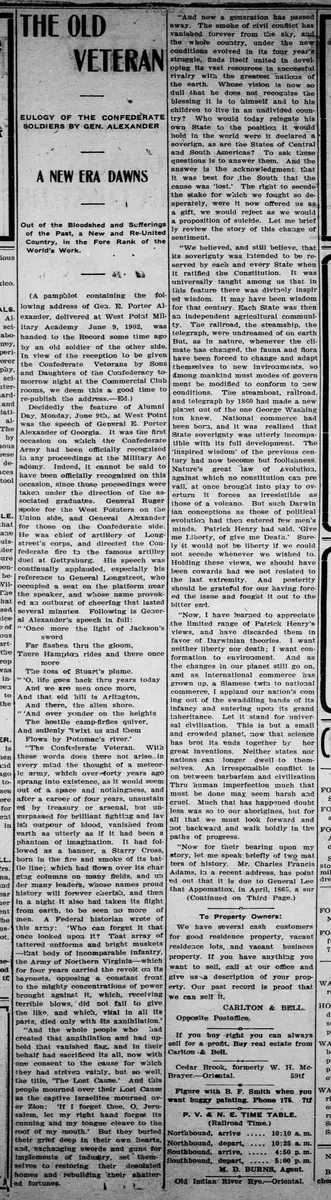
EULOGY OF THE CONFEDERATE SOLDIERS BY GEN. ALEXANDER
A NEW ERA DAWNS
Out of the Bloodshed and Sufferings of the Past, a New and Re-United Country, in the Fore Rank of the World's Work.
(A pamphlet containing the following address of Gen. E. Porter Alexander, delivered at West Point Military Academy June 9, 1902, was handed to the Record some time ago by an old soldier of the other side.
In view of the reception to be given the Confederate Veterans by Sons and Daughters of the Confederacy tomorrow night at the Commercial Club rooms, we deem this a good time to re-publish the address.—Ed.)
Decidedly the feature of Alumni Day, Monday, June 9th, at West Point was the speech of General E. Porter Alexander of Georgia. It was the first occasion on which the Confederate Army had been officially recognized in any proceedings at the Military Academy. Indeed, it cannot be said to have been officially recognized on this occasion, since these proceedings were taken under the direction of the associated graduates. General Ruger spoke for the West Pointers on the Union side, and General Alexander for those on the Confederate side. He was chief of artillery of Longstreet's corps, and directed the Confederate fire in the famous artillery duel at Gettysburg. His speech was continually applauded, especially his reference to General Longstreet, who occupied a seat on the platform near the speaker, and whose name provoked an outburst of cheering that lasted several minutes. Following is General Alexander's speech in full:
'Once more the light of Jackson's sword
Far flashes thru the gloom,
There Hampton rides and there once more
The toss of Stuart's plume.
'O, life goes back thru years today
And we are men once more,
And that old hill is Arlington,
And there, the alien shore.
'And over yonder on the heights
The hostile camp-fires quiver,
And sullenly twixt us and them
Flows by Potomac's river.'
The Confederate Veteran.
With these words does there not arise in every mind the thought of a meteoric army, which over forty years ago sprang into existence, as it would seem out of a space and nothingness, and after a career of four years, unsustained by treasury or arsenal, but unsurpassed for brilliant fighting and lavish outpour of blood, vanished from earth as utterly as if it had been a phantom of imagination. It had followed as a banner, a Starry Cross, born in the fire and smoke of its battle line; which had flown over its charging columns on many fields, and under many leaders, whose names proud history will forever cherish, and then in a night it also had taken its flight from earth, to be seen no more of men. A Federal historian wrote of this army: Who can forget it that once looked upon it? That array of tattered uniforms and bright muskets—that body of incomparable infantry, the Army of Northern Virginia—which for four years carried the revolt on its bayonets, opposing a constant front to the mighty concentrations of power brought against it, which, receiving terrible blows, did not fail to give the like, and which, vital in all its parts, died only with its annihilation.'
"And the whole people who had created that annihilation and had upheld that vanished flag, and in their behalf had sacrificed its all, now with one consent to the cause for which they had striven vainly, but so well, the title, The Lost Cause.' And this people mourned over their Lost Cause as the captive Israelites mourned over Zion: If I forget thee, O, Jerusalem, let my right hand forget its cunning and my tongue cleave to the roof of my mouth.' But they buried their grief deep in their own hearts, and, exchanging swords and guns for implements of industry, set themselves to restoring their desolated homes and rebuilding their shattered fortunes.
"And now a generation has passed away. The smoke of civil conflict has vanished forever from the sky, and the whole country, under the new conditions evolved in its four years' struggle, finds itself united in developing its vast resources in successful rivalry with the greatest nations of the earth. Whose vision is now so dull that he does not recognize the blessing it is to himself and to his children to live in an undivided country? Who would today relegate his own State to the position it would hold in the world were it declared a sovereign, as are the States of Central and South Americas? To ask these questions is to answer them. And the answer is the acknowledgment that it was best for the South that the cause was lost.' The right to secede the stake for which we fought so desperately, were it now offered us as a gift, we would reject as we would a proposition of suicide. Let me briefly review the story of this change of sentiment.
"We believed, and still believe, that its sovereignty was intended to be reserved by each and every State when it ratified the Constitution. It was universally taught among us that in this feature there was divinely inspired wisdom. It may have been wisdom for that century. Each State was then an independent agricultural community. The railroad, the steamboat, the telegraph, were undreamed of on earth. But, as in nature, whenever the climate has changed, the fauna and flora have been forced to change and adapt themselves to new environments, so among mankind must modes of government be modified to conform to new conditions. The steamboat, railroad, and telegraph by 1860 had made a new planet out of the one George Washington knew. National commerce had been born, and it was realized that State sovereignty was utterly incompatible with its full development. The 'inspired wisdom' of the previous century had now become but foolishness. Nature's great law of evolution, against which no constitution can prevail, at once brought into play to overturn it forces as irresistible as those of a volcano. But such Darwinian conceptions as those of political evolution had then entered few men's minds. Patrick Henry had said, 'Give me Liberty, or give me Death.' Surely it would not be liberty if we could not secede whenever we wished to. Holding these views, we should have been cowards had we not resisted to the last extremity. And posterity should be grateful for our having forced the issue and fought it out to the bitter end.
"Now, I have learned to appreciate the limited range of Patrick Henry's views, and have discarded them in favor of Darwinian theories. I want neither liberty nor death: I want conformation to environment. And as the changes in our planet still go on, and as international commerce has grown up, a Siamese twin to national commerce, I applaud our nation's coming out of the swaddling bands of its infancy and entering upon its grand inheritance. Let it stand for universal civilization.
This is but a small and crowded planet, now that science has brought its ends together by her great inventions. Neither states nor nations can longer dwell to themselves. An irresponsible conflict is on between barbarism and civilization. Thru human imperfection much that must be done may seem harsh and cruel. Much that has happened doubtless was so to our aborigines, but for all that we must look forward and not backward and walk boldly in the paths of progress.
"Now for their bearing upon my story, let me speak briefly of two matters of history. Mr. Charles Francis Adams, in a recent address, has pointed out that it is due to General Lee that Appomattox, in April, 1865, a sur
(Continued on Third Page.)
THE OLD VETERAN
render of the Confederate Army was made, instead of the struggle being prolonged into a guerilla war, such as has been recently seen in South Africa. This action does indeed place Lee upon an exalted plane. And it fortunately happened that his rival actor in this great drama was General Grant, a brother graduate of the Military Academy. Our Alma Mater may cherish the record of that day when two of her sons, having each written his name so high in the annals of war, now united to turn the nation into the paths of peace. For General Grant, who has been proudly called by his victorious army Unconditional Surrender Grant, now seemed only to seek excuses to spare the Confederate every possible mortification and to save them from individual losses, even at the expense of his own government. His example was immediately followed by every man in the army down to the humblest teamster. Time fails me to describe the friendliness, courtesy, and generosity with which the whole victorious army seemed filled. The news of the surrender and of its liberal terms was received everywhere with similar feelings of generous conciliation. In proof, it is only necessary to refer to the early negotiations between Sherman and Johnston. President Lincoln also fully shared these feelings, and even planned for the South financial compensation for its loss of property by the emancipation of its slaves. Thus, for six days--from April 9th to 14th,--there was every prospect that reconstruction would be accomplished in the spirit manifested by Grant and under the direction of Lincoln, who, without her knowledge, was at that time the South's most powerful friend. Our treatment would have been not less liberal than that we have just seen accorded by the British to the Boers.
"Oh, the pity of it. That this spirit of peace and good-will could not have been permitted to spread over the whole country, and influence the breasts alike of both victors and vanquished. By the fatuous act of an assassin, in a moment this fair vision was shattered, and in its place, and without fault upon her part, there was invoked against the prostrate South a whirlwind of rage and resentment. Indeed, it is due to the restraint put upon the political leaders of the North by General Grant that the death of Lincoln did not mark for the South the beginning of greater woes than those of the war itself.
"There resulted many years of bitterness and estrangement between the sections, retarding the growth of national spirit and yielding but slowly even to the great daily object-lesson of the development of the country. But at last, in the fulness of time, the stars in their courses have taken up the work. As in 1865 one wicked hand retarded our unification by the murder of Lincoln, so in 1898 another assassin, equally wicked and equally stupid, by blowing up the Maine, has given us a common cause and made us at last and indeed a nation, in the front rank of the world's work of civilization, with its greatest problems committed to our care.
"But there is still one thing more to be said. Was all our blood shed in vain? Was all the agony endured for the Lost Cause but as water spilled upon the sand? No. A thousand times no.
"We have set the world record for devotion to a cause. We have given to our children proud memories and to history new names, to be the theme and an inspiration for unborn generations. The heroes of future wars will emulate our Lees and Jacksons. We have taught the armies of the world the casualties to be endured in battle; and the qualities of heart and soul developed both in our women and men, in the stress and strain of our poverty and in the furnace of our affliction, have made a worthier race, and have already borne rich reward in the building up of our country. But above and beyond all, the firm bonds which today hold together this great nation could have never been wrought by debates in Congress. Human evolution has not yet progressed so far. Such bonds must be forged, welded, and proved in the heat of battle and must be cemented in blood. Peace Congresses and arbitrations have never yet given birth to a nation, and this one had to be born in nature's way.
"So much for the attitude of the South and the steps thru which it has been reached. But bear with me yet a little, for I cannot leave the tho'ts and memories evoked by my theme without some reference to a few among the great figures who moved amid those scenes, lest my story should seem to you as one of Hamlet with Hamlet left out:
"'And Love, where death has set its seal,
Nor age can chill, nor rival steal,
Nor falsehood disavow."
"Shall I name to you at once the Confederate hero who deserves the highest pedestal, who bore the greatest privations, and contributed most freely of his blood to win every victory and resist every defeat? I name the private soldier. Practically without pay and on half rations, he enlisted for life or death and served out his contract. He did not look the fighting man he was. He was lean, sunburned and bearded, often barefoot and ragged. He had neither training nor discipline, except what he acquired in the field. He had only antiquated and inferior arms until he captured better ones in battle. He had not even military ambition, but he had one incentive which was lacking to his opponents brave and loyal as they were. Meeting him on the march one might recognize in his eyes a certain far-away look. He was fighting for his home. From the time of Greece to that of South Africa, all history attests the stimulus of the thought of 'home' to the soldier fighting for it. And if some young military scientists among your bright boys can formulate an equation to express the battle power of an army, I am sure he will find the thought of home' to be the factor in it with highest exponent. So there was nothing anomalous about the fighting of our army. We fought for our homes under men that we loved and trusted. This brought out the best in every individual, whether private or general.
"Upon our President, Jefferson Davis, there fell from the necessity of his prominent position not only defeat, but obloquy, and woes too many to enumerate. History, however, will do him justice as having been most worthy to represent us, whether as a man, a statesman, or a soldier. And as any compromise of the issue at stake would have only carried with it the seeds of another war, the nation is to be congratulated that to his high courage and devotion to his cause no compromise was possible. And how shall I speak to you of the great Lee, whom it was an education to know,--never elated, and never depressed, but always calm and audacious in reliance upon himself and his troops, who in their turn relied upon him and loved him unto death: of stern and grave Stonewall Jackson, trusting only in the God of battles and in the righteousness of his cause, but winning by the fierce courage his personality inspired; of Joseph E. Johnston, master of strategy in the great game of war, whose brain was reason's self incased in bone': of Beauregard, who won Bull Run by his personal tenacity and with such science and skill defended Sumter and Petersburg; of Longstreet, whom Lee called his old war horse,' doing heavy work on every field, from Bull Run to Appomattox; of A. P. Hill, whose name was last on the lips of Lee upon his death-bed, and of Jackson when he crossed over the river to rest in the shade of the trees': of genial, dashing Stuart, always ready for any venture and sanguine of success, who took up the battle left unfinished by Jackson's fall and carried it to its brilliant end; of gifted Hampton, our Chevalier Bayard, with his sabre-scarred face, who served his state as effectively in peace as he had done in war, and always bore without abuse the grand old name of gentleman'; of Hood, with his one leg and crippled arm, under whom the Texans loved to fight: of good old Ewell also with his one leg, and bald head and lustrous woodcock eye, who believed fighting to be the sole business of a soldier: of Early, whose unreconciled spirit is perhaps still raiding up and down the Valley; and of a thousand others whose forms and faces throng upon my memory, and whose names history has inscribed upon her roll of honor.
"It were a shorter task to try and enumerate the great fields of battle made historic by their valor. Dolorous and bootless Antietam is conspicuous as the bloodiest single day in the annals of this continent. Pickett's charge at Gettysburg was the brilliant culmination of a school of attack which has forever passed away with the advent of modern arms. But Jackson's Valley campaign will always illustrate the correct principles of strategy, however weapons may be altered or improved. The Wilderness and Spottsylvania where the Federal army in eight days suffered more casualties than befell in all the wars from the discovery of America to 1860, were but the initial combats of what should be called the 'Battle of Grant and Lee,' begun on the Rapidan on May 4, 1864, and fought without par until ended at Appomattox on April 9, 1865, eleven months and six days. History has scarcely a parallel for such supreme display of battle power upon either side. At the opening, Grant marshaled 122,146 men, and 61,274 followed Lee. In its progress every available reinforcement was called in by each side, the Confederates even robbing the cradle and the grave to repair their wasting ranks. At the end the Federal losses had reached a total of 124,390. The Confederate losses can never be known, for their army was wiped out of existence, and no reports were possible. But the final act was the surrender of 28,356 Confederates to a force of 100,000 immediately about them--a million men being in arms on the Union side.
"And so, did time permit, lessons could be learned and stirring events be depicted from the memories of innumerable other scenes. But I prefer to leave the picture as it stands. We didn't GO into our cause, we were BORN into it. We fought it out to its remotest end and suffered to the very utmost its dying aches and pains. But they were rich in compensations and have proven to be only the birth-pangs of a new nation, in whose career we are proud to own and to bear a part.
"And to our Alma Mater, (West Point), who taught us, not the skill to unravel conflicting political creeds --not
"That acumen to divide
A hair 'twixt South and Sou'west side"-
but rather to illustrate by our lives manly courage and loyalty to convictions, we commend the record of
"The Old Confederate Veteran, we know him as he stands
And listens for the thunder of the far-off battle lands.
He hears the crash of musketry, the smoke rolls like a sea,
For he tramped the fields with Stonewall, and he climbed the heights with Lee.
The Old Confederate Veteran, his life is in the past.
And the war-cloud, like a mantle, round his rugged form is cast.
He hears the bugle calling o'er the far and mystic sea,
For he tramped the fields with Stonewall and he climbed the heights with Lee."
What sub-type of article is it?
What themes does it cover?
What keywords are associated?
What entities or persons were involved?
Where did it happen?
Story Details
Key Persons
Location
West Point Military Academy
Event Date
June 9, 1902
Story Details
Gen. Alexander eulogizes the Confederate Army and its leaders, reflects on the 'Lost Cause' of the Civil War, acknowledges the benefits of national reunification, praises the private soldiers' devotion, and highlights key battles and figures in a speech at West Point.