Thank you for visiting SNEWPapers!
Sign up free
Lewistown Gazette
Lewistown, Mifflin County, Pennsylvania
What is this article about?
A visitor to Washington on July 4, 1866, describes the subdued Independence Day celebrations, dominated by gatherings of colored people honoring Abraham Lincoln, contrasts with Philadelphia's events, details a visit to the U.S. Capitol including rotunda paintings and dome frescoes symbolizing American progress and Civil War victory, and poses a query on racial amalgamation.
Clipping
OCR Quality
Full Text
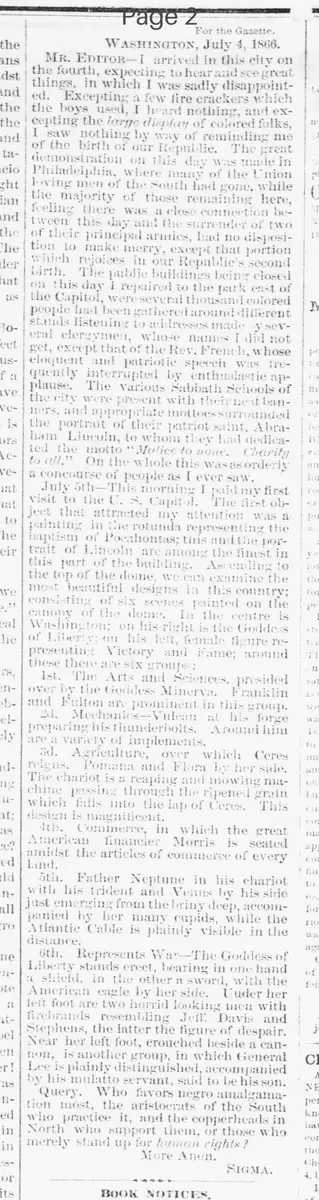
WASHINGTON, July 4, 1866.
Mr. Editor—I arrived in this city on the fourth, expecting to hear and see great things, in which I was sadly disappointed. Excepting a few fire crackers which the boys used, I heard nothing, and excepting the large display of colored folks, I saw nothing by way of reminding me of the birth of our Republic. The great demonstration on this day was made in Philadelphia, where many of the Union loving men of the South had gone, while the majority of those remaining here, feeling there was a close connection between this day and the surrender of two of their principal armies, had no disposition to make merry, except that portion which rejoices in our Republic's second birth. The public buildings being closed on this day I repaired to the park east of the Capitol, where several thousand colored people had been gathered around different stands listening to addresses by several clergymen, whose names I did not get, except that of the Rev. French, whose eloquent and patriotic speech was frequently interrupted by enthusiastic applause. The various Sabbath Schools of the city were present with their neat banners, and appropriate mottoes surrounded the portrait of their patriot saint, Abraham Lincoln, to whom they had dedicated the motto "Malice to none. Charity to all." On the whole this was as orderly a concourse of people as I ever saw.
July 5th—This morning I paid my first visit to the U. S. Capitol. The first object that attracted my attention was a painting in the rotunda representing the baptism of Pocahontas; this and the portrait of Lincoln are among the finest in this part of the building. Ascending to the top of the dome, we can examine the most beautiful designs in this country; consisting of six scenes painted on the canopy of the dome. In the centre is Washington; on his right is the Goddess of Liberty on his left, female figure representing Victory and Fame: around these there are six groups:
1st. The Arts and Sciences, presided over by the Goddess Minerva. Franklin and Fulton are prominent in this group.
2d. Mechanics—Vulcan at his forge preparing his thunderbolts. Around him are a variety of implements.
3d. Agriculture, over which Ceres reigns. Pomona and Flora by her side. The chariot is a reaping and mowing machine passing through the ripened grain which falls into the lap of Ceres. This design is magnificent.
4th. Commerce, in which the great American financier Morris is seated amidst the articles of commerce of every clime.
5th. Father Neptune in his chariot with his trident and Venus by his side just emerging from the briny deep, accompanied by her many cupids, while the Atlantic Cable is plainly visible in the distance.
6th. Represents War—The Goddess of Liberty stands erect, bearing in one hand a shield, in the other a sword, with the American eagle by her side. Under her left foot are two horrid looking men with firebrands resembling Jeff. Davis and Stephens, the latter the figure of despair. Near her left foot, crouched beside a cannon, is another group, in which General Lee is plainly distinguished, accompanied by his mulatto servant, said to be his son.
Query. Who favors negro amalgamation most, the aristocrats of the South who practice it, and the copperheads in the North who support them, or those who merely stand up for human rights?
More Anon.
SIGMA.
What sub-type of article is it?
What themes does it cover?
What keywords are associated?
What entities or persons were involved?
Letter to Editor Details
Author
Sigma.
Recipient
Mr. Editor
Main Argument
the july 4, 1866, celebrations in washington were subdued and focused on colored people's orderly gatherings honoring lincoln, contrasting with southern reluctance post-civil war surrenders; a capitol visit highlights symbolic artwork of american ideals and union victory; questions who truly favors negro amalgamation amid southern practices and northern support.
Notable Details