Thank you for visiting SNEWPapers!
Sign up free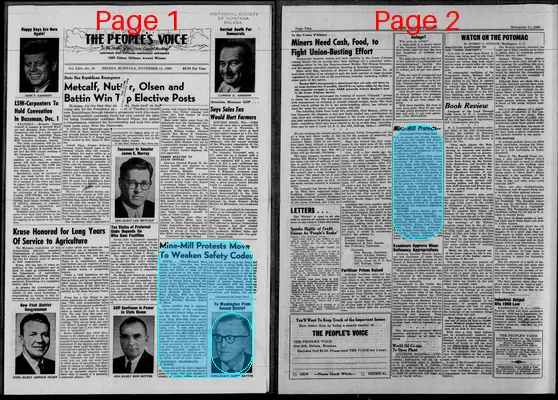
The People's Voice
Helena, Lewis And Clark County, Montana
What is this article about?
Ernest Salvas of the International Union of Mine, Mill & Smelter Workers charges the Montana Mine Safety Code Committee with weakening safety provisions in the draft code from February 1960. At hearings in Butte, he criticizes the code's inadequate scope for smelting and refining hazards and proposes over 30 strengthening recommendations, including deleting escape clauses.
Merged-components note: Merged page 1 story with its continuation on page 2 and included overlapping image on page 1.
Clippings
1 of 2
OCR Quality
Full Text
Protests
Move
To Weaken
Safety
Codes
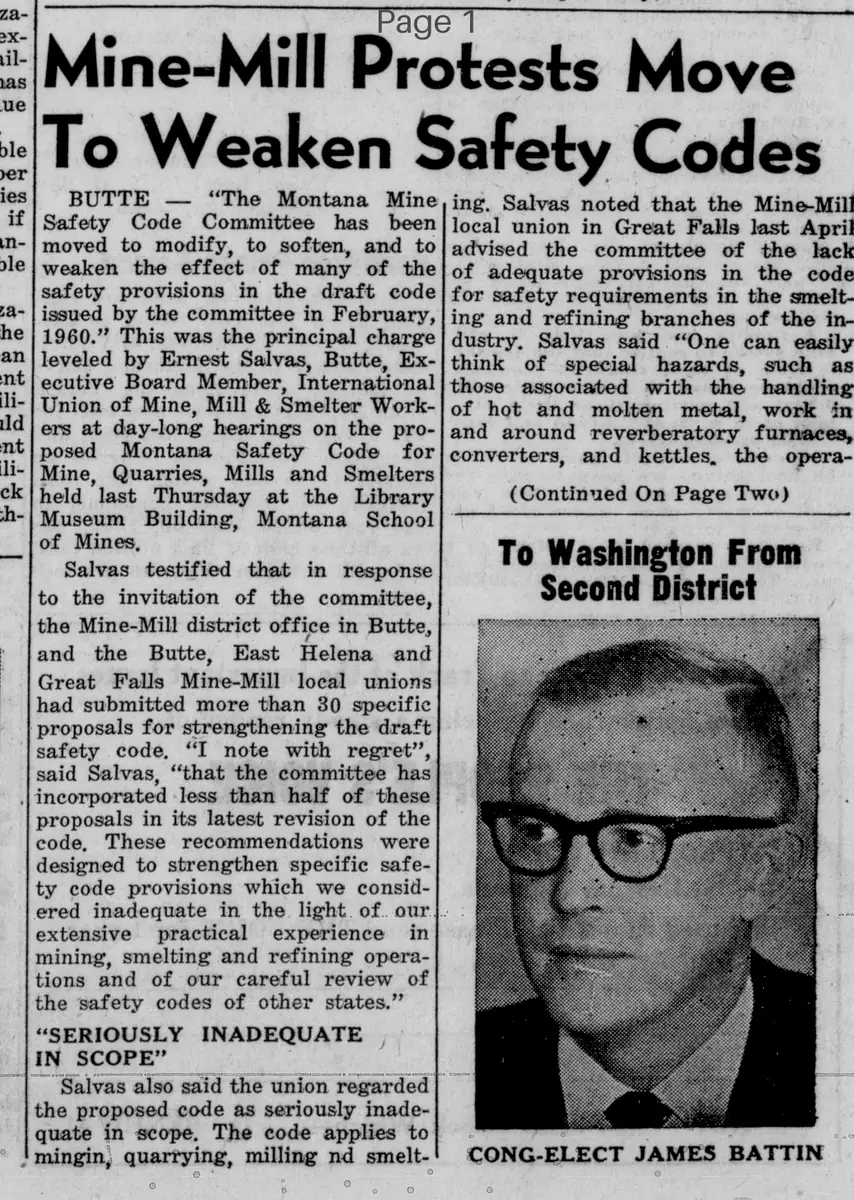
BUTTE "The Montana Mine Safety Code Committee has been moved to modify, to soften, and to weaken the effect of many of the safety provisions in the draft code issued by the committee in February, 1960." This was the principal charge leveled by Ernest Salvas, Butte, Executive Board Member, International Union of Mine, Mill & Smelter Workers at day-long hearings on the proposed Montana Safety Code for Mine, Quarries, Mills and Smelters held last Thursday at the Library Museum Building, Montana School of Mines.
Salvas testified that in response to the invitation of the committee, the Mine-Mill district office in Butte, and the Butte, East Helena and Great Falls Mine-Mill local unions had submitted more than 30 specific proposals for strengthening the draft safety code. "I note with regret" said Salvas, "that the committee has incorporated less than half of these proposals in its latest revision of the code. These recommendations were designed to strengthen specific safety code provisions which we considered inadequate in the light of our extensive practical experience in mining, smelting and refining operations and of our careful review of the safety codes of other states."
"SERIOUSLY INADEQUATE
IN SCOPE"
Salvas also said the union regarded the proposed code as seriously inadequate in scope. The code applies to mining quarrying, milling and smelting. Salvas noted that the Mine-Mill local union in Great Falls last April advised the committee of the lack of adequate provisions in the code for safety requirements in the smelting and refining branches of the industry. Salvas said "One can easily think of special hazards, such as those associated with the handling of hot and molten metal, work in and around reverberatory furnaces, converters, and kettles, the operation of cranes and booms, exposure to noxious acid vapors and arsenic, lead, cadmium and other forms of industrial poisoning --all peculiar to smelting and refining. The absence of any reference whatsoever to these problems is notable".
Salvas offered nearly fifty recommendations for strengthening various provisions of the proposed code.
Among these were the deletion of escape clause provisions exempting mines in existence at the time the code goes into effect from having to make alterations that would be required for compliance, and authorizing inspectors to relax the provisions of the code in "extenuating circumstances". Salvas pointed out that Montana statutes provide that such relaxation may be granted by the State Industrial Accident Board.
Salvas also proposed that safety standards for radon gas in underground mines conform to standards to be set by the American Standards Association
Mine-Mill union leaders also attending the hearings included:
Art Stuart, Denver, Mine-Mill Assistant Research Director; George Kalafatich, Butte; John Glace, Butte; Blaine Beakey, Butte; Lew Cochran, Butte; Tom McGuire, Anaconda; Heber Briggs, Anaconda; Joe Dunne, Anaconda; Charles Gallaway, Anaconda; John Lyons, Anaconda, and Owen McNally, Anaconda
What sub-type of article is it?
What themes does it cover?
What keywords are associated?
What entities or persons were involved?
Where did it happen?
Story Details
Key Persons
Location
Butte, Montana
Event Date
Last Thursday, After February 1960
Story Details
Union leader Ernest Salvas testifies at hearings on the proposed Montana Safety Code, charging the committee with weakening safety provisions and proposing numerous strengthening recommendations, particularly for smelting hazards.