Thank you for visiting SNEWPapers!
Sign up free
Editorial
October 11, 1844
The Charlotte Journal
Charlotte, Mecklenburg County, North Carolina
What is this article about?
Editorial by Gen. R. L. Caruthers advocating protective tariffs, quoting Hon. Andrew Stewart on benefits to American labor, agriculture, exports, and national wealth. Warns that repealing tariffs would destroy home markets for farmers, especially in Virginia, amid British trade imbalances.
Clipping
OCR Quality
95%
Excellent
Full Text
Gen. R. L. CARUTHERS.
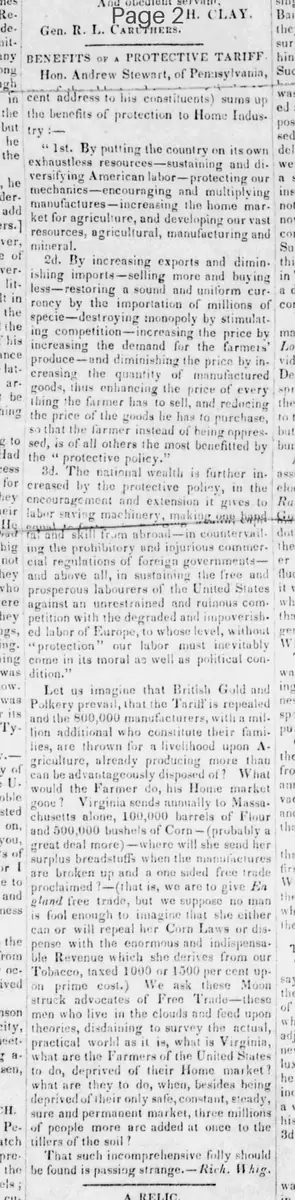
BENEFITS OF A PROTECTIVE TARIFF.
Hon. Andrew Stewart, of Pennsylvania, (in a recent address to his constituents) sums up the benefits of protection to Home Industry:-
'1st. By putting the country on its own exhaustless resources—sustaining and diversifying American labor—protecting our mechanics—encouraging and multiplying manufactures—increasing the home market for agriculture, and developing our vast resources, agricultural, manufacturing and mineral.
2d. By increasing exports and diminishing imports—selling more and buying less—restoring a sound and uniform currency by the importation of millions of specie—destroying monopoly by stimulating competition—increasing the price by increasing the demand for the farmer's produce—and diminishing the price by increasing the quantity of manufactured goods, thus enhancing the price of every thing the farmer has to sell, and reducing the price of the goods he has to purchase, so that the farmer instead of being oppressed, is of all others the most benefited by the "protective policy."
3d. The national wealth is further increased by the protective policy, in the encouragement and extension it gives to labor saving machinery, making one hand do the work of ten—bringing capital and skill from abroad—in countervailing the prohibitory and injurious commercial regulations of foreign governments—and above all, in sustaining the free and prosperous labourers of the United States against an unrestrained and ruinous competition with the degraded and impoverished labor of Europe, to whose level, without "protection" our labor must inevitably come in its moral as well as political condition.'
Let us imagine that British Gold and Polkery prevail, that the Tariff is repealed and the 500,000 manufacturers, with a million additional who constitute their families, are thrown for a livelihood upon Agriculture, already producing more than can be advantageously disposed of? What would the Farmer do, his Home market gone? Virginia sends annually to Massachusetts alone, 100,000 barrels of Flour and 500,000 bushels of Corn—(probably a great deal more)—where will she send her surplus breadstuffs when the manufactures are broken up and a one sided free trade proclaimed?—(that is, we are to give England free trade, but we suppose no man is fool enough to imagine that she either can or will repeal her Corn Laws or dispense with the enormous and indispensable Revenue which she derives from our Tobacco, taxed 1000 or 1500 per cent upon prime cost.) We ask these moon struck advocates of Free Trade—these men who live in the clouds and feed upon theories, disdaining to survey the actual practical world as it is, what is Virginia to do, what are the Farmers of the United States to do, deprived of their Home market? what are they to do, when, besides being deprived of their only safe, constant, steady, sure and permanent market, three millions of people more are added at once to the tillers of the soil? That such incomprehensible folly should be found is passing strange.—Rich. Whig
BENEFITS OF A PROTECTIVE TARIFF.
Hon. Andrew Stewart, of Pennsylvania, (in a recent address to his constituents) sums up the benefits of protection to Home Industry:-
'1st. By putting the country on its own exhaustless resources—sustaining and diversifying American labor—protecting our mechanics—encouraging and multiplying manufactures—increasing the home market for agriculture, and developing our vast resources, agricultural, manufacturing and mineral.
2d. By increasing exports and diminishing imports—selling more and buying less—restoring a sound and uniform currency by the importation of millions of specie—destroying monopoly by stimulating competition—increasing the price by increasing the demand for the farmer's produce—and diminishing the price by increasing the quantity of manufactured goods, thus enhancing the price of every thing the farmer has to sell, and reducing the price of the goods he has to purchase, so that the farmer instead of being oppressed, is of all others the most benefited by the "protective policy."
3d. The national wealth is further increased by the protective policy, in the encouragement and extension it gives to labor saving machinery, making one hand do the work of ten—bringing capital and skill from abroad—in countervailing the prohibitory and injurious commercial regulations of foreign governments—and above all, in sustaining the free and prosperous labourers of the United States against an unrestrained and ruinous competition with the degraded and impoverished labor of Europe, to whose level, without "protection" our labor must inevitably come in its moral as well as political condition.'
Let us imagine that British Gold and Polkery prevail, that the Tariff is repealed and the 500,000 manufacturers, with a million additional who constitute their families, are thrown for a livelihood upon Agriculture, already producing more than can be advantageously disposed of? What would the Farmer do, his Home market gone? Virginia sends annually to Massachusetts alone, 100,000 barrels of Flour and 500,000 bushels of Corn—(probably a great deal more)—where will she send her surplus breadstuffs when the manufactures are broken up and a one sided free trade proclaimed?—(that is, we are to give England free trade, but we suppose no man is fool enough to imagine that she either can or will repeal her Corn Laws or dispense with the enormous and indispensable Revenue which she derives from our Tobacco, taxed 1000 or 1500 per cent upon prime cost.) We ask these moon struck advocates of Free Trade—these men who live in the clouds and feed upon theories, disdaining to survey the actual practical world as it is, what is Virginia to do, what are the Farmers of the United States to do, deprived of their Home market? what are they to do, when, besides being deprived of their only safe, constant, steady, sure and permanent market, three millions of people more are added at once to the tillers of the soil? That such incomprehensible folly should be found is passing strange.—Rich. Whig
What sub-type of article is it?
Economic Policy
Trade Or Commerce
Agriculture
What keywords are associated?
Protective Tariff
Home Industry
Free Trade
Agriculture
Manufactures
American Labor
Exports Imports
Farmer Benefits
What entities or persons were involved?
Hon. Andrew Stewart
Gen. R. L. Caruthers
Virginia Farmers
Massachusetts
England
Polkery
Editorial Details
Primary Topic
Benefits Of Protective Tariff To Home Industry And Agriculture
Stance / Tone
Strongly Pro Protective Tariff And Anti Free Trade
Key Figures
Hon. Andrew Stewart
Gen. R. L. Caruthers
Virginia Farmers
Massachusetts
England
Polkery
Key Arguments
Protects And Diversifies American Labor, Encourages Manufactures, Increases Home Market For Agriculture.
Increases Exports, Diminishes Imports, Restores Sound Currency, Benefits Farmers By Raising Produce Prices And Lowering Goods Prices.
Encourages Labor Saving Machinery, Attracts Capital, Counters Foreign Regulations, Protects Us Labor From European Competition.
Repealing Tariff Would Destroy Home Markets For Agriculture, Adding Millions To Farming Surplus.
Virginia Relies On Manufacturing States For Surplus Disposal; Free Trade Favors England Unilaterally.