Thank you for visiting SNEWPapers!
Sign up free
Literary
January 22, 1921
Iron County News
Hurley, Iron County, Wisconsin
What is this article about?
In this chapter continuation, the Pearlhunter, jailed as Red Mask, rejects a bribe from his antagonist to leave Flatwoods. After the sheriff delivers supper, the enemy taunts him about his parents and a girl. The Pearlhunter escapes by loosening a window bar, then flees eastward into the woods, avoiding the cabin where the girl tends her father amid potential danger.
Merged-components note: Section title, serialized story chapter, and related image illustration belong to the same literary component 'The Blue Moon Tale of the E Flatwoods'.
Clipping
OCR Quality
75%
Good
Full Text
THE BLUE MOON
TALE OF THE E FLATWOODS
By DAVID ANDERSON
CHAPTER VIII—Continued.
-11-
The tall form of the Pearlhunter stiffened in the gloom; his fingers gripped the revolver butt.
"You might get Bull Masterson," he said, "and wait across there on the lower point of Alpine island. But don't do anything unless the mob starts. I don't know much law, but I do know the law couldn't hurt you for rescuing a sheriff's prisoner from a mob."
"Law! Law!" The Boss growled. "When I know they've ketched the wrong man—"
He would have grumbled still further, but the Pearlhunter urged him to go. With last whispered word, the sturdy old fellow stumped away in the gloom, half reluctant still, as though he felt he was disgracing himself not to stay and fight—somebody.
The Pearlhunter strained his ears for sounds farther up the street particularly for any loud talk or excitement back of the Mud Hen.
It was the hour just after nightfall, when village streets are most likely to be deserted—the hour when loungers go home to supper. Not a sound out of the ordinary rode the air.
At the moment, a door opened on the back porch of the sheriff's house. A square of light picked out the rough boards. The sheriff appeared with a flat basket in the hollow of his arm. A woman's hand pulled back the muslin curtains at a side window and held candle close to the pane to light him across the jail yard.
The Pearlhunter lounged down on the broken chair. A moment later a key, scraping unbelievably loud on the dull silence of the jail, hunted its way into the lock. The heavy outer door whined back. A match scraped: the sputtering flame was laid to the stub of a candle. An arm held it through the bars of the inner door.
"Oh, you're awake! It was so quiet in here I thought mebbe y'u might be asleep."
With the air of a man dog tired the Pearlhunter dragged himself up off the chair, shambled out into the hall and took the stub of candle from the sheriff's hand.
The sheriff fumbled three or four dishes and a tin cup of black coffee out of the flat basket and held them close to the bars. He stood well back, taking quite evident pains to keep his revolver butt out of reach. He did not know there was a very dependable weapon already on the other side of the bars. He made no move to unlock the door or to enter the cell.
None of this escaped the Pearlhunter. The chance to use his stove leg was as good as gone, or rather, it was not going to come. Once he considered the desperate move of drawing his revolver and forcing the sheriff to open the door. But the sheriff was known to be a brave man. He might fight, and if he did, one or the other of them would be killed. The Pearlhunter dismissed the plan.
"Th' woman didn't know there'd be company tonight," the sheriff muttered as he held the dishes within reach of the arm thrust through the bars. "I'm afeared you'll be skimped a little. But we'll try an' cook up a plenty in the morning."
He closed the door and turned the key in the lock. The Pearlhunter watched him until he had crossed the square of light shining out from the kitchen and re-entered the house, until the door closed and the muslin curtains fell back into place at the side window. Then he laid the stove leg by. His chance was gone.
The revolver tucked under his waistband at the flank of his back and hidden by his blouse seemed to have a personality. Its friendly presence helped his appetite, though, for that matter, it was already keen enough, as he had eaten nothing since morning. He could have eaten three such suppers as the sheriff provided.
The friendly revolver: the thought of a grizzled old river man, doubtless at that moment rowing hard up the river, took some of the smart out of his cuts and bruises. His left eye was swelling shut. He winked it limber and stood wondering whether to blow out the candle or leave it burn a while; finally blew it out, and went back to the west window.
A sound caught his ear; steps coming down the river road. He listened. The steps turned in at the jail yard; came around to the west window. A face appeared between the bars.
Enough light fell from the stars to reveal its identity—the suave, handsome face of the man he least expected to see there.
The Pearlhunter came close to the window. The other backed a step away.
"Pleased to find you in," he sneered.
The Pearlhunter passed by the taunt in silence. It seemed to irritate the other that his shot had missed.
"Just thought I'd call around at your ah—your boarding place this evening and talk over a little matter of business—a sort of proposition—a bargain," he drawled.
The man on the inside of the horse made no answer. His face was as rolled as if he hadn't heard. Neither was the other much on talk. He shot straight and talked the same way.
Half petulantly he shifted to his other foot; took his thumbs out of his vest pockets. The easy smile left his face; the real man came out—a wildcat, fanged and clawed.
"I'll uncork this rotten old jug," he growled, "if you'll bolt the Flatwoods and stop queerin' my game."
His lips snapped tight. His cards were on the table. The Pearlhunter pondered them in his deliberate way and cast up the sum total of their exact value.
First. There would be no mob. Otherwise he would have trusted to that. The meeting behind the Mud Hen had fizzled.
Second. He had no stomach for going into court.
Third. "Queerin'" his "game." What did he mean by his game? He couldn't have meant the Blue Moon, for he didn't know the Pearlhunter knew he had it. His game. That tense scene at the fence the evening before flashed up clear as the river bed under the jack light: a girl with a basket; frightened eyes; a yellow curl that rose and fell upon a startled bosom.
"I'll stay where I am," he answered, crisp and cold. "The law put me in; the law can get me out."
The other shrugged his shoulders, furious at the baffling coolness he encountered. And yet he couldn't afford to give up his plans, or spoil them by any untimely show of his real feelings. The easy smile came back.
"Those questions you were expecting to ask—I might answer them to boot."
The Pearlhunter's fingers tightened on the bar. He breathed deep. Those questions! His life through, they had haunted him. And the man before him knew the answer. His face set hard.
"Answer or not, as you please," he said; "but I'll not bolt the Flatwoods. I was expectin' to ask about my—father."
The other whipped a curious look at him.
"Your father!" he snarled. The scowl on his face became it better than the smile. "As like you as two peas; with the same lot of fool Sir Galahad notions about the women—angels and white lilies, and all that rot. He crossed my path once too often, and for the last time, seven years ago. He's in hell now. And your mother—"
The fist that stabbed out of the window fell almost short, landing with a snap instead of a crash, like a lash that can reach only so far. It stung the man on the point of the cheek and shot his head back.
He staggered and threw up his hand to his face. His other hand involuntarily dropped toward his hip. Well for him that it stopped before it got there. The Pearlhunter had snatched the revolver from under his blouse and held it just below the window ledge.
The man on the outside backed away, his face stung to flame by the blow. He felt for his knife; seemed to remember where he had left it—between the ribs of a man. Anyhow, it would have been as useless as the revolver. Noise precluded the use of the one; walls and bars the other.
"I'd kill you," he retorted finally, his tones steady, though strained, like the current that plays across the top of a whirlpool, "only I haven't time. There's a flock of yellow curls and a devilish trim pair of ankles waitin' for me down the road."
He had so framed the taunt as to reflect on the girl his very thought dishonored. Without another word he turned and walked away.
The Pearlhunter seriously debated whether to shoot him dead and trust to fate for the rest. The revolver crawled up over the window sill. He grasped one of the bars to steady his hand. A start of surprise came to his face. The revolver went back below the window sill. The bar was loose.
It was almost unbelievable, but it was so. For some reason or other it had not been fixed very firmly in its auger hole sockets. There was play—a heartening amount of it—between the upper and lower auger holes. His blood missed a beat; then leaped the higher.
He jammed the bar into the lower socket. The bottom of the hole was soft. The rain had probably rotted it. He jammed the bar again and the wood gave. He put all his strength to it. Each effort drove the bar a little deeper; gave it a little more play at the top. If he could only drive it far enough so that the top would clear: He was working like a wild man.
Bearing down with all his strength, he rotated the bar. The tremendous exertion opened the cuts and scratches on his neck and breast until they bled afresh. He jammed the bar down again; bore upon it with all his strength; rotated it again and again.
Less than half an inch still held at the top. His exertions brought the sweat out upon his face. Another effort: tremendous: to the last ounce of his power.
His hands were like fire—but the bar gave! He could move it a tiny mite to the side of the upper auger hole. The clearance was ever so little—but it cleared. Bracing his knee against the wall and grasping the casement with his left hand for anchorage he bent and worked and twisted the bar outward. At last, by a final supreme heave, it cleared the upper log.
There remained—only to lift it out of the lower auger hole.
The Pearlhunter dropped back panting and mopped the sweat from his face with his sleeve. The effort had been tremendous.
A minute to get his breath; another spent in listening; and he worked the loosened end a little freer; lifted out the bar; crawled outside; put it back into place again, feeling about with his fingers to make sure there were no scars on the wood or bits of chips scraped loose, and stole away under the trees.
It would probably be quite impossible for the city-bred to appreciate fully the feelings of the Pearlhunter at finding the breath of the open woods once more upon his face. The trees were like comrades in arms. The rough bark that covered their stout hearts actually felt friendly and good to his hands as he darted like a shadow from one to the other on his way out of the jail yard and up the side of the bluff.
Well knowing there would be eyes on his trail in the morning, he dared not go directly to where his misgivings urged him. The sheriff he did not fear. To the sheriff he was still the notorious Red Mask. To the mob that was sure to gather he would be the Red Mask. His escape, with lock and bolt untouched, would mystify both mob and sheriff. They would ascribe it to the dread powers with which popular fancy had invested his name.
But in the rabble that would curse and clamor about the old jail there would be one pair of eyes that the loosened bar would not escape; a pair of eyes that would find it as sure as the morning came, and read the riddle at a glance. And they would be eyes capable of finding a trail—and following it. Much as it went against him, therefore, he turned his steps east instead of west and plunged in among the clumped underbrush that grew along the top of the cliff.
Crossing the river road was the problem. Choosing a place where the grass came close to the track on each side, a short distance above where the path leaves it at the turn, he leaped across, and using considerable care to hide his trail, picked his way down along the inside of the brush-tangled fence row.
That path! It led out of an old world into a new. Peering through the bushes he spared a hurried glance toward the low place in the fence where the path crossed. The stars peopled the place with memories. A girl with a basket; round, frank eyes; the sunbonnet caught by an overhanging limb; the curl that wouldn't behave—they all came to life out of the shadows. So many things had happened since he walked that path with her that it seemed long, long ago; and it was only yesterday.
The picture dissolved. A breath between steps it had held him, and he was off on the long, lanky jog. The memory had brought a half longing to traverse the path again, but prudence warned him to keep away. The sharpest eyes in the Flatwoods would be on that path at sunrise.
If the night did hold the menace he feared—had in so many words had threatened—it would undoubtedly develop in or near the three-gabled cabin. As he drew near the place his mastery of woodcraft showed in his approach. The bushes were not allowed to give up a sound.
A light shone through the front windows of the main room of the cabin. He wondered at its being made; it made him uneasy, for the evening was gone and the ripe night come. Not many candles were alight at that hour in Flatwoods. He sank back under the bushes and crawled nearer. The muslin curtains were drawn, but no shadows crossed them. The stillness within vaguely disquieted him. He was searching for a way to crawl a little nearer, when the low tones of the cello broke across the silence; and he knew the girl was keeping her lonely vigil beside the stricken old man.
Then came the voice from a throat the gods had kissed. Each tone found a kindred sound in the cello and coaxed it forth to flutter out upon the listening night in a lustrous witchery that somehow brought to the fancy of the listener under the bushes a picture of soft-winged swallows skimming over sun-kissed waters.
The figure of a man slid into the candle glow that beat the night back for a space outside the window—trim, compact, jaunty—the man he had expected to find prowling there.
The picture was gone. He had little ear for the music that followed. The hand of the listener at the window stole up against the light and dragged off his hat. The man crouching in the bushes could make out the crisp locks that clung close to the bared head.
The song ended. The last soft harmony of the cello lost itself among the listening trees. There came a muffled shuffling inside the cabin; a huge shadow, as of two figures builded together, crossed the curtain of the window at the west side of the door.
The Pearlhunter knew what was happening—the girl leading the stricken man to his bed. But his eyes were upon the still figure outside the window.
One shadow came back, a slim, trim shadow; there followed the creaking of a chair; a head, hung with loose hair, rocked back and forth across the curtain—and the man who crouched under the bushes knew the girl was alone with her thoughts.
The man at the window watched the shadow. It seemed to rouse him—to recall fancies that the song had caused to wander far. He glanced about; pulled himself together; made a half petulant step toward the door.
The man in the underbrush stiffened; slowly rose noiseless as smoke. The man approaching the door seemed to hesitate; stopped. The other sank down again in the bushes.
The head of flowing hair rocked back and forth across the curtains.
It was a strained moment: a three-handed game in the dark; an intense three-angled drama of life—mayhap of more than life, if the honor of a woman is more than that.
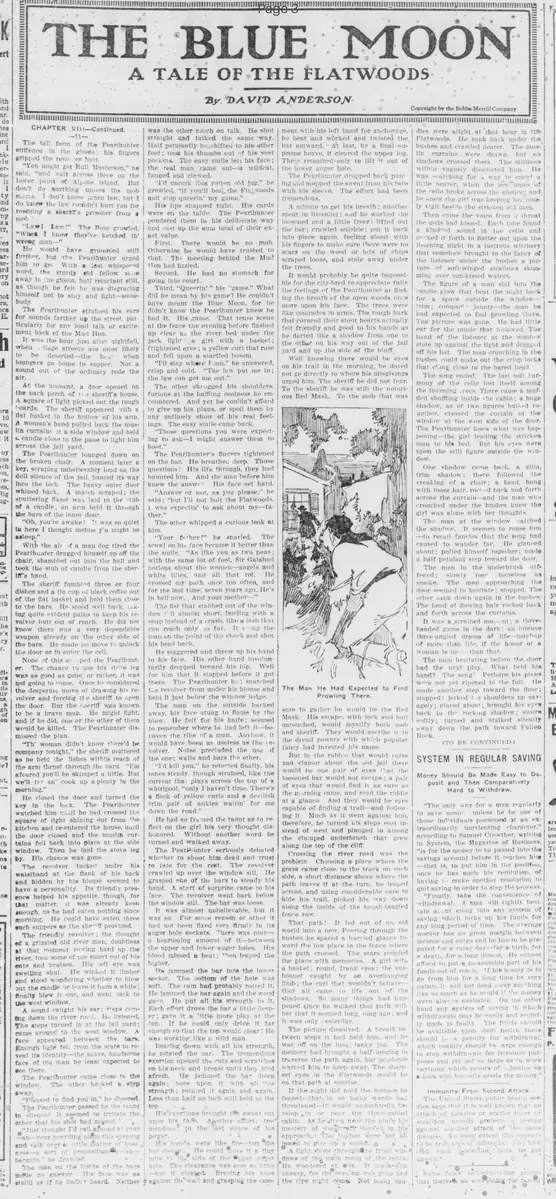
The man hesitating before the door had the next play. What held his hand? The song? Perhaps his plans were not yet ripened to the full. He made another step toward the door; stopped; jerked his shoulders up savagely; glared about; brought his eyes back to the rocking shadow; swore softly; turned and stalked silently away down the path toward Fallen Rock.
(TO BE CONTINUED)
TALE OF THE E FLATWOODS
By DAVID ANDERSON
CHAPTER VIII—Continued.
-11-
The tall form of the Pearlhunter stiffened in the gloom; his fingers gripped the revolver butt.
"You might get Bull Masterson," he said, "and wait across there on the lower point of Alpine island. But don't do anything unless the mob starts. I don't know much law, but I do know the law couldn't hurt you for rescuing a sheriff's prisoner from a mob."
"Law! Law!" The Boss growled. "When I know they've ketched the wrong man—"
He would have grumbled still further, but the Pearlhunter urged him to go. With last whispered word, the sturdy old fellow stumped away in the gloom, half reluctant still, as though he felt he was disgracing himself not to stay and fight—somebody.
The Pearlhunter strained his ears for sounds farther up the street particularly for any loud talk or excitement back of the Mud Hen.
It was the hour just after nightfall, when village streets are most likely to be deserted—the hour when loungers go home to supper. Not a sound out of the ordinary rode the air.
At the moment, a door opened on the back porch of the sheriff's house. A square of light picked out the rough boards. The sheriff appeared with a flat basket in the hollow of his arm. A woman's hand pulled back the muslin curtains at a side window and held candle close to the pane to light him across the jail yard.
The Pearlhunter lounged down on the broken chair. A moment later a key, scraping unbelievably loud on the dull silence of the jail, hunted its way into the lock. The heavy outer door whined back. A match scraped: the sputtering flame was laid to the stub of a candle. An arm held it through the bars of the inner door.
"Oh, you're awake! It was so quiet in here I thought mebbe y'u might be asleep."
With the air of a man dog tired the Pearlhunter dragged himself up off the chair, shambled out into the hall and took the stub of candle from the sheriff's hand.
The sheriff fumbled three or four dishes and a tin cup of black coffee out of the flat basket and held them close to the bars. He stood well back, taking quite evident pains to keep his revolver butt out of reach. He did not know there was a very dependable weapon already on the other side of the bars. He made no move to unlock the door or to enter the cell.
None of this escaped the Pearlhunter. The chance to use his stove leg was as good as gone, or rather, it was not going to come. Once he considered the desperate move of drawing his revolver and forcing the sheriff to open the door. But the sheriff was known to be a brave man. He might fight, and if he did, one or the other of them would be killed. The Pearlhunter dismissed the plan.
"Th' woman didn't know there'd be company tonight," the sheriff muttered as he held the dishes within reach of the arm thrust through the bars. "I'm afeared you'll be skimped a little. But we'll try an' cook up a plenty in the morning."
He closed the door and turned the key in the lock. The Pearlhunter watched him until he had crossed the square of light shining out from the kitchen and re-entered the house, until the door closed and the muslin curtains fell back into place at the side window. Then he laid the stove leg by. His chance was gone.
The revolver tucked under his waistband at the flank of his back and hidden by his blouse seemed to have a personality. Its friendly presence helped his appetite, though, for that matter, it was already keen enough, as he had eaten nothing since morning. He could have eaten three such suppers as the sheriff provided.
The friendly revolver: the thought of a grizzled old river man, doubtless at that moment rowing hard up the river, took some of the smart out of his cuts and bruises. His left eye was swelling shut. He winked it limber and stood wondering whether to blow out the candle or leave it burn a while; finally blew it out, and went back to the west window.
A sound caught his ear; steps coming down the river road. He listened. The steps turned in at the jail yard; came around to the west window. A face appeared between the bars.
Enough light fell from the stars to reveal its identity—the suave, handsome face of the man he least expected to see there.
The Pearlhunter came close to the window. The other backed a step away.
"Pleased to find you in," he sneered.
The Pearlhunter passed by the taunt in silence. It seemed to irritate the other that his shot had missed.
"Just thought I'd call around at your ah—your boarding place this evening and talk over a little matter of business—a sort of proposition—a bargain," he drawled.
The man on the inside of the horse made no answer. His face was as rolled as if he hadn't heard. Neither was the other much on talk. He shot straight and talked the same way.
Half petulantly he shifted to his other foot; took his thumbs out of his vest pockets. The easy smile left his face; the real man came out—a wildcat, fanged and clawed.
"I'll uncork this rotten old jug," he growled, "if you'll bolt the Flatwoods and stop queerin' my game."
His lips snapped tight. His cards were on the table. The Pearlhunter pondered them in his deliberate way and cast up the sum total of their exact value.
First. There would be no mob. Otherwise he would have trusted to that. The meeting behind the Mud Hen had fizzled.
Second. He had no stomach for going into court.
Third. "Queerin'" his "game." What did he mean by his game? He couldn't have meant the Blue Moon, for he didn't know the Pearlhunter knew he had it. His game. That tense scene at the fence the evening before flashed up clear as the river bed under the jack light: a girl with a basket; frightened eyes; a yellow curl that rose and fell upon a startled bosom.
"I'll stay where I am," he answered, crisp and cold. "The law put me in; the law can get me out."
The other shrugged his shoulders, furious at the baffling coolness he encountered. And yet he couldn't afford to give up his plans, or spoil them by any untimely show of his real feelings. The easy smile came back.
"Those questions you were expecting to ask—I might answer them to boot."
The Pearlhunter's fingers tightened on the bar. He breathed deep. Those questions! His life through, they had haunted him. And the man before him knew the answer. His face set hard.
"Answer or not, as you please," he said; "but I'll not bolt the Flatwoods. I was expectin' to ask about my—father."
The other whipped a curious look at him.
"Your father!" he snarled. The scowl on his face became it better than the smile. "As like you as two peas; with the same lot of fool Sir Galahad notions about the women—angels and white lilies, and all that rot. He crossed my path once too often, and for the last time, seven years ago. He's in hell now. And your mother—"
The fist that stabbed out of the window fell almost short, landing with a snap instead of a crash, like a lash that can reach only so far. It stung the man on the point of the cheek and shot his head back.
He staggered and threw up his hand to his face. His other hand involuntarily dropped toward his hip. Well for him that it stopped before it got there. The Pearlhunter had snatched the revolver from under his blouse and held it just below the window ledge.
The man on the outside backed away, his face stung to flame by the blow. He felt for his knife; seemed to remember where he had left it—between the ribs of a man. Anyhow, it would have been as useless as the revolver. Noise precluded the use of the one; walls and bars the other.
"I'd kill you," he retorted finally, his tones steady, though strained, like the current that plays across the top of a whirlpool, "only I haven't time. There's a flock of yellow curls and a devilish trim pair of ankles waitin' for me down the road."
He had so framed the taunt as to reflect on the girl his very thought dishonored. Without another word he turned and walked away.
The Pearlhunter seriously debated whether to shoot him dead and trust to fate for the rest. The revolver crawled up over the window sill. He grasped one of the bars to steady his hand. A start of surprise came to his face. The revolver went back below the window sill. The bar was loose.
It was almost unbelievable, but it was so. For some reason or other it had not been fixed very firmly in its auger hole sockets. There was play—a heartening amount of it—between the upper and lower auger holes. His blood missed a beat; then leaped the higher.
He jammed the bar into the lower socket. The bottom of the hole was soft. The rain had probably rotted it. He jammed the bar again and the wood gave. He put all his strength to it. Each effort drove the bar a little deeper; gave it a little more play at the top. If he could only drive it far enough so that the top would clear: He was working like a wild man.
Bearing down with all his strength, he rotated the bar. The tremendous exertion opened the cuts and scratches on his neck and breast until they bled afresh. He jammed the bar down again; bore upon it with all his strength; rotated it again and again.
Less than half an inch still held at the top. His exertions brought the sweat out upon his face. Another effort: tremendous: to the last ounce of his power.
His hands were like fire—but the bar gave! He could move it a tiny mite to the side of the upper auger hole. The clearance was ever so little—but it cleared. Bracing his knee against the wall and grasping the casement with his left hand for anchorage he bent and worked and twisted the bar outward. At last, by a final supreme heave, it cleared the upper log.
There remained—only to lift it out of the lower auger hole.
The Pearlhunter dropped back panting and mopped the sweat from his face with his sleeve. The effort had been tremendous.
A minute to get his breath; another spent in listening; and he worked the loosened end a little freer; lifted out the bar; crawled outside; put it back into place again, feeling about with his fingers to make sure there were no scars on the wood or bits of chips scraped loose, and stole away under the trees.
It would probably be quite impossible for the city-bred to appreciate fully the feelings of the Pearlhunter at finding the breath of the open woods once more upon his face. The trees were like comrades in arms. The rough bark that covered their stout hearts actually felt friendly and good to his hands as he darted like a shadow from one to the other on his way out of the jail yard and up the side of the bluff.
Well knowing there would be eyes on his trail in the morning, he dared not go directly to where his misgivings urged him. The sheriff he did not fear. To the sheriff he was still the notorious Red Mask. To the mob that was sure to gather he would be the Red Mask. His escape, with lock and bolt untouched, would mystify both mob and sheriff. They would ascribe it to the dread powers with which popular fancy had invested his name.
But in the rabble that would curse and clamor about the old jail there would be one pair of eyes that the loosened bar would not escape; a pair of eyes that would find it as sure as the morning came, and read the riddle at a glance. And they would be eyes capable of finding a trail—and following it. Much as it went against him, therefore, he turned his steps east instead of west and plunged in among the clumped underbrush that grew along the top of the cliff.
Crossing the river road was the problem. Choosing a place where the grass came close to the track on each side, a short distance above where the path leaves it at the turn, he leaped across, and using considerable care to hide his trail, picked his way down along the inside of the brush-tangled fence row.
That path! It led out of an old world into a new. Peering through the bushes he spared a hurried glance toward the low place in the fence where the path crossed. The stars peopled the place with memories. A girl with a basket; round, frank eyes; the sunbonnet caught by an overhanging limb; the curl that wouldn't behave—they all came to life out of the shadows. So many things had happened since he walked that path with her that it seemed long, long ago; and it was only yesterday.
The picture dissolved. A breath between steps it had held him, and he was off on the long, lanky jog. The memory had brought a half longing to traverse the path again, but prudence warned him to keep away. The sharpest eyes in the Flatwoods would be on that path at sunrise.
If the night did hold the menace he feared—had in so many words had threatened—it would undoubtedly develop in or near the three-gabled cabin. As he drew near the place his mastery of woodcraft showed in his approach. The bushes were not allowed to give up a sound.
A light shone through the front windows of the main room of the cabin. He wondered at its being made; it made him uneasy, for the evening was gone and the ripe night come. Not many candles were alight at that hour in Flatwoods. He sank back under the bushes and crawled nearer. The muslin curtains were drawn, but no shadows crossed them. The stillness within vaguely disquieted him. He was searching for a way to crawl a little nearer, when the low tones of the cello broke across the silence; and he knew the girl was keeping her lonely vigil beside the stricken old man.
Then came the voice from a throat the gods had kissed. Each tone found a kindred sound in the cello and coaxed it forth to flutter out upon the listening night in a lustrous witchery that somehow brought to the fancy of the listener under the bushes a picture of soft-winged swallows skimming over sun-kissed waters.
The figure of a man slid into the candle glow that beat the night back for a space outside the window—trim, compact, jaunty—the man he had expected to find prowling there.
The picture was gone. He had little ear for the music that followed. The hand of the listener at the window stole up against the light and dragged off his hat. The man crouching in the bushes could make out the crisp locks that clung close to the bared head.
The song ended. The last soft harmony of the cello lost itself among the listening trees. There came a muffled shuffling inside the cabin; a huge shadow, as of two figures builded together, crossed the curtain of the window at the west side of the door.
The Pearlhunter knew what was happening—the girl leading the stricken man to his bed. But his eyes were upon the still figure outside the window.
One shadow came back, a slim, trim shadow; there followed the creaking of a chair; a head, hung with loose hair, rocked back and forth across the curtain—and the man who crouched under the bushes knew the girl was alone with her thoughts.
The man at the window watched the shadow. It seemed to rouse him—to recall fancies that the song had caused to wander far. He glanced about; pulled himself together; made a half petulant step toward the door.
The man in the underbrush stiffened; slowly rose noiseless as smoke. The man approaching the door seemed to hesitate; stopped. The other sank down again in the bushes.
The head of flowing hair rocked back and forth across the curtains.
It was a strained moment: a three-handed game in the dark; an intense three-angled drama of life—mayhap of more than life, if the honor of a woman is more than that.
The man hesitating before the door had the next play. What held his hand? The song? Perhaps his plans were not yet ripened to the full. He made another step toward the door; stopped; jerked his shoulders up savagely; glared about; brought his eyes back to the rocking shadow; swore softly; turned and stalked silently away down the path toward Fallen Rock.
(TO BE CONTINUED)
What sub-type of article is it?
Prose Fiction
What themes does it cover?
Moral Virtue
Love Romance
Liberty Freedom
What keywords are associated?
Pearlhunter
Jail Escape
Confrontation
Flatwoods
Sheriff
Antagonist Taunt
Woman Honor
Woodcraft
What entities or persons were involved?
By David Anderson
Literary Details
Title
Chapter Viii—Continued
Author
By David Anderson
Key Lines
"I'll Stay Where I Am," He Answered, Crisp And Cold. "The Law Put Me In; The Law Can Get Me Out."
"Your Father!" He Snarled. The Scowl On His Face Became It Better Than The Smile. "As Like You As Two Peas; With The Same Lot Of Fool Sir Galahad Notions About The Women—Angels And White Lilies, And All That Rot. He Crossed My Path Once Too Often, And For The Last Time, Seven Years Ago. He's In Hell Now. And Your Mother—"
The Fist That Stabbed Out Of The Window Fell Almost Short, Landing With A Snap Instead Of A Crash, Like A Lash That Can Reach Only So Far. It Stung The Man On The Point Of The Cheek And Shot His Head Back.
It Was A Strained Moment: A Three Handed Game In The Dark; An Intense Three Angled Drama Of Life—Mayhap Of More Than Life, If The Honor Of A Woman Is More Than That.
The Man Hesitating Before The Door Had The Next Play. What Held His Hand? The Song? Perhaps His Plans Were Not Yet Ripened To The Full. He Made Another Step Toward The Door; Stopped; Jerked His Shoulders Up Savagely; Glared About; Brought His Eyes Back To The Rocking Shadow; Swore Softly; Turned And Stalked Silently Away Down The Path Toward Fallen Rock.